
Immigrant-language newspaper research
How to find ancestors in immigrant-language newspapers
An ancestor may be hard to find in an English-language paper but visible in the newspaper their community read. Start with a place and a life after settlement, try name forms in both languages, and test any apparent match against independent records.

On this page
- Begin with a life after arrival
- Build two search lanes for the same person
- Treat each name form as a clue, not a correction
- Follow organizations and people around the household
- Use hometown notices without confusing old and new places
- Choose an issue you can actually inspect
- Browse the page when the search box is silent
- Translate small passages with the page beside you
- Compare language papers and other records without merging them
- Try one community-paper search this week
- Common questions about immigrant-language newspaper research
- Sources and further reading
An ancestor who lived for years in one town may have appeared in a newspaper you have never searched because it was written for people who shared a language. A church gathering, a society election, a visitor from a familiar hometown or a small death notice could place someone in a network that an English-language report barely noticed. The paper might have been published nearby or delivered to readers farther away.
This is not a shortcut to a complete family story. A printed name may refer to someone else, and a community item may report what a correspondent heard rather than what they witnessed. The useful shift is to search for the social world around a settled person, not just an English spelling of their name. Here is how to make that search manageable, including when you cannot read the language fluently.
Begin with a life after arrival
Choose an ancestor you can place in a U.S. community at a particular time. A census entry, city directory, church register or family letter might give you a town and a range of years. Keep the source for that starting point in your notes. You are looking for the person as a neighbor, employee, congregant, member or visitor after settlement, not trying to reconstruct an arrival from passenger news.
Write a question small enough to answer: “Did this household take part in a named mutual-aid society while living in this town?” or “Does a community notice connect this person to relatives in another city?” Leave the society or relative blank if you do not yet know one. A question about whether the ancestor was “in the immigrant press” is too broad to guide a search.
Record what you know separately from what you suspect. An address from a dated directory is a starting fact; a family story that the ancestor belonged to a particular association is a lead to test. A change of address or a move between towns may explain why the same person appears in different community columns, but it needs its own evidence.
Do not assume that every language community had a newspaper serving every place and year. A paper's publishing town, the places named in its columns and the location of an individual reader are three different things. The Minnesota Historical Society describes how some Swedish American papers reached beyond their immediate cities, but that is a documented feature of that press, not a rule for every immigrant-language title. Its history of Swedish American newspaper publishing is a useful example of why readership geography deserves checking.
Build two search lanes for the same person
Make a short worksheet with two columns. On one side put the names and words found in local English-language records: the person's recorded name, street, workplace, town and any known organization. On the other put forms you have actually seen in a family document, church record or language newspaper, along with candidate variants clearly marked as guesses. Do not silently replace a recorded form with a spelling you think looks more authentic.
These lanes can meet through an address, occupation, spouse, lodge or hometown. A search for only a surname may be noisy; a surname plus an organization or a place mentioned in a notice may be more discriminating. If the archive supports phrase searching, also try one short phrase at a time. Save the search terms that returned nothing so you do not repeat them as if they were new evidence.
For a purely fictional illustration, suppose a directory lists “M. Vale” on Cedar Street, and a separate family note says the household attended a language congregation. “M. Vale,” the street and the congregation are search leads, not proof that any later newspaper mention of Vale is that household. In the fictional worksheet, a society event is worth investigating only if the dates and other identifying details line up. Nothing about this example is a historical claim.
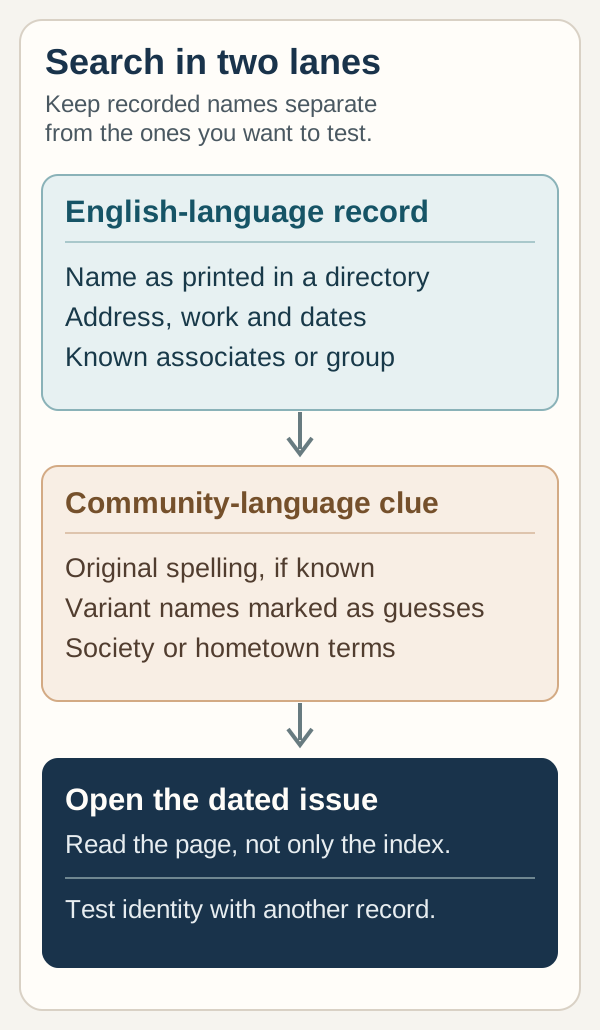
A blank result in one lane is not a verdict. The issue may be missing, the name may use another script, or searchable text may not capture what is printed. The lane is a way to remember what you tried, not a promise that every search will return a person.
Treat each name form as a clue, not a correction
A family name can appear with or without accent marks, in a different alphabet, in several romanizations, or in an English-language form that does not resemble the original at first glance. Given names can be translated or replaced in some records; a transliteration instead represents the sounds or letters of one writing system in another. Those are different processes. Neither tells you by itself which spelling the person used at home.
Start with forms that are documented in your own sources and transcribe them as printed, including initials and diacritics you can read. Then create a separate “try next” list. For non-Latin scripts, ask whether the archive searches the original characters, a romanized transcription, or only OCR from page images. If you are unsure, test a short word you can see clearly on an image rather than assuming the search box understands all scripts.
Search given name and surname apart, then pair one form with a street, town or associate. An older typeface, cramped column or damaged scan may turn one letter into another in OCR. Searching a distinctive organization or place can find the issue even when the personal name does not match. Do not treat the OCR display as a transcription: look at the page before writing down the name.
When someone else translates a notice for you, preserve both the visible original and the translation. Ask them to mark uncertain letters, titles and kinship terms. A form that resembles your ancestor's name is a candidate identification until the item supplies more than resemblance.
Follow organizations and people around the household
A name search can miss a person who appears as “the secretary's wife,” an unnamed choir member or part of a group. Search the institutions they might have joined, but only when another source gives you a reason to look: a congregation named on a certificate, a society in a letter, or an employer listed in a directory. Try the institution's full name and a shorter version, including the original-language form if you can document it.
Look for meeting announcements, anniversary reports, fundraising appeals, club elections, performances, school events and thank-you notes. A report may name organizers rather than every participant. An organization's repeated meeting place can help you decide which community column to read, but attendance at one reported event does not establish membership. Likewise, an association named beside a person's name might be a sponsor, beneficiary or simply the venue; read the grammar and the surrounding text.
The Minnesota Historical Society's account of *Svenska amerikanska posten* describes a Minneapolis Swedish-language paper with news about Swedish Americans, reader letters and other community material. Its account also notes that the paper tried some English-language content. That example shows why a single title can contain more than one kind of clue. It does not establish that another language paper used the same sections or covered the same kinds of people.
Make a small network list rather than an enormous family tree: person, dated mention, organization, place and relationship as actually stated. When a recurring name sits beside your candidate's name in several issues, look for an independent source that might explain the connection. A shared surname or repeated proximity on a page is not enough.
Use hometown notices without confusing old and new places
A community paper may carry news from a place of origin, a letter from another U.S. city, or a local item about someone visiting relatives. Label every place by its role in the particular sentence: where the paper was published, where the event happened, where the correspondent wrote from, and where the named person lived. One item can contain all four.
Try a hometown or district name from an independently sourced record, then watch for alternative spellings and later administrative names. Do not infer a birthplace from a paper's regional readership. If a notice says someone “of” a town attended a dinner in another town, pause before deciding whether “of” means birthplace, former residence or current home. Keep the original wording and the date attached to any translation.
Fictional example: a note in a made-up language weekly says “Lena Vale of Harbor City visited cousins in Pine Borough.” It may describe residence, or the phrasing might be more complicated in the original. Even if a documented ancestor has the same name, the item has not established the cousins' names, exact relationship or where Lena was born. Those are questions for other evidence.
A notice about a former hometown may still matter if it names a person, a relative or an association that can be linked to your household. But a homeland-news column full of place names is not itself evidence that your ancestor read it or contributed news. Follow a specific connection, not the mere presence of a familiar map label.
Choose an issue you can actually inspect
Once you have a plausible title, check the dates and form of its surviving issues before you conclude that a search failed. A catalog description of a newspaper's run is not an inventory of every issue you need. Note the exact title on the issue, its publishing place, the date you want and whether the accessible material is page images, searchable text, microfilm or print. If an online set stops short, a library or historical society may be able to identify another holding.
Avoid spending the whole session collecting titles. Pick one paper justified by your person's town, congregation or documented network and one limited period when that person lived there. The Minnesota Historical Society's title page for *Svenska amerikanska posten* gives a stated publication span of 1885 to 1940 and describes the title's content. That history is useful context; it is not proof that a particular issue, item or surname appears in an accessible scan. Check the issue itself.
If the title has editions, supplements or a changed name, record which one you inspected. A community item might be in a general weekly, a religious publication or a club bulletin rather than the nearest English-language daily. If you cannot establish coverage for your exact date, write “issue availability unknown,” not “no mention.”
Browse the page when the search box is silent
Text search is a way into a page, not the page. Search a few documented name forms and one or two community terms. Then open a plausible issue and look at the printed columns. Check headers, continuations, neighboring notices, advertisements and captions. A hit can be an unrelated item in the adjacent column, while a genuine mention may be omitted from searchable text.
If you cannot read the language, first identify structural cues: a dated heading, a town name you recognize, a repeated organization name, or a list of people. Compare a few issues to learn where local notes tend to sit in that particular paper. Do not assume that a section layout is stable across years. Save the issue and page reference before asking a translator to help, so the translator can see the entire notice rather than an isolated crop.
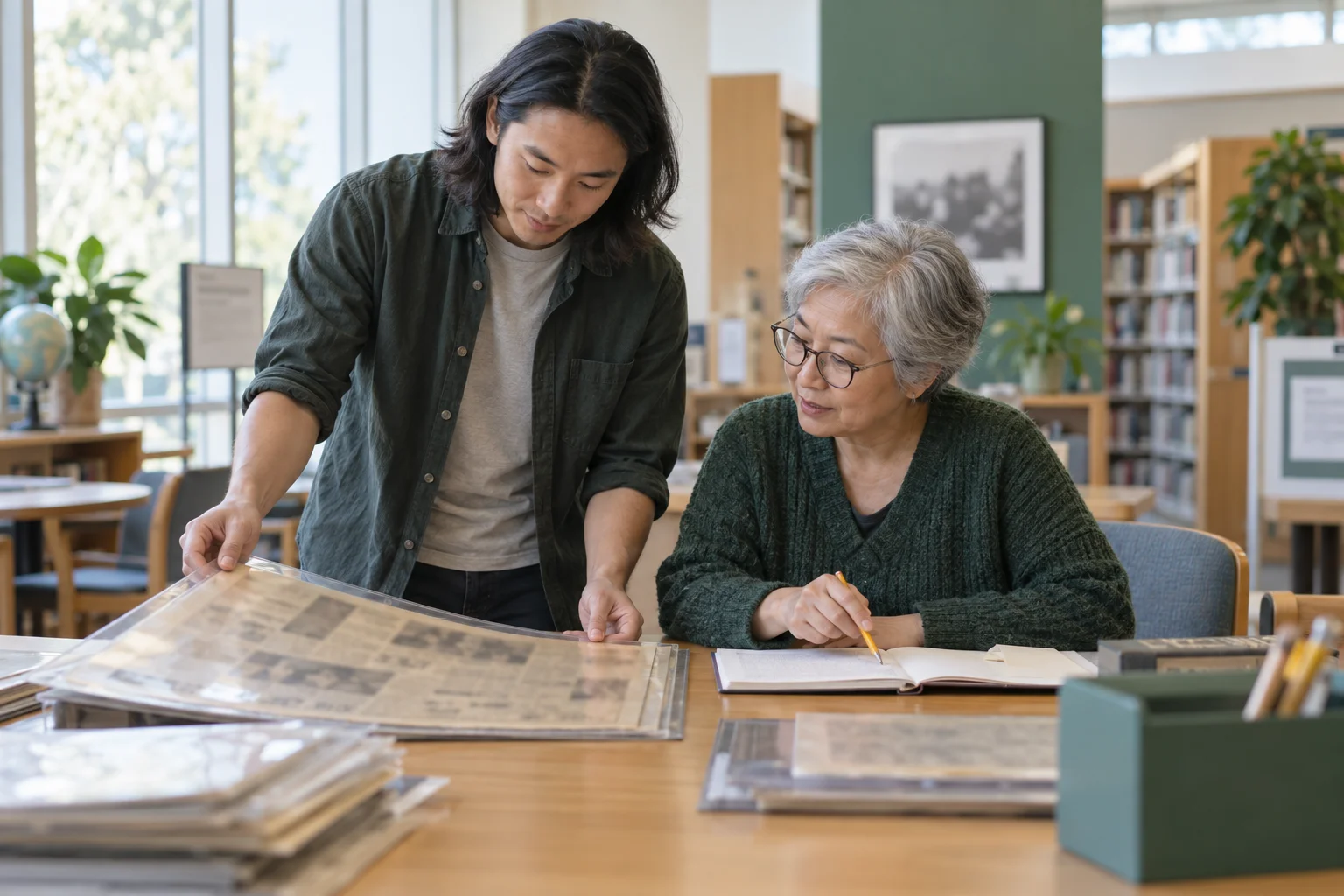
If the scan is too faint to read, record the uncertainty. A clearer copy, another issue or a repository holding might help later. Do not complete an illegible surname because it matches the one you hope to find. The difference between “I saw this on the page” and “the index suggested this” belongs in your notes.
Translate small passages with the page beside you
Translate the whole short item rather than only the apparent name. A sentence may say that somebody sent news, hosted a visitor, was expected at an event, or had died. Those are different claims. Headings and neighboring entries may tell you which town or date the notice concerns. An isolated automated translation can miss an abbreviation, surname boundary or relationship term.
Make three lines in your notes: a careful transcription of the original where legible, a working translation, and questions about uncertain words. If you use translation software, mark it as a provisional aid. For a critical relationship or event, ask a competent reader of the language and period to review the passage, ideally with the full page. Tell them your research question without proposing the answer, and ask which words admit more than one reading.
Watch for an English-language rendering of a name in another record that does not match the printed language form character for character. Do not “fix” the original to make your sources agree. If the item calls someone a cousin, for example, preserve the source term and note whether its sense is clear in context before putting a relationship on a tree. A translation helps you understand what the page may say; it does not prove that the named person is your ancestor.
Compare language papers and other records without merging them
A bilingual comparison is strongest when the sources add different identifying details. A language paper might give an association and a street; an English directory might give a name, occupation and street; a church record might name a spouse. Lay the dates and wording side by side. Ask whether the combination distinguishes your person from someone else with a similar name in the same place.
Two newspapers are not necessarily independent witnesses. An English article may reprint a language-paper notice, or both may rely on one contributor. Look for a credit line, identical unusual phrasing or the same mistake. When you cannot tell, describe them as two printings of a claim rather than two confirmations. A dated directory or original organization record, if available, may test a different part of the identification.
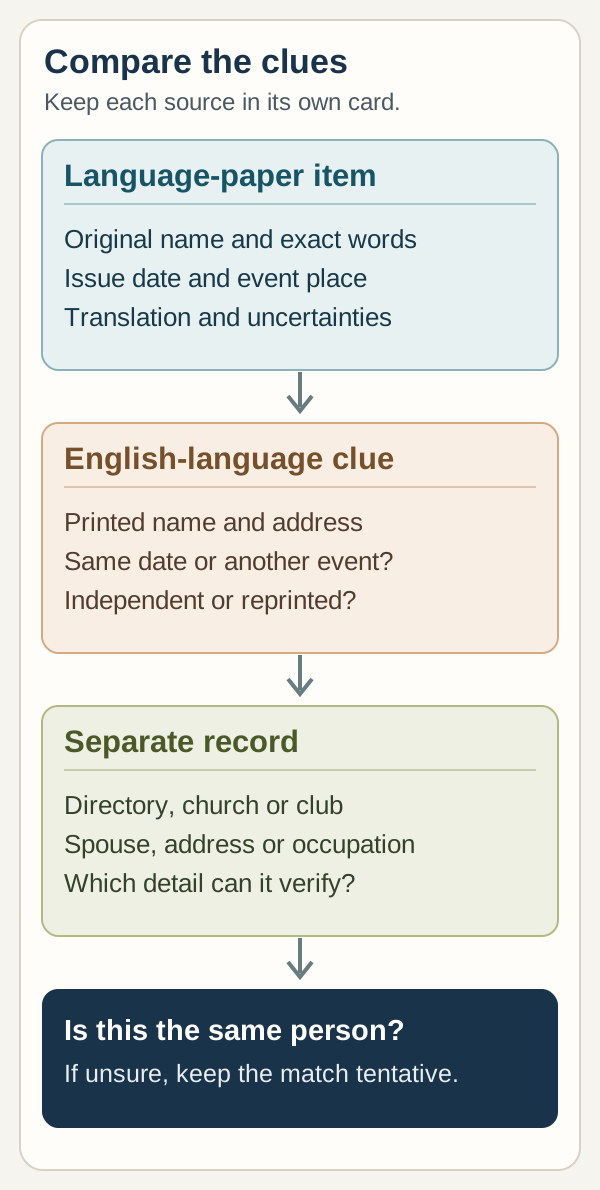
Keep a source card for every promising item: newspaper title as printed, publication city, issue date, page and column if visible, collection or holding, stable link or call number, access date, exact wording, translation, and what remains uncertain. If one source gives a year and another an address, do not assemble a precise event neither source actually states.
A negative search is also worth a line: title, dates covered, name forms and whether you searched text or inspected images. “No result in the text index” means less than “I read all surviving pages for these issues,” and neither proves the ancestor did not belong to that community.
Try one community-paper search this week
Choose one person already documented in a town after settlement. Write their name as a contemporary record gives it and identify one possible link to a language community: a family document, congregation, association, correspondent or hometown. If that link is only family lore, label it a hypothesis. Limit the first attempt to a few years and one title with a reason to cover that person's community.
Write down two name forms you can source and up to two additional forms marked as experiments. Search one name together with a place or organization; then try the community clue on its own. Open a relevant page image whether or not the name-search result looks convincing. Spend time on the surrounding column. If the text is in a script you cannot read, save a clear page reference and identify a small passage for help rather than guessing what it says.
Finish with a four-line note: “What the page actually prints”; “My working translation”; “Why this might be my person”; “What independent record could test it.” If you found nothing, write down the issues and search modes you checked, and choose one sensible next place to look. That is a useful result. The exercise is complete when you can explain your evidence or your gap to someone else without turning a possibility into a fact.
Common questions about immigrant-language newspaper research
Do I need to speak the language to start?
No. A documented name, address, organization and date range can help you locate a likely issue. Read its layout, save the full page and seek help with a short passage. Do not make a relationship or identity claim from a translation you cannot check.
What if the family name appears in a different alphabet?
Preserve the original characters if the page or a reliable transcription gives them. Keep romanizations and translated given names in separate search fields. Search the original script only when the archive supports it, and use place or organization clues to browse around a failed name search.
Does a familiar hometown notice prove this is my relative?
No. It establishes what a dated item reports, subject to your reading of the language. Compare the person, date, residence, associates and context with independent records. If the identifying details are thin, keep the match tentative.
Why can't I find the person in a title that served the community?
The relevant issue may be absent, the person may never have been mentioned, or the name may be hard for the index to read. Record the exact title and issues you tested. A paper's long publication history does not mean every resident appeared in it.
Sources and further reading
- Minnesota Historical Society, Swedish American Newspaper Publishing.
- Minnesota Historical Society, *Svenska amerikanska posten* title history.