
Newspaper research foundations
Start with the research question before you search a newspaper
Turn a family-history hunch into a clear question, an evidence target, and a search brief you can actually use.

On this page
- A family clue is a question in disguise
- Separate the claim from the evidence
- Decide what kind of newspaper item could answer you
- Name the people without pretending you know more than you do
- Fix the time window before you browse
- Treat place as a set of relationships
- Define the unknowns that could change your search
- Build a search brief that fits on one screen
- Choose a stopping point before you start
- Use the Library of Congress as a planning resource
- Try the question-writing exercise this week
- Interpret a name match in context
- Sources for checking newspaper records
A family story often arrives as a fragment.
Someone remembers that a great-grandfather was mentioned in the paper. A handwritten note says a couple "announced their marriage." An old photograph has a town and a year on the back. You may even have a clipping, but no title, date, or page number.
That fragment is enough to begin. It is not enough to search well.
Newspaper research becomes much easier when you decide what you are trying to establish before opening a search box. The aim might be to locate a death notice, test a family story, identify a business, or find a mention of a move. Each aim calls for different evidence. A vague search can return hundreds of tempting names without answering the question you actually have.
This guide helps you turn a hunch into a small research brief. You will define the claim, separate what you know from what you suspect, choose the evidence that would answer the question, and record uncertainty in a useful way. The later work of finding the right newspaper title and checking date and place coverage will be much clearer because you will know what the newspaper needs to prove.
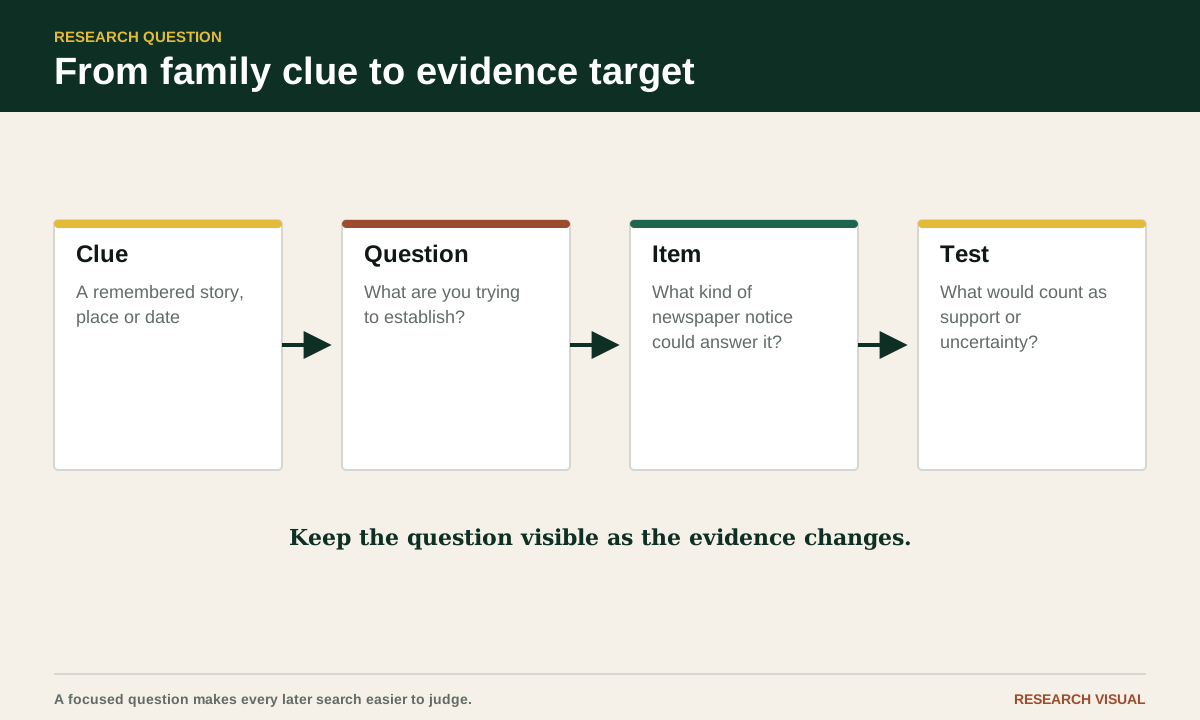
A family clue is a question in disguise
Take a sentence such as, "I think Nora lived in Cedar Falls around 1912, and her brother may have died there."
That sentence contains several different questions:
- Did Nora live in Cedar Falls in 1912?
- Which Nora are you talking about?
- Did her brother die there, or did a notice simply appear there?
- What was the brother's name?
- Is the goal to find an announcement, confirm a date, or learn the names of relatives?
A search engine treats the whole sentence as a pile of terms. A researcher can take it apart.
Start by writing the clue exactly as you received it. Keep the original wording, including uncertainty. Then write a plain version of what you want to know. For example:
I want to find a contemporary newspaper item that can show whether Nora Bell was living in Cedar Falls, Iowa, in 1912 and identify any notice about her brother's death.
That version is still broad, but it gives you something to refine. It names a person, a place, a time, an event, and a possible document type. It also says "show whether," rather than treating the family memory as settled fact.
Separate the claim from the evidence
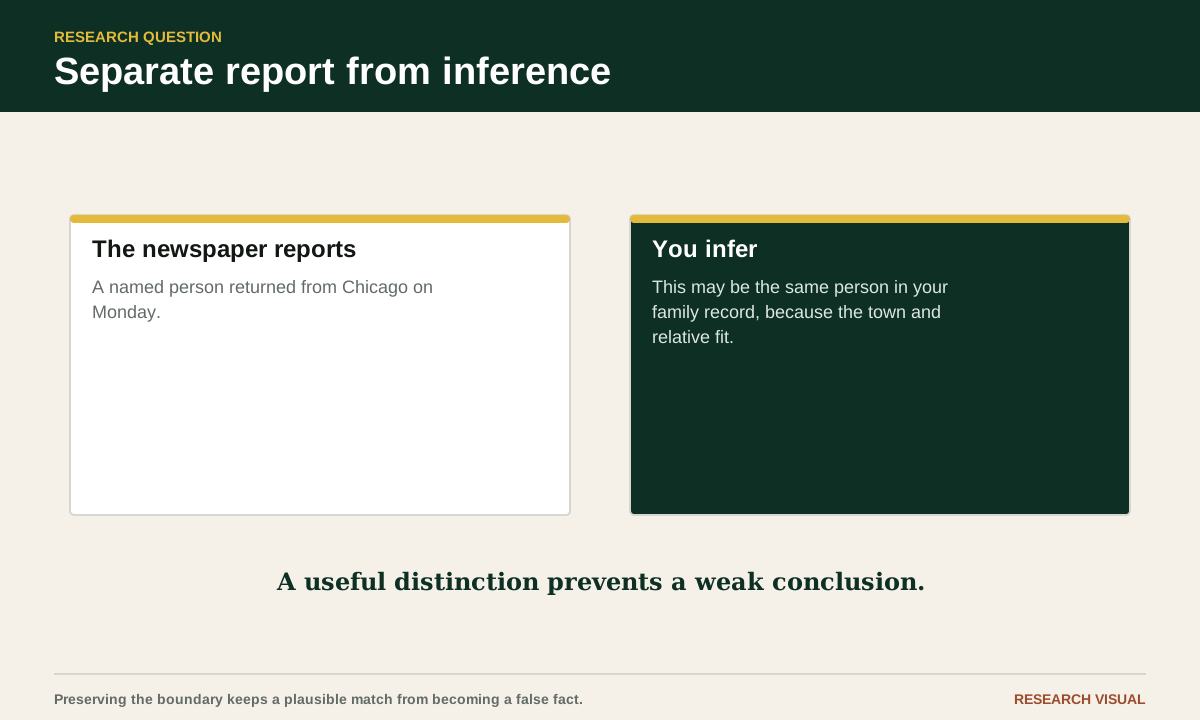
A claim is the statement you want to test. Evidence is the material that could support, weaken, or change that statement.
The distinction matters because a newspaper may tell you one thing while you infer another. A death notice might name a person, date, and residence. It may not prove that every relative named in the notice was biologically related. A wedding announcement may call someone a "daughter of" a named parent, but an item about a social gathering may simply list guests with no relationship at all.
Write your target claim in one sentence. Then ask what a newspaper would need to contain for you to accept it as supported. The answer might be:
- the person's full name and a place of residence
- an event date, publication date, or both
- a relationship stated in the article
- a quote or wording that identifies the event
- a reference to a business, organization, regiment, school, or congregation
- a location that connects the person to the right community
You are defining an evidence target, not a preferred outcome. If the paper does not contain the detail you hoped for, that is a result too. It may tell you that the source cannot answer the question on its own.
Decide what kind of newspaper item could answer you
Newspapers carry many kinds of material, and each has a different evidentiary value. A formal obituary may name survivors and a funeral location. A brief death notice may give only a name and date. A marriage announcement can include parents, occupations, residences, and the ceremony location, while a simple license notice may contain only the couple's names.
A local column may report that a person visited relatives, attended a club meeting, or returned from a trip. These notes can place someone in a community, but they rarely establish a complete residence history. A legal notice may identify an estate or land matter without explaining a family relationship. An advertisement can show that a business used a name at a particular time, but it may not identify the person who ran it.
Describe the item you need in ordinary language. Try one of these forms:
- "A notice published near the event that names the couple and at least one parent."
- "A death notice or obituary that identifies the deceased, the residence, and the funeral place."
- "A local-news item that places this person in town during the target month."
- "An advertisement or business notice that ties the surname to a named address."
This description will later guide your choice of date range and search terms. It will also stop you from treating every mention of the surname as an answer.
Name the people without pretending you know more than you do
Names are slippery in newspapers. A person may appear with initials, a nickname, a middle name, a married name, a title, or a spelling that differs from the family record. Two people in the same town may share a common name. An article can also use a relationship instead of a given name, such as "Mrs. William Harper" or "the infant son of Charles Reed."
Create a small identity note before searching. Include every form that is already supported by your records:
- full name and known variants
- maiden name or married name, if documented
- approximate age or birth year
- spouse, parents, siblings, or children already identified
- occupation, address, neighborhood, church, lodge, school, or military unit
- places connected to the person
Mark each detail as known, reported, or suspected. "Born in 1884" might come from a civil record. "Worked at the mill" might come from a family memory. "Middle initial was J" might be an assumption based on one later record. The labels keep a weak clue from quietly becoming a search fact.
Do not add every relative you have ever found to the search brief. Choose the details that distinguish this person from others. A spouse's name, an occupation, or a neighborhood may be more useful than a long family tree.
Fix the time window before you browse
A newspaper item has more than one relevant date. The event may happen on a Tuesday, the paper may publish the notice on Thursday, and a later paper may print a correction or follow-up. A funeral may be held several days after a death. A marriage announcement may appear before the ceremony, after it, or both.
Write down the date you are trying to establish and the dates you are willing to search. If you know only that an event occurred in June 1912, begin with a sensible window around June rather than a single issue. The exact width depends on the event and the available records. A death notice may appear quickly, while a social or legal matter can continue for weeks.
Record each date with its reason and confidence:
- June 1912: family story places Nora in town; reported.
- 14 June 1912: possible death date from a later index; unconfirmed.
- 16 to 30 June 1912: initial newspaper search window; a research choice, not a source date.
This simple distinction prevents a common error. A date chosen for convenience is not the same as a date found in a source.
Treat place as a set of relationships
A newspaper can be connected to a place in several ways. It may be published there, circulate there, report on people who live there, or print an edition for a wider area. A person may live in a rural township, work in a nearby county seat, attend church across a county line, and appear in the paper of the town where an event took place.
Write the places in layers:
- The person's residence at the time of the event, if known.
- The event location, such as a church, hospital, courthouse, or cemetery.
- The nearest town or city likely to have a newspaper.
- The county and state.
- Nearby communities where relatives, employers, or institutions were located.
The purpose is not to create a giant list of towns. It is to expose the assumptions inside a phrase such as "the local paper." Which local community? Local to the residence, the event, or the newspaper office?
For a rural family, a county seat paper may be more useful than a tiny township publication. For an immigrant community, a newspaper in the group's language may carry material that an English-language daily did not. For a Black family in the United States, a Black-owned or community newspaper may report people and events overlooked by a larger paper. These are research possibilities, not guarantees.
Define the unknowns that could change your search
Good research briefs make uncertainty visible. List the unknowns that could send you toward a different paper or a different date.
Examples include:
- Was the person living in the town or only visiting?
- Was the event in the town named by the family, or in a nearby place?
- Was the person known by a different surname at the time?
- Was the publication weekly, daily, religious, ethnic, labor, or community-based?
- Did the town use a former name or belong to a different county then?
- Did the newspaper title change during the period?
- Is the remembered year an event year, a publication year, or the year of a later family retelling?
You do not need to solve all of these before continuing. You do need to know which are open. An unknown belongs in your plan; it does not belong hidden inside a confident search phrase.
One useful habit is to write a short "could be wrong if" sentence. For example: "This search plan changes if the marriage took place in Waterloo rather than Cedar Falls, or if Nora was using her married surname by June." That sentence tells you what to test when the first search fails.
Build a search brief that fits on one screen
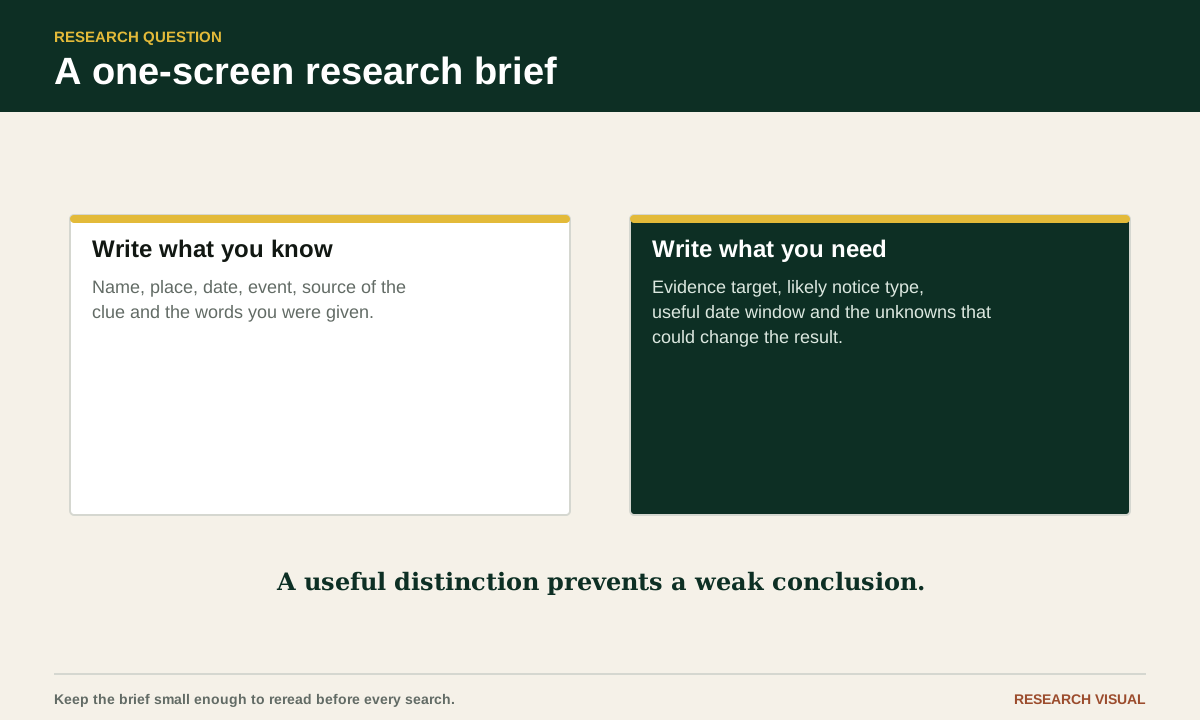
A search brief is a compact working document. It is not a polished family-history narrative. Keep it short enough to read beside a newspaper viewer.
Use this template:
Question: What newspaper evidence could show whether Nora Bell lived in Cedar Falls in 1912 and report her brother's death?
Person or people: Nora Bell, possible brother James Bell; variants and married names to check.
Event or subject: Residence and death notice.
Places: Cedar Falls; Black Hawk County; nearby communities connected to the family.
Time window: June 1912, widening if the date is not confirmed.
Likely evidence: A local-news item, death notice, obituary, funeral report, or item naming a residence or relative.
Known: Nora's name appears in a 1914 city directory; a family note says she was in Cedar Falls in 1912.
Reported: James may have died in June 1912.
Unknown: James's full name, exact death date, Nora's residence, and the title that served the community.
A result would be useful if: It names the right person and supplies at least one identifying detail that agrees with another record.
A result would not settle the question if: It contains only the surname, a generic name, or an unconnected advertisement.
Notice what this brief does not do. It does not list every newspaper website. It does not assume a title. It does not promise that a newspaper will answer the question. Those decisions belong to the next part of the research.
Choose a stopping point before you start
Newspaper searching can expand forever because every name suggests another search. Decide in advance what will count as a useful result and when you will pause.
You might pause after you have:
- located an item that meets your evidence target
- checked the item against at least one independent record
- searched the most plausible date window in the most plausible publication routes
- documented a coverage gap that prevents a fair conclusion
- found that the surviving wording is too vague to distinguish the person
A stopping point is not a declaration that the family story is true or false. It is a record of what the current evidence can support. If you find only a name and town, write exactly that. If a notice names the person but gives no relationship, do not upgrade it into proof of the relationship.
This discipline also protects your time. When a search produces dozens of unrelated names, return to the evidence target. Ask whether the new item could answer your question. If not, file it as a lead rather than as a discovery.
Use the Library of Congress as a planning resource
The Directory of U.S. Newspapers in American Libraries can help you identify newspaper records for a place and time and find information about where copies may be held. It is a directory, so a title record does not mean every issue survives or that every listed holding is digitized.
The Library of Congress search tips for the directory explain that its records are catalog data and that searches can be adjusted by place, title, and other fields. Use that resource after you have written your question. Otherwise, a list of titles can become a distraction from the evidence you need.
Chronicling America provides free access to selected digitized historic newspaper pages. Its coverage is valuable, but selective. A successful search there can give you a page to inspect. An empty result does not show that no newspaper reported the event.
These resources help with the plan. They do not replace the plan.
Try the question-writing exercise this week
Set aside thirty minutes and choose one newspaper clue from your family notes. Work on paper or in a plain text file.
First, copy the clue without correcting it. Second, write one question beginning with "What newspaper evidence could show..." Third, list the people, places, dates, and event in separate lines. Fourth, mark each detail as known, reported, suspected, or unknown. Fifth, describe the item that would answer the question and the item that would only be a lead.
Now ask a friend or family member to read only your question and evidence target. Can they tell what you are trying to establish without hearing the original story? If they cannot, simplify the wording. Remove background that does not affect the search.
Finish by writing one sentence that sets a boundary: "I will treat this as a lead until an item also identifies [detail]." Fill in the detail that matters most, such as residence, relationship, date, or occupation.
Save the brief with a date. If the question changes later, keep the old version. A changed question is useful evidence about how your understanding developed.
Interpret a name match in context
The first name match can feel like progress because names are concrete. A newspaper research project moves forward when a source tests a claim.
That change in viewpoint affects every choice. You search for the kind of item that could carry the needed detail. You widen the date window for a reason. You record a title gap instead of silently treating an empty result as negative evidence. You compare the wording of the paper with other records rather than letting a familiar surname close the case.
A good newspaper question is modest enough to answer and precise enough to challenge. It may end with a confirmed event, a narrowed possibility, or a documented gap in the surviving coverage. All three outcomes improve the family history because they tell you what the newspaper actually contributes.
Begin with the question. The search will have somewhere to go.