
Coverage planning
Build a newspaper coverage map before you search for names
Track places, dates, titles, surviving issues, gaps, and repositories so an empty newspaper search means something.

On this page
- Begin with the event window, not the collection range
- Give every candidate its own coverage row
- Separate title coverage from issue coverage
- Record places at the same level as dates
- Track repository types without ranking them
- Mark the difference between searchable and viewable
- Map gaps as information, not failure
- Build a date grid for the most important window
- Connect each repository to a specific action
- Use a coverage map to choose where to spend effort
- Try the coverage-mapping exercise this week
- Coverage is part of the evidence
- Sources for checking newspaper coverage
A newspaper title can exist in a catalog and still be useless for a particular family question.
The title may have begun after the event. The repository may hold only a few years. The right date may be missing even though surrounding issues survive. A digitized collection may show a date range that describes the title, while the actual images cover only part of that range. Another institution may hold microfilm or paper copies that are not online.
A coverage map keeps these facts together.
Think of it as a research ledger for a newspaper question. It records the place, date window, candidate title, issue-level availability, format, repository, and uncertainty. You can see where evidence may exist and where an empty search would tell you very little.
This is different from a title list. A title list says what publications may have existed. A coverage map asks whether the relevant issue, in the relevant place and time, survives somewhere you can inspect. If you still need to identify likely titles, begin with the newspaper-title guide before filling in the rows.
Begin with the event window, not the collection range
Write the event and its date range at the top of the map. Include the date you know, the date you suspect, and the wider period you are willing to check.
For example:
Event: possible death of James Bell
>
Place: Cedar Falls area, Black Hawk County, Iowa
>
Working date: 14 June 1912
>
Search window: 1 June to 15 July 1912
>
Evidence target: a notice, obituary, funeral report, or local item that identifies James and connects him to Nora Bell
The working date and search window are not the same fact. The first comes from a record or family report. The second is your research choice. Label them separately.
The window should reflect how the item might have been published. A daily paper may report a death quickly. A weekly may publish the news in the next issue, a later local column, or a memorial item. A marriage announcement may appear before the ceremony and a report after it. A legal notice can have a longer publication pattern.
If the date is only a year, do not pretend the map has a precise event window. Mark the uncertainty and choose a broad initial period that you can narrow as new evidence appears.
Give every candidate its own coverage row
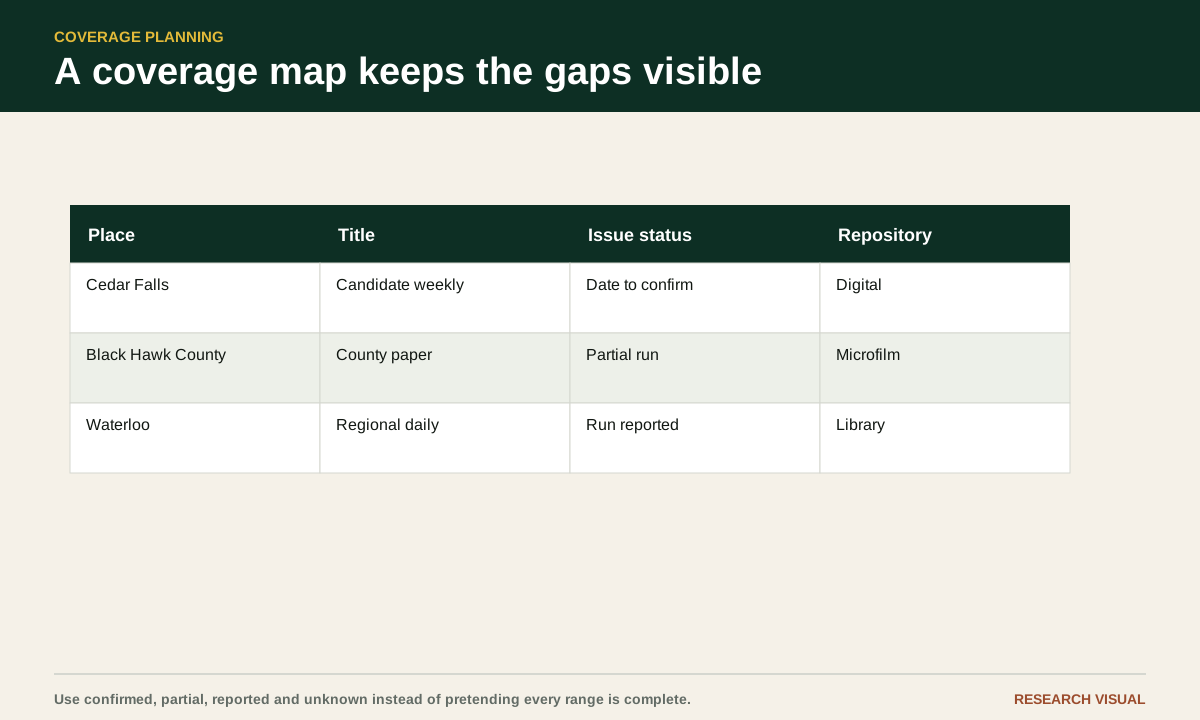
Create one row for each title and keep the fields consistent. A plain text table works, as does a spreadsheet or notebook.
For example, one provisional row might read:
- Place: Cedar Falls
- Title: candidate title
- Issue dates needed: 1 June to 15 July 1912
- Issues reported: unknown
- Format: digitised status unknown
- Repository: institution or collection to check
- Confidence: open
- Next note: verify the exact dates
The row is a question record, not a declaration that the title covers the event. Use words such as confirmed, reported, partial, unknown, and not found. Avoid a simple yes or no until you have inspected the evidence behind the entry.
Record the title exactly as it appears in the source, then keep a separate field for the title form seen on an issue. This prevents a catalog display from being confused with an issue masthead.
If the same title is available in two formats or at two institutions, give each route its own row. A digitized run and a microfilm run can have different gaps. One repository may list holdings by month while another lists a single date range.
Separate title coverage from issue coverage
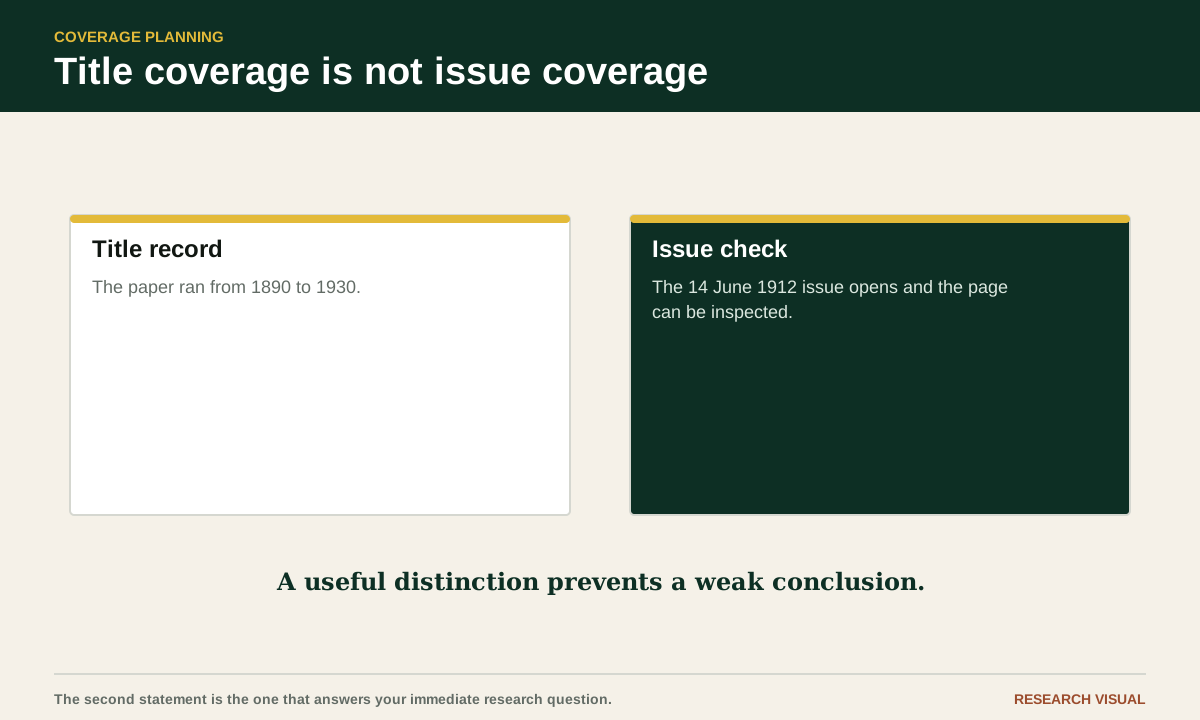
A title record might say that a newspaper ran from 1890 to 1930. That describes the publication's history. It does not show that every issue from 1890 to 1930 survives.
Issue coverage is more specific. It asks whether an issue dated 14 June 1912, or a reasonable surrounding issue, is actually held and viewable. The answer may be:
- Date-specific holding reported: a catalogue or repository describes a holding for this date or period. Record who reported it and the wording.
- Issue opened: you opened an item identified as the issue. This does not establish that every page is present or readable.
- Page inspected: you viewed relevant page(s). Record whether the image and wording are legible.
- Text searched: record the query, filters and result separately from page inspection.
- Not located: the issue or page did not appear in the route checked. Do not infer that no copy exists elsewhere.
- Unknown: available catalogue or access information does not answer the question.
A title's broad date range does not confirm that a particular issue can be opened. A reported holding is a lead to check with its repository. A search result is not a substitute for inspecting the page.
These labels keep a broad date range from doing too much work. A title may be the right newspaper and still fail to provide the specific issue you need. When a row points to a library, microfilm or public collection rather than a complete online run, the free and library access guide can help you turn that lead into a practical request.
When you inspect a digital viewer, record the issue date shown by the collection and the date printed on the page. They should agree, but OCR and metadata can be wrong. If they disagree, make a note rather than silently choosing one.
Record places at the same level as dates
A coverage map needs more than one place field. Add the newspaper's publication place, the event place, the county, and any nearby community that matters.
A paper published in a county seat may carry township news. A regional paper may list multiple cities in its title. A community paper may serve a group spread across several towns. A paper printed across a state line may be closer to the family than the paper in the official county seat.
Use a place note like this:
Event place: rural township, Black Hawk County
>
Likely reporting center: Cedar Falls
>
Nearby alternative: Waterloo daily
>
Boundary issue: family record uses a modern county description; confirm the historical county
The note does not need to solve geography immediately. It preserves the reason each place appears on the map.
A place mismatch can explain a failed search. If the event happened in a township but you searched only a city daily, the map should show that limitation. If the person lived in one town but died in another, include both relationships.
Track repository types without ranking them
Different repositories expose different parts of a newspaper's survival. A public library may hold microfilm. A state library may preserve a run or provide a catalog record. A university may have local-history collections or special collections. A historical society may hold paper copies, clippings, or a local index. A digital collection may offer page images for selected dates.
Record the format and access route separately:
- digitized page images
- searchable text with an image behind it
- microfilm viewed onsite or through a lending route
- bound paper volumes
- clipping files or local indexes
- catalog record with holdings information
- finding aid for an archival collection
A repository entry should answer three questions: what institution holds the material, what date or format is described, and what you must do to inspect it. "At the library" is not enough. Write the library name, catalog link, call number or collection name when available, and the date you checked the information.
The Library of Congress directory can help identify title records and reported access points. The Library of Congress also warns through its directory frequently asked questions that holdings information is not complete for every institution. Treat a directory result as a lead to verify, not a final inventory.
Mark the difference between searchable and viewable
A newspaper can be searchable without giving you reliable page images. It can also have clear page images with weak or missing OCR.
Add two fields to your map:
Text search: Can you search words or names in the collection?
Page inspection: Can you open the original page image or a scan?
You need page inspection for evidence. Search text is an aid for finding a page, and OCR can miss names, split columns, confuse letters, or attach words from a neighboring article. A blank result may mean the item is absent, the issue is absent, or the text was not read correctly.
Record the search behavior you used. If a viewer lets you browse by date but does not expose an issue list, note that. If the collection has an index but no image for a cited page, note that too. These distinctions matter when you later explain why a newspaper search did not settle the question.
The Library of Congress Chronicling America collection offers selected digitized historic newspaper pages. Its collection description makes the word "selected" important. An empty result there is not a complete statement about every newspaper that existed in a place.
Map gaps as information, not failure
Coverage gaps come in different forms. Name the type you have found.
A publication gap means the title did not exist during the event period. A survival gap means the title existed, but the relevant issues are not known to survive. A repository gap means an institution may hold material, but the catalog does not give enough detail. A digitization gap means an issue may survive in physical form but is not online. A search gap means the issue is available, but the name search is unreliable or incomplete.
You can also have a place gap. The title is well documented, but it may not have covered the community connected to the event. An edition gap occurs when one edition survives but a different geographic or time edition may have contained the missing item.
Write the gap beside the row. For example:
Title existed in June 1912. Digitized collection begins in 1914. Physical holdings are unknown. Result cannot rule out a notice in 1912.
That sentence is more useful than "no result." It tells the next researcher what to look for and prevents a false negative from entering the family narrative.
Build a date grid for the most important window
A title-level range is too broad for a close search. Build a date grid for the window that could answer your question.
For a daily, list each publication date in the target period, or group dates by week if the event date is uncertain. For a weekly, list the expected issue dates. Mark each date with separate statuses for holding reported, issue opened, page inspected, text searched, not located, or unknown. More than one can apply. Explain the codes in a note so another person can read the map.
- V = issue opened; note separately whether relevant pages were inspected
- H = date-specific holding reported; not yet opened
- G = date or page not located in the route checked
- T = title or edition uncertain
- S = text searched; record the query and whether page inspection followed
For example, a weekly-paper date grid could record:
- 6 June 1912: expected weekly issue; viewed, page images inspected.
- 13 June 1912: expected weekly issue; viewed, local column searched and page images checked.
- 20 June 1912: expected weekly issue; not located in the run.
- 27 June 1912: issue listed by a library, not yet viewed.
- 4 July 1912: regular issue uncertain; holiday publishing pattern not checked.
The codes are for your own use. Explain them in a note so another person can read the map. The point is to make the search auditable, not to create a perfect database.
Pay attention to holiday dates, combined issues, special editions, and publication frequency changes. If the calendar does not match the expected issue pattern, record the uncertainty instead of assuming a missing issue.
Connect each repository to a specific action
A coverage map becomes useful when every promising row tells you what to do next. Write an action that matches the repository and format.
For a digital run, the action might be "open the issue list for June 1912 and verify 13 June page images." For microfilm, it might be "ask the public library whether the reel includes 1912 and how the holdings are labeled." For a university collection, it might be "read the finding aid and contact the reference desk about the newspaper title and date range." For a clipping file, it might be "check whether the file is indexed by person, place, or subject."
Avoid vague actions such as "search more." Name the date, title, and question. If you contact a library, include the title as printed, the place, the target dates, and the format you are seeking. A librarian can answer a precise holdings question more readily than a general request for "old newspapers."
Keep a record of the answer. Libraries can have local knowledge that is not visible in a national directory, including unprocessed material, alternate title forms, or a microfilm reel labeled under a successor title.
Use a coverage map to choose where to spend effort
The map should help you decide whether to inspect issues, widen the date window, add a repository, or revise the newspaper candidate.
Prioritize rows with three qualities:
- the title existed during the event period
- the publication had a plausible relationship to the place and item
- the relevant issues are viewable or likely to be held somewhere
A row with excellent title relevance but no surviving issues deserves a clear gap note and perhaps a library inquiry. A row with good issue availability but a weak local relationship may be a useful comparison, not your only source. A row with both a strong relationship and date-specific holdings reported is ready for the next check: open the issue if access allows, then inspect relevant pages before page-level searching. For search methods and image checking, see the OCR and page-image guide. Record each status separately.
Do not treat the map as a scoring contest. Its purpose is to show why you are choosing one route before another and what evidence is missing from each route.

Try the coverage-mapping exercise this week
Return to one research brief and choose no more than three newspaper candidates. Create a coverage table with these columns: title, publication place, event place, target date window, title date range, issue dates found, format, repository, text searchable, page viewable, gap type, and next action.
Open the record for each candidate and copy the date range exactly. Then inspect the issue list or holdings description. Mark at least one specific date as holding reported, issue opened, page inspected, text searched, not located, or unknown. These are separate statuses and more than one can apply. If you cannot establish a status, say why.
Now draw a short date grid for the strongest candidate. Use the expected publication frequency to decide which dates belong on it. Mark every date you checked, including a date where the search produced nothing. Add one sentence explaining what an empty result can and cannot show.
Finish by writing a coverage conclusion of three sentences:
The strongest candidate is [title] because [local relationship]. Issues for [date range] are [viewable, reported, partial, or unknown] through [repository]. A negative search would [meaningful conclusion or limited conclusion] because [coverage condition].
That conclusion should make sense to someone who has not seen your family notes. If it does not, add the missing place or date relationship.
Coverage is part of the evidence
Researchers often treat the newspaper article as the evidence and the missing issues as an inconvenience. Coverage deserves its own place in the reasoning.
If the relevant issue is available and you have checked the relevant pages or search route, a negative result describes what you did not find in that material. Whether it changes your conclusion also depends on whether this newspaper and type of item were likely to report the event. If the issue does not survive or was not available to inspect, the same negative search says very little. If the collection has poor OCR, a blank name search is weaker than an inspection of likely pages. If another edition may exist, the available copy may not represent the complete publication.
The coverage map tells you how much weight an absence can carry. It also preserves promising routes that are not immediately accessible. You can return later with a clear date, title, repository, and question instead of starting over.
A newspaper map does not promise a discovery. It gives every result, including a gap, an honest meaning.