
Choosing a newspaper
Find the right newspaper for a family-history question
Identify the newspaper title, edition, and local relationship most likely to carry the evidence you need.

On this page
- Start with the community around the event
- Learn the difference between a title and a place
- Use a newspaper directory to build a candidate list
- Read the masthead like a catalog record
- Watch for title changes as a chain
- Distinguish a title change from a new edition
- Check frequency and the likely kind of item
- Look beyond the town name
- Rank candidates without pretending to know the answer
- Trace a title through library records and issue images
- Try the title-identification exercise this week
- Choose a newspaper with a reason to report the event
- Sources for checking newspaper titles
A newspaper search can fail even when the right story was printed somewhere.
The problem is often the title. Researchers search the town they know, find one newspaper record, and assume that paper represents the whole local press. A town may have had a daily and a weekly, a county paper, a paper in another language, a religious or labor publication, or a title that changed names during the period in question. A neighboring town may also have served the same rural community.
Finding the right newspaper means matching a publication to a place, a date, a community, and the kind of item you need. You are choosing a likely witness. You are not trying to collect every title connected with a county.
This guide focuses on title identity, editions, title changes, and local relationships. It follows naturally from turning a family clue into a research question and will help you make a short list of plausible papers before you worry about whether particular issues are available.
Start with the community around the event
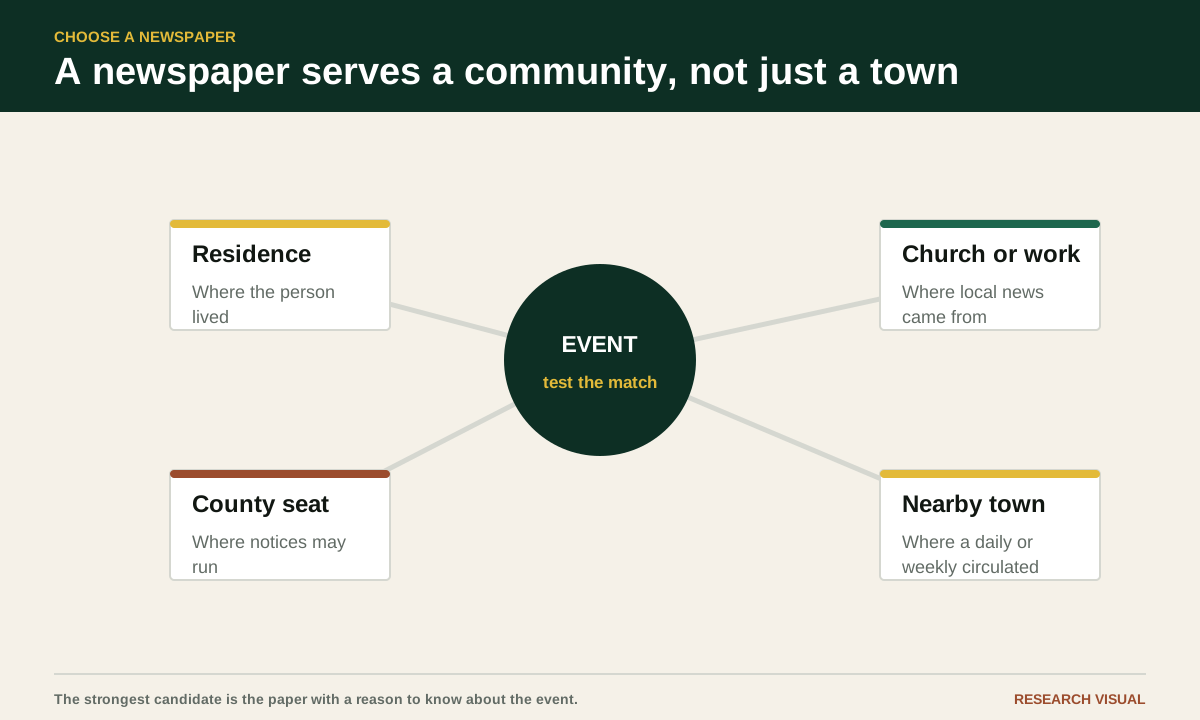
The place in a family record is a starting point, not a complete newspaper answer.
Suppose a marriage record says the couple lived in a rural township. The ceremony may have taken place in a church in the nearest village. The announcement may have appeared in the county seat weekly. A larger city daily may have carried a brief notice because the bride's family lived there. All of those papers could be local in a meaningful sense.
Write down the social and geographic setting of the event:
- residence of the person or couple
- place of the ceremony, death, court hearing, business, or military departure
- county seat
- nearest town with a known printing office
- communities where parents, employers, congregations, or organizations were based
Then ask which community had a reason to print the item. A county court notice points toward a paper that carried legal notices. A club meeting might appear in a town society column. A story about a farm family may appear in the nearest weekly even if the farm was outside the town itself.
The question is about the newspaper's relationship to the event, including its reach into the community and the way it gathered local news.
Learn the difference between a title and a place
A place can have several newspaper titles, and a title can serve several places. Catalog records often describe the place of publication, which is useful but not identical to the paper's full audience.
A paper printed in a county seat may publish items from surrounding townships. A title may identify two cities in its title because it served both. A regional daily may carry an edition for a particular community. A weekly may use a county name even though its office was in one town.
Keep two notes:
Where it was printed: the city, town, or community named in the newspaper record or masthead.
Whom it may have served: the town, county, language community, religious community, industry, or readership implied by its local columns and circulation.
Do not turn the second note into a fact unless a source supports it. It is a research hypothesis. You can test it by looking at sample issues, newspaper histories, library descriptions, or the way the paper labels local news.
This distinction matters when a search for "the Cedar Falls paper" produces a title published in Cedar Falls. That title may be a strong candidate, but it does not automatically rule out the Waterloo daily, a Black community paper, or a county weekly.
Use a newspaper directory to build a candidate list
The Directory of U.S. Newspapers in American Libraries is a useful starting point for identifying U.S. newspaper titles published across time. The Library of Congress describes it as a searchable index of newspapers in various formats, with information that can help researchers identify titles for a place and time and find access points.
Search by the place and period from your research question. Record the title exactly as the directory presents it, including punctuation and place qualifiers. Note the beginning and ending dates shown in the record. A title with a date range that overlaps your event is a candidate. It is not yet proof that the specific issue survives or that the paper covered your family.
Make a short candidate list. These invented titles demonstrate the note format only:
- Candidate: Cedar Falls Gazette. Place named in record: Cedar Falls. Date overlap: 1908 to 1916. Why it might matter: local weekly during the event.
- Candidate: Black Hawk County News. Place named in record: county seat. Date overlap: 1900 to 1920. Why it might matter: countywide notices may appear.
- Candidate: Waterloo Daily Courier. Place named in record: Waterloo. Date overlap: 1890 to 1925. Why it might matter: nearby daily with wider circulation.
Use titles you actually find for your place and date. Keep the list small. Three or four well-reasoned candidates are more useful than a long unranked list. Once you have them, map the exact dates, places and surviving issues instead of assuming that a title-level date range means every issue is available.
The directory's search guidance explains that its results are based on catalog data. Read the record as a description of a publication, not as a guarantee about digitized content.
Read the masthead like a catalog record
When you can view a page image or a scan, inspect the masthead before trusting the search result. The masthead can show the title as printed, the publication place, frequency, date, edition wording, and sometimes the publisher or editor.
A catalog may normalize capitalization or omit a leading article. A search interface may display a short title while the page image shows a longer form. OCR can also misread a title, especially near decorative type. The masthead is the newspaper's own statement about its identity for that issue.
Record what you see, including meaningful changes:
- the exact title on the issue
- city or town of publication
- weekly, daily, semiweekly, or other frequency
- morning, evening, Sunday, county, regional, or geographic edition
- publisher or ownership wording if it helps distinguish titles
- volume and issue number, while remembering that numbering can be unreliable
You do not need to transcribe every line. Capture enough to distinguish this paper from a similarly named title and to explain why it belongs in your research notes.
Watch for title changes as a chain
A newspaper may change its title after a merger, a change in ownership, a move, a political change, or a shift in audience. The former title may contain the issues you need even when a directory search for the later title looks promising.
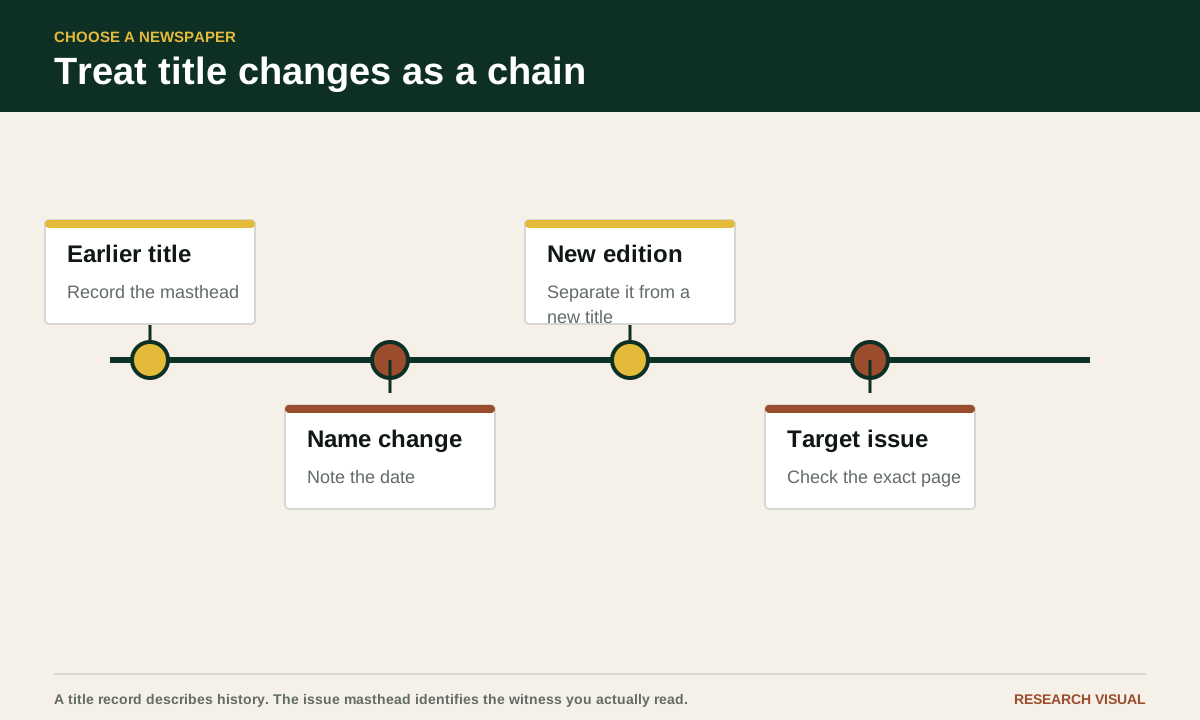
Treat titles as a chain across time. Write the title used before the event, the title used during the event, and the title used afterward if you can document them. A chain might look like this:
The Valley Herald, 1888 to 1896 → The Valley Herald and Gazette, 1896 to 1904 → The Gazette, 1904 onward
This format is a working hypothesis until a catalog record, newspaper history, or issue image supports each connection. Do not merge titles simply because they were published in the same town.
The Library of Congress newspaper cataloging guidance describes records for earlier and later titles, variant titles, and editions. You do not need to learn cataloging codes to use the underlying idea. Look for statements that one title continues, absorbs, succeeds, or is absorbed by another.
A title change can also be temporary. A masthead may use a variant for a short period and later return to the earlier form. Keep the issue date attached to every title you record.
Distinguish a title change from a new edition
A title change affects the publication's name. An edition is a version of a newspaper issued for a frequency, time, geography, or audience.
A daily may publish a morning and evening edition. A paper may have a city edition and a rural edition. A Saturday edition may carry a different label from the weekday paper. A county edition may share most content with the main issue but use different local notices.
For your research, edition wording matters when the item is local or time-sensitive. An announcement in a city edition may not appear in the county edition. A late edition may contain a correction that an earlier edition lacks. A Sunday paper may carry a feature that never appeared during the week.
Record the edition only when the issue or catalog record identifies it. Do not invent an edition from a difference in page content. If two copies have the same title and date but differ, note the difference and investigate whether the repository describes them as separate editions.
The practical question is simple: could the edition change whether the item appears, disappears, or changes wording? If yes, keep it in your candidate description.
Check frequency and the likely kind of item
Frequency helps you rank titles. A daily offers many publication dates, but that does not guarantee detailed local coverage. A weekly may devote more space to community notes, church events, school news, and rural correspondence. A specialized paper may be the best source for an organization or language community even if it published less often. If a school's own publication is your target, see our guide to finding ancestors in school and college newspapers. For an adult town club, follow fixtures and match reports in local papers rather than assuming a national sports title covered it.
Match the paper's rhythm to the event. A death notice may appear in the next available issue. A weekly social column may gather several days of visits and events. A business announcement may run repeatedly. A legal notice may be scheduled according to a formal publication requirement. For an agricultural fair or show, follow county fair newspaper reports from advance notices to later results rather than treating the announcement as proof the event happened.
Also consider the paper's editorial identity. A labor paper, religious paper, ethnic paper, student paper, or agricultural paper may use different names for people and events. The absence of an item in a general daily does not carry much weight if the community primarily read another publication. If a faith community is your lead, see how to find ancestors in historical religious newspapers by following title changes and checking exact issue holdings.
If a job or workplace is the stronger clue, our guide to finding ancestors in historical labor newspapers follows it toward a possible paper without assuming union membership.
Frequency and audience are clues for ranking. They are not reasons to assume a result exists.
Look beyond the town name
A newspaper's local relationship can cross modern boundaries. County lines change. Towns merge or adopt new names. Rural routes and rail connections can make a distant town the practical center for a community. A family may appear in a paper from the place where a relative worked rather than the place where the family lived.
Check historical place names and county boundaries when the record date is old. Use a historical map, a local history, a county history, or a library guide when available. Keep the source and the date of the place description in your notes. A present-day map can show distance, but it cannot by itself explain how people moved through the older community.
Ask local questions:
- Which town handled legal notices for the area?
- Which paper printed township or rural correspondence?
- Where did people go for the courthouse, rail station, hospital, or major market?
- Was there a paper for a language, faith, labor group, or racial community?
- Did the named place lie near a state or county boundary?
These questions help you find a paper with a plausible reporting relationship instead of selecting the nearest title by modern geography.
For research in a Black community, see our guide to finding ancestors in historic Black newspapers for title lists, issue coverage and access routes.
Rank candidates without pretending to know the answer
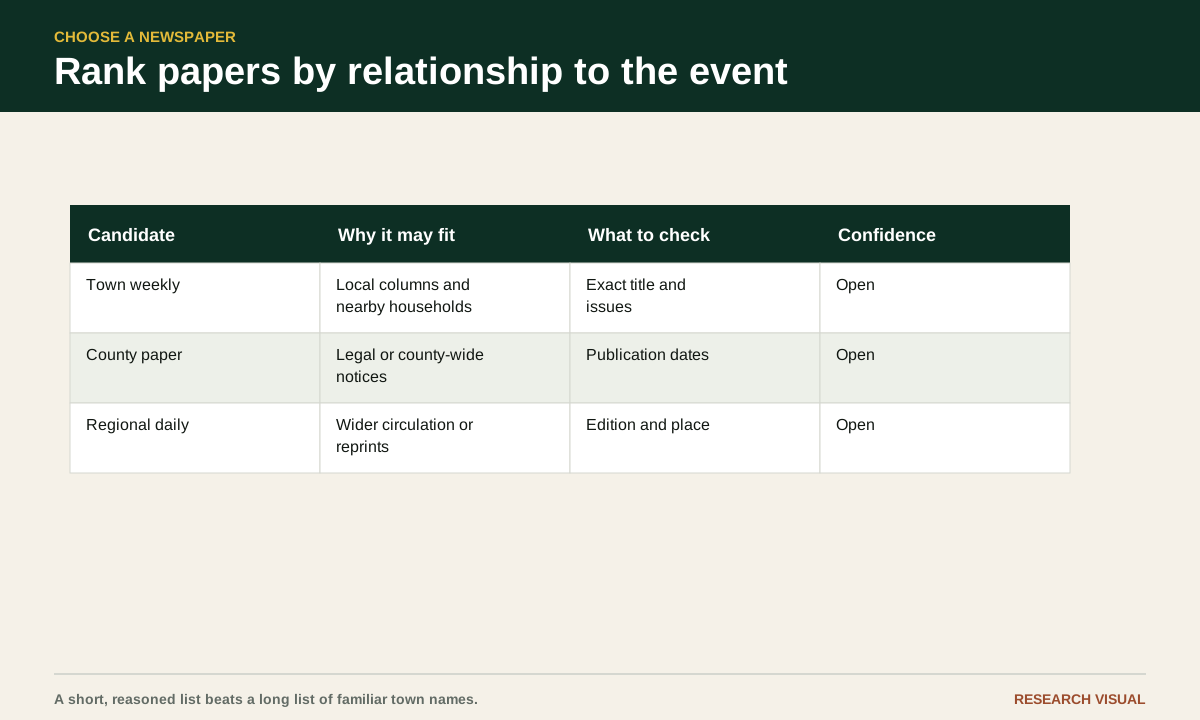
Give each candidate a short reason for its rank. You can use a simple scale such as high, medium, or low confidence, as long as the reason is written beside it.
For example:
High candidate: Published in the event town during the target year; sample issues contain local family and community notices.
Medium candidate: Published in the county seat during the target year; likely to carry county legal and social news, but its relationship to the rural township is not yet clear.
Medium candidate: Published in a nearby city; relevant because the person's employer and siblings were there.
Low candidate: Similar title in a neighboring state; kept only because the family record gives an uncertain place name.
This ranking does not predict which paper contains the item. It tells you how to allocate attention and what assumption to test first. If the high candidate has no surviving issues in the relevant period, the medium candidates remain meaningful rather than feeling like random alternatives.
Trace a title through library records and issue images
When a title looks promising, compare at least two kinds of description. A directory or catalog record can show a publication range and relationships to other titles. An issue image can show the exact masthead and edition language. A local library, state library, university, or historical society may provide a newspaper history or a holdings note.
Treat each source as answering a different question:
- A catalog record: What publication is this, and how is it related to other titles?
- A holdings record: Which institution reports having copies, and for what dates or format?
- An issue image: What title and edition appeared on a particular date?
- A local history: How did the paper fit the community?
If the sources disagree, preserve the disagreement. It may reflect a title change, incomplete cataloging, a missing issue, or a difference between a publication date and a holdings date. Do not silently choose the description that makes your search easier.
The Library of Congress notes in its directory frequently asked questions that holdings information is not complete for every institution and title. A missing library link is a reason to look elsewhere, not evidence that no copy exists.
Try the title-identification exercise this week
Choose one event from your research brief. Do not search for the family name yet. Your only task is to identify plausible newspaper titles.
Write the event place, date, county, and the kind of item you hope to find. Search the Library of Congress directory for that place and period. Copy three to five candidate titles into a table. For each one, record the publication place, date range, frequency if shown, and any note about earlier or later titles.
Next, find one issue image or a library description for the strongest candidate. Read the masthead. Add the exact title, date, and edition wording to your notes. If the title differs from the directory display, record both forms and explain the difference.
Finally, rank your candidates. Give each a reason tied to the event. Write one unresolved question beside the top candidate, such as "Did this weekly print rural notices?" or "Was there a separate evening edition in 1912?"
You have finished the exercise when you can explain why the top title is plausible without claiming that it contains the answer.
Choose a newspaper with a reason to report the event
Think of a newspaper as a publication with a place, audience, schedule, editorial purpose, and history, not just as a search box. Ask: which publication had a credible reason to report this event for this community at this time?
A title change or nearby community paper may add another candidate rather than replace the local paper. Keep the list short, dated, and ranked with a reason for each choice. That gives your issue-coverage search a clear starting point without claiming any one paper contains the answer.