
Workers and the labor press
How to find ancestors in historical labor newspapers
Start with a worker and job you can document. Follow the workplace toward a possible labor paper, then read the dated issue and test any apparent identity against records made for another purpose.

On this page
- Start with the worker you can already place
- Draw the route from workplace to possible local and paper
- Find the newspaper that could have covered the job
- Search with workplace language, not just a surname
- Read the whole page and follow nearby issues
- Follow ordinary working life as well as disputes
- Keep a printed name separate from union membership
- Test the identification with records made for another purpose
- Work around missing issues without filling the gap with a story
- Preserve the issue and state the limited claim
- Try one workplace-to-paper search this week
- Common questions about historical labor newspapers
- Sources and further reading
A relative who worked at a mill, on a railway or in a hospital may have left few records in their own voice. A labor newspaper offers another way into that working life. It might report a shop meeting, print a letter from an employee, mention a local's picnic or name someone after a workplace injury. But the paper's audience could be much broader than its membership, and a familiar name is not yet your relative.
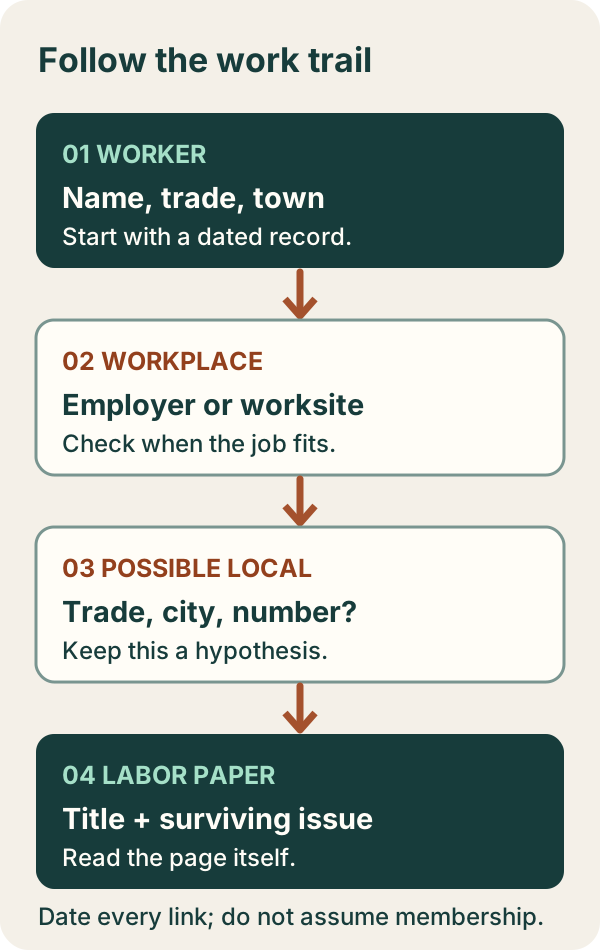
The useful route is worker → workplace → possible local or labor organization → newspaper title and surviving issue. You do not have to know that the person belonged to a union before starting. In fact, keeping that question open makes the search more honest. Build the route from what you can document, read any item in its original issue, and test an identification with evidence created outside the newspaper.
Start with the worker you can already place
Write down a name, a place and a date range supported by something other than the paper you hope to find. A census occupation, city directory entry, family letter, employment card or photograph with a credible caption may provide the first anchor. Say exactly what it establishes. “Machinist in this city in one census year” is not the same as “employed at this plant throughout the decade.”
Make a small work-history note with the person's name as used at the time, likely spelling variants, occupation, known employer or worksite, address if available, and the source for each point. Mark a remembered employer as a family account rather than a verified fact. For a mobile worker, distinguish the home address from the place of work. A job title might change while the person stayed with one employer, or a trade might take them through several worksites.
Then ask a question you could answer from a particular issue: Did a labor paper name this worker in connection with the documented workplace during a stated period? That is narrower than asking whether the ancestor “was in the labor movement.” The second question might eventually matter, but a name search cannot answer it alone. If the starting facts are thin, use our guide to framing a newspaper research question before looking for a title.
Do not confine this method to factory operatives. A printer, domestic worker, teacher, garment worker, farm laborer or transit employee might have encountered a workplace publication or a paper serving a wider trade. Equally, a worker might never have appeared in one. Begin with the documented job and local setting, not with an assumption about how that person organized.
Draw the route from workplace to possible local and paper
A union name in a family story is a lead, not a final identification. Organizations could have local bodies, regional councils, occupational branches and broader federations. A newspaper may have belonged to one local, a city labor council, a national organization or an independent publisher sympathetic to workers. Do not treat all those relationships as interchangeable.
On one page, make four columns: worker; workplace and job; possible local or organization; paper and issue. In the first two, enter only information you can attribute. Put possibilities and the reason for each in the third column. Leave the paper column blank until a catalog or an actual issue establishes its title, publication place and dates. A workplace and a local may have overlapped without the employee joining it. More than one organization may have represented different trades at one site or at different times.
If you know a city but not the employer, look for the trade and city first. If you know an employer but not the trade, use the plant or department as your anchor. A local number found in a later record is not automatically the number in an earlier decade. Note when each link in the chain was true rather than drawing one timeless line through the family history.
Find the newspaper that could have covered the job
Start with a title that plausibly served the place and period. The Library of Congress guide to organized-labor digital resources points to labor-related newspapers in Chronicling America and describes searching for unions, people and labor events. Its examples are starting points, not evidence that every trade, local or year is represented online. A paper from another city may have carried a national story but missed the ordinary affairs of your relative's shop.
Check the publication's own masthead when you can. Who issued it? Where was it published? Was it a union organ, a city labor paper, a trade periodical or a general newspaper with a labor column? A title containing “labor” is not necessarily the publication of the organization you are tracing. Conversely, a local newsletter may be cataloged under an organization name rather than an obvious newspaper title.
Use the Library of Congress Directory of U.S. Newspapers FAQ to understand what its title and holdings records can tell you. Search by publication place and title variants, then check the dates and institution shown for a likely holding. A catalog record is not the issue itself. Ask whether the particular month or week survives in print, on microfilm or as a digital page. Our newspaper coverage map can keep a title's run, actual issue gaps and repositories separate.
Do not assume a surviving run is searchable by full text. Some collections expose page images only; others require onsite consultation. A repository's description may cover a large archival collection rather than a complete run of its paper. Check the issue dates before deciding that a failed search means your person was not mentioned.
Search with workplace language, not just a surname
Try a compact set of search terms built from your work-history note: surname and variant, employer or worksite, trade, town, organization name and possible local number. Search these singly and in sensible pairs. A workplace name may be printed differently from the official corporate name. A department, street, shop nickname or railway division may be more useful than a national company name. Record where each form came from instead of treating every variant as an alias proved by evidence.
Look beyond headlines. Candidate items include notices of meetings, elections and appointments, reports from correspondents, anniversary lists, benefit appeals, workplace visits, grievances, safety campaigns, sporting teams and letters to the editor. Some may name employees without any membership claim. Local column headings, issue indexes and adjacent pages may get you closer than a search box that only recognizes a surname in an advertisement or a reprinted story.
For a common name, add place and occupation before making an identification. For an uncommon name, still check the date and context. Initials might stand for another person, and a woman's name could appear under a married form or as a named worker in her own right. Avoid deciding that an unnamed “Mrs. Smith” is the spouse in your tree because the husband worked nearby. See our guide to finding women in old newspapers when name forms complicate a search.
Read the whole page and follow nearby issues
A search hit is a pointer to a printed page, not a transcription to copy into your tree. The Library of Congress Chronicling America FAQ explains that its searchable text is produced by optical character recognition and is not fully accurate. Open the image, enlarge the column, check the item heading, and read surrounding text. Look at the masthead, date, edition and page number. The item may be a letter, a paid notice or a reprint rather than original reporting.
If no name appears, browse likely issues around the date of a known workplace change. A weekly paper could report an event after it occurred, and a later issue might publish a correction or response. The event date, issue date and date you accessed the image are different things. Keep them in separate fields. Search text variants, then browse the sections where workplace or local news actually appears.
When a paragraph is hard to read, transcribe only what is visible and mark uncertain letters. Do not silently make the print match your ancestor's name. Save an image or stable link as the repository permits, along with the surrounding page context. A cropped name without its column heading may remove the very clue that tells you what role the person held.

Follow ordinary working life as well as disputes
A strike headline can draw attention, but much of a worker's traceable life was not a strike. Look for routine notices about shift changes, training, workplace safety, social events, relief funds and people moving between shops. Such items can place a name in a working community even when they never state a job title or membership status. A notice about a retirement gathering may also name colleagues, but the list might include guests and relatives rather than a roster of employees.
If a dispute does form part of your question, start by checking the workplace and date rather than treating a named worker as a participant. The Library of Congress strikes and work stoppages guide distinguishes sources about specific events from statistical reporting and recommends researching union activities in newspapers for more detailed situations. A broad count of workers affected is not a list of who stopped work. A report may quote an observer, name a manager or mention someone whose role is unclear.
Follow the paper across several issues if the story develops. Note whether later accounts correct a date, attribute a statement or reproduce wording from another paper. Repeated text is not independent corroboration. Compare it with a local general newspaper when useful, but keep your focus on what the labor paper's own format and audience add to the worker's story.
Keep a printed name separate from union membership
This is the central caution: being named in a union paper does not establish union membership or strike participation. A reader could send a letter, a business could be mentioned in a report, and a worker could be quoted because they were at a workplace. Even an item that calls someone “our friend” is not a membership record. A notice listing a local's officers may support a narrower claim about a role, provided the name and identity are secure, but it still needs its date and context.
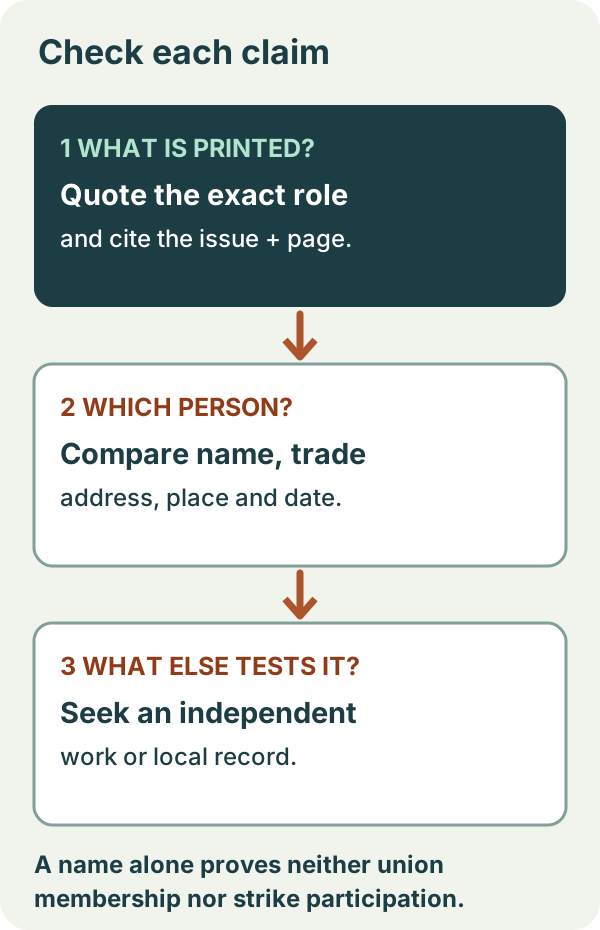
For each match, write two sentences. First: “This issue says…” followed by the exact name and role the item actually assigns. Second: “I think this may be my relative because…” followed by the independently known details that fit. Add what conflicts or remains unknown. If the article uses “members” for a group but does not specify whether the named person belongs to it, do not transfer that label to the person.
A labor paper also has a point of view. It may defend a campaign, omit dissent, print selected letters or name people for reasons that served its publisher. That does not make its details useless; it tells you to ask who supplied the information and why. If a person appears in opposing publications, retain each publication's wording rather than merging their descriptions into one supposedly neutral account.
Test the identification with records made for another purpose
Choose the next record for the claim at hand. A directory or census may help place a same-named person in the city and trade. A payroll or personnel file, if preserved and accessible, may establish an employer at a particular time. A local's membership ledger or dues record, if it survives, is more directly relevant to membership than a newspaper mention. A meeting minute naming a person may help explain a role, though it still requires an identity check. An address in a paper can be compared with a directory without assuming both sources are equally precise.
Cornell University's Kheel Center collections overview describes holdings in industrial and labor relations, including union, management and other records, and links to collection guides. It is a route for locating potentially relevant archival material, not a promise of a particular ancestor's file. Search a repository catalog for the organization, local, employer and date range; read the finding aid for restrictions and series descriptions; ask staff about an undigitized item only after noting the collection and box or volume, if supplied.
Identity deserves its own test. Compare at least two discriminating details where possible, such as address, trade, full name, age, employer or a named relative. Two articles repeating the same name with no new detail are weaker than one article combined with an independently created employment record. A common-name match in the correct city is a candidate, not a conclusion. If two people fit, preserve both possibilities and search for a detail that separates them.
Do not force a yes-or-no answer when the surviving evidence supports only “possibly.” A record might establish that your relative worked for the employer without showing whether they belonged to the local. A membership card might establish a local affiliation without showing whether they joined one particular walkout. Write the claim at the resolution the evidence allows.
Work around missing issues without filling the gap with a story
A failed name search can mean several different things: no issue survives for the date, the run survives but is not digitized, the scan is hard for text recognition, the person is described without a name, or no mention was published. Keep those possibilities apart. Log title, repository, issue dates examined, search terms and any missing dates. If you browsed page images rather than full text, say so.
Try a neighboring labor paper, a title associated with the broader trade or a general local newspaper only when its place and dates make sense. A national paper may describe the workplace without naming employees. A local general paper may give a street or employer name that helps locate a labor title. Neither substitutes for the missing issue. Our guide to free and library newspaper access can help you find print and microfilm routes before paying for another search service.
For an undigitized run, contact a holding library with the exact title, publication city and date window. Ask whether those issues exist and how to consult them, rather than requesting a search for every occurrence of a surname. If the catalog describes an organization archive, ask whether it includes its periodical and which years. You may get a useful answer about the holdings even if the paper cannot be supplied remotely.
Preserve the issue and state the limited claim
A useful citation lets another person reach the item: exact newspaper title, publication place, issue date, edition if given, page and column or item heading, repository, stable link or call number, and access date for an online copy. Save the image and a careful transcription when permitted. If the page number is absent, describe how you reached the page. Keep the issue date separate from any event date printed in the item.
In your research log, separate an observation from a conclusion. For a hypothetical example, “The April issue names J. Ellis beside a shop notice” would be an observation if you had checked that page. “J. Ellis was my great-grandparent and a member of Local X” would be a much larger claim needing separate evidence. Record any alternative reading of initials or damaged type. Our guide to verifying and preserving a newspaper discovery offers a fuller record-keeping checklist.
A partial result still matters. You may establish the paper that served an employer, locate the local's publication or document that a particular issue is missing. Those findings make the next search more precise without turning an absence into proof.
Try one workplace-to-paper search this week
Choose one historical relative with a documented occupation and place. On a single sheet, write the source for those facts and one question about a possible workplace mention. Add an employer only if you can source it; otherwise write “unknown.” List one possible organization or local as a hypothesis, not a fact.
Find a labor title whose publication place and dates could fit, and verify that at least one relevant issue is available. Search two combinations: a name variant with the workplace or trade, and a workplace term with the town. If full-text search fails, open one likely issue and browse the local or shop news. Spend time reading the masthead and the column, not just the highlighted word.
Finish with a brief note even if you find nothing. Record the issue you opened, terms used, what was readable, any gaps, and one independent record that could test your question. If you find a name, transcribe its exact context and write a provisional identification sentence. Do not add membership or participation to your family tree unless a source supports that specific claim.
Common questions about historical labor newspapers
Does a union newspaper mention prove my ancestor was a union member?
No. The person may be an employee, correspondent, visitor, relative or someone discussed by the paper. Check the item's exact wording and identity, then seek a relevant membership or local record before asserting membership. Even confirmed membership does not by itself establish participation in a particular strike.
What if I know the employer but not the local number?
Search the worksite, trade, city and period first. Browse papers serving that trade or city and note local numbers as they appear in issues or catalog descriptions. Verify that any number applied to the worksite at the date you need; do not carry a later local number back automatically.
Are labor papers only useful for strike research?
No. Routine workplace news, meetings, appointments, correspondence and community events may offer stronger identity clues than a large dispute story. Search for the worker's ordinary job and place as well as any documented event.
What does it mean if the person's name is not searchable?
It may mean the issue is missing, not digitized, poorly recognized by OCR or simply silent about that worker. Check the actual run and page images before drawing an inference. A negative search documents what you searched, not where the person was or what they did.
Sources and further reading
- Library of Congress, Organized Labor: Library of Congress Digital Resources
- Library of Congress, Directory of U.S. Newspapers FAQ
- Library of Congress, Chronicling America FAQ
- Library of Congress, Organized Labor: Strikes, Lockouts, and Work Stoppages
- Cornell University Library, Kheel Center Collections