
Women's family history
How to find female ancestors in old newspapers
Search old newspapers for women under maiden names, married names and a husband's name, then check local columns and confirm each match.

On this page
- Start with the woman you can document
- Make a small name-variant list
- Look beyond births, weddings and obituaries
- Search for the life she lived outside her household
- Follow a change of name without skipping a step
- Check the whole clipping before attaching it to your tree
- What to do when the search stays empty
- A search session you can finish today
- Sources and further reading
You know her name from a census. You search it in an old newspaper collection and find nothing. Then you spot a local notice about a visit from “Mrs. William Carter.” Could that be her? The clipping doesn't tell you.
Many women appear in historical newspapers under names you wouldn't think to type into a search box. A married woman might be named with her own first name, her husband's first name, an initial, or simply as someone's daughter or mother. A later mention may use a different surname. That makes it easy to miss her, and just as easy to claim a match too soon.
You can get further by making a short list of the names she might have used, then checking each newspaper mention against the people and places in her other records. Clara and the notices below are fictional examples of that process.
Start with the woman you can document
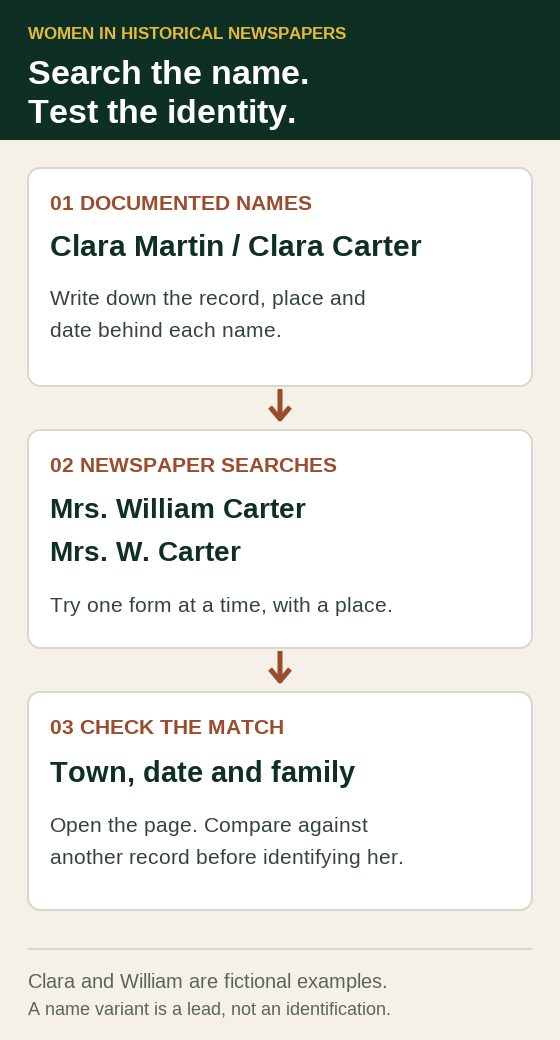
Before opening the newspaper archive, write down what you know about her from a census, marriage record, directory, letter or other source. Include the names she used, where she lived and when, and the relatives you can identify. Keep a question mark beside anything supplied only by a family story.
Suppose a 1900 census lists Clara Martin and a 1904 marriage record links her to William Carter. Search for Clara Martin in earlier papers and Clara Carter in later ones. Newspaper editors did not necessarily follow that timeline. A notice might use her birth name, a nickname, or no given name at all.
The Library of Congress guide to researching female ancestors recommends reading the original census page closely for household, neighborhood and other clues. Those details give you ways to check a newspaper mention when the name is incomplete.
Make a small name-variant list
Begin with a handful of forms that fit the woman and the period. For Clara, the working list could look like this:
- Clara Martin
- Clara Carter
- C. Carter
- Mrs. Clara Carter
- Mrs. William Carter
- Mrs. W. Carter
- Mrs. Carter, searched with the town or a relative's name
Treat every form as a search query. A hit for Mrs. Carter still needs evidence linking her to Clara. Keep names from a second marriage in a separate dated group. If she kept her surname or used another one, follow what her records say; the example list may not fit her life.
Don't paste the whole list into one query. Try one form at a time with a place and a manageable date range, noting the result and the filters you used. Search features differ among collections: quotes, wildcards and proximity searches may work in one archive and fail in another.
FamilySearch's obituary research guidance warns that an obituary may identify a married woman as “Mrs. [husband's name],” without her own first or birth name. That convention can make local notices harder to recognize too. When a search for Clara returns nothing, try William's name with the likely town and period, then check any result against the family records.
Look beyond births, weddings and obituaries
If you're searching only the life-event notices, you'll miss much of what a local paper can say about a person's everyday life. The Library of Congress guide to women in newspapers points to personal mentions and rural correspondent columns, including visits, travel and illness. It also recommends searching affiliations such as churches or community groups when a person's name does not appear on its own.
Browse the pages around the date you care about. A short note might be tucked between items about other households; a society page may include guests at a gathering; a town correspondent may report who visited relatives for the weekend. Column headings and layout vary, so inspect actual pages instead of assuming every paper used a section called “Society.” Our guide to researching social and local columns shows how to work with these everyday mentions and test what they can establish.
Try searching for someone connected to her: a parent, daughter, neighbor, or spouse. Suppose you know Clara's sister was Ruth Martin. A local item about Ruth's visit to “her sister, Mrs. William Carter” could offer a stronger lead than a standalone hit for Mrs. Carter. You still need to check whether Ruth and William belong to the family you have documented.
Names of schools, churches, clubs and workplaces can help, particularly when they appear alongside a town. A mention of a choir performance does not identify every member of the choir, though. Keep an unnamed group reference as background unless you can connect your ancestor to the event with a separate record.
Search for the life she lived outside her household
A spouse's name can unlock a search, but it can also crowd out the woman's own story. Look at the records you gathered before deciding which words to try next. Did she teach at a school, run a shop, attend a particular church, work in a union, or take part in a local society? Search those names alongside the town and a relevant period. A newspaper may mention her own activities under a name you did not expect, or place her among people you can recognize from other records.
If she taught school, our guide to researching a schoolteacher ancestor explains how to look for appointments and follow the clues to education records.
Suppose a directory lists Clara as a dressmaker. A search for “Carter” and “dressmaker” may be more useful than another exact-name search. In a small paper, browse the advertisements as well: a trade address or a notice of altered opening hours could give you a lead. An advertisement might be placed by someone else with that surname, so compare the address and date before assigning it to her. Our guide to tracing a family business through newspaper notices goes further into that kind of search.
Try the headings the newspaper actually uses. A local correspondent's column might name visitors by their home town; a school report might list staff with initials; a club item might use a title or office rather than a full name. Read a few issues from the period to learn where those items appear. That takes longer than a keyword search, but it helps when the online index has missed a small notice.
Keep track of what came from the newspaper and what came from somewhere else. If a directory says she was a dressmaker and a newspaper advertisement gives only “Carter, dressmaker,” the shared occupation is worth following. It does not yet show who paid for the advertisement. Save both records and look for an address, a business name, or a later notice that distinguishes the people involved.
Follow a change of name without skipping a step
A gap between two newspaper mentions can be hard to interpret. Clara Martin might disappear from one town's pages just as Mrs. Carter begins appearing in another. The timing is interesting, but there may be several women with those names. Find a record that actually links Clara Martin to the later surname, such as a marriage record, before you treat the mentions as a continuous trail.
Make a simple timeline with one row for each mention. Record the *name as printed*, the publication date and place, the other people named, and the source that supports the identification. Leave the identity field as “possible” when the item does not make the connection. If you later learn that Clara moved, you can revisit the rows without quietly changing what each clipping said.
Widowhood and another marriage may introduce further surnames or courtesy forms. A paper might continue to use “Mrs. William Carter” in one item and use Clara's own given name in another. In the timeline, put the printed form beside the date. Don't assume the newer wording automatically replaces all earlier forms. The same caution applies when a woman did not marry: your search list should reflect her own records, not an assumed husband's name.
If you cannot find a record tying the two names together, leave a visible break in the timeline. A daughter, sibling or old address may give you a testable way across it later. An honest gap is more useful than a smooth story built from people who happened to share a surname.
Check the whole clipping before attaching it to your tree
Open the full page image for each promising hit and record the newspaper title, place, issue date, page, and the words around the mention. The online text may leave out an important line, join columns incorrectly, or turn a name into something else. If the image is unclear, say so.
Then test the identity against what you know:
- Was she living in the area then, or could the item describe a visit?
- Does a named spouse, sibling, child or host match a documented family connection?
- Are there two Carter households in town, or two women who could be Mrs. William Carter?
- Do later notices mention the same people and places?
In our fictional example, a June 1912 notice says “Mrs. William Carter of Elm Street” visited Ruth Martin. A directory placing William and Clara Carter on Elm Street that year, together with a record naming Ruth as Clara's sister, would strengthen the match. If several William Carters lived nearby, or the directory is from a different decade, keep the notice marked as possible.
Notice what the item actually says. “Mrs. William Carter visited Ruth Martin” does not, by itself, establish Clara's birth surname, the date of her marriage, or the relationship between the women. Newspapers can misprint names and repeat gossip. The Library of Congress advises checking discoveries against other records before accepting them as family history. For more on preserving an issue and explaining uncertainty, see our guide to verifying newspaper evidence.
What to do when the search stays empty
First check coverage. Does the collection include the town, years and actual issues you need? The Library of Congress describes Chronicling America as a collection of *select* digitized pages. An empty search there leaves open the possibility of a mention in another paper, a missing issue, or a surviving undigitized copy. Our newspaper coverage map guide walks through those gaps.
If the issue is available, search a shorter name form, the husband's name, or a relative's name. Try the place name or event language, then browse likely local pages manually. A failed name search can be a problem with the page's OCR, rather than an absence of the person. The OCR and page-image guide has a practical route through misspellings and unreadable text.
If the paper itself isn't online, look up a title for the correct place and period in the Library of Congress newspaper directory. Its records help you identify publications and access leads; they do not guarantee that every issue survives. A local library may hold microfilm or a clipping file. Ask about the specific title and years you need.
Check the town she left as well as the one she moved to. A paper back home might mention a return visit or identify her as someone's daughter. Keep a separate set of dates and source notes for that search.
A search session you can finish today
Pick one woman and one ten-year period. Gather two records that establish her name and place, then write down up to six name forms you want to try. Check the dates covered by one relevant paper before running the queries.
For each promising result, save the page or its stable link and note the newspaper title, issue date and page. Write down the exact wording that connects the woman to another person or place. Mark the result confirmed, possible, or not this person, with a short reason. “Possible, same name and town but no family connection” is a useful outcome. It keeps you from repeating the search and gives you a clear next record to find.
If the first result is only a surname and a town, the next useful step may be a directory entry or a relative's obituary. Save the uncertain newspaper mention and return to it when you have another way to identify her.