
Business and local life
How to use historical newspaper advertisements to trace a family business
Use historical newspaper advertisements, business notices and local columns to trace occupations, addresses, partnerships and family connections.

On this page
- A business advertisement is a family clue, not just a sales pitch
- Define the business question before searching
- Read the whole notice for identity clues
- Search the language of trade names and occupations
- Follow addresses as they change
- Use advertisements to connect people and partnerships
- Treat auctions and dissolutions as turning points
- Read business cards and local columns together
- Check employers, customers and neighboring trades
- Test the evidence against other records
- A hands-on newspaper exercise for this week
- Advantages and limits of business notices
- Sources
A family business can disappear from formal records while leaving a lively paper trail in the local press. A shopkeeper buys an advertisement for a new address. A printer announces a change of partners. A harness maker places a business card beside a notice about an auction. A local column mentions that a family has moved its trade to the next town. Each item may be brief, but together they can show how work, place and family relationships changed over time.
This kind of newspaper research is not mainly about finding a famous article. It is about reading ordinary commercial language closely. An advertisement can name an owner, but it can also preserve a trade name, street, employer, product, building or business associate. Those details give you new ways to test whether two newspaper references belong to the same person.
The Library of Congress guide on using newspapers and trade literature describes local newspapers as useful for researching local companies, while trade publications can add industry context. Its guide to newspapers in house-history research also recommends searching addresses, streets, towns and counties because newspaper items can connect people with buildings and local activity. You can use the same principle for a family business: search not only for a surname, but for the places and commercial words that surrounded it.
A business advertisement is a family clue, not just a sales pitch
Read an advertisement first as a message meant to attract customers, not as a family history. It may not spell out a relationship or offer a full account. It can still point to information not yet present in your records: what it sold, which street it occupied, or who handled a branch. Treat each as a lead until another record confirms how it connects to your family.
That distinction keeps your conclusions proportionate. If an advertisement says “J. R. Bell & Son, carriage builders,” it shows that the advertiser used that trading name and described the business using those words. It does not identify the son's full name, establish the people's legal or biological relationship, or prove who owned the business. Check those questions against other records. If a notice gives the same surname and street as a known ancestor, it is a promising lead, not automatic proof.
Advertisements can also reveal absence. A firm that advertised every week and then vanished may have closed, changed names, moved, or simply stopped paying for space. That gap should prompt a question. It is not evidence of death or failure until another source explains it.
Define the business question before searching
Begin with a question narrow enough to guide a newspaper search. “What did my ancestor do?” is a useful starting concern, but it is too broad for efficient reading. Turn it into a question about a person, place, time and evidence target.
You might ask when Thomas Reed began trading as a bootmaker, whether Mary Evans was the proprietor at 14 High Street, or whether two men using the same firm name became partners. You might also ask which employer explains an occupation change or whether a business moved, changed its trade name, or continued under a new owner.
Write down what you already know and what would count as useful evidence. Your search brief might include a surname, initials, business name, town, likely street, occupation, date range and variant spellings. Add terms for the type of notice you want: “business card,” “removed,” “successor,” “dissolution,” “auction,” “stock,” “warehouse,” “agent,” “proprietor,” or “formerly.” These words help you search for commercial events rather than only biographical stories.
Keep a short list of negative findings too. If you searched a town and date range for several spellings without finding a business, note the coverage you checked and the terms used. A missing result may reflect poor indexing, a surviving newspaper gap, a business that did not advertise, or a different title. It should not silently become a conclusion.
Read the whole notice for identity clues
When you find a promising advertisement, read beyond the bold business name. The small print often carries the detail that distinguishes one firm from another. Note the exact wording, date, newspaper title, issue, page and column if available. Save or cite the page image where possible, because advertising text can be altered by optical character recognition and because layout itself may show whether an item is a display advertisement, a legal notice or a short local item.
Look for the following kinds of information:
- Full names, initials, honorifics and descriptions such as “jun.” or “widow of.”
- The business form, including “and Son,” “Brothers,” “& Co.,” “late of,” or “successor to.”
- Street names, building names, nearby landmarks and branch locations.
- Goods and services, especially unusual combinations that identify a particular firm.
- References to factories, warehouses, depots, agencies, farms or workshops.
- Telephone, telegraph or postal details that help separate places with similar names.
- Claims about experience, former employment or a previous business address.
- A date of opening, removal, expansion, sale, retirement or transfer.
Transcribe meaningful wording accurately, including spelling and punctuation where it affects interpretation. If the page image is unclear, mark a doubtful reading with brackets or a question mark in your notes. Do not silently turn an initial into a full name or assume that “son” means a biological relationship. Newspaper language can be promotional, conventional or legally cautious.
Classify the item before using it. A display advertisement seeks customers. A business card may be a small recurring notice with a name and trade. A local column may report a move or visit without being written by the business. A legal notice can announce a partnership dissolution or sale. These genres have different purposes and different risks of exaggeration. Your evidence log should include the item type so you remember what the wording can and cannot establish.
Search the language of trade names and occupations
Family researchers often search for a surname and miss the business because the newspaper uses a different expression. Build searches from the language a customer or reporter might use. Try the surname with the occupation, but also search for the product, service, shop name, street and business form.
For a furniture maker, possible terms might include cabinet maker, undertaker, furniture dealer, workshop, showroom and auction. A tailor might appear elsewhere as a clothier, cutter, outfitter or merchant tailor. A woman running a business may be named as a proprietress, dressmaker, milliner, boarding-house keeper, dealer or widow.
Search variants separately. Test initials, abbreviated first names, common spelling changes, “&” and “and,” singular and plural trade names, and terms such as “Co,” “Company,” “Bros,” “Brothers,” “Son” and “Sons.” The Library of Congress guide on using newspapers and trade literature specifically notes that abbreviations such as “Bros” can matter in newspaper searches and recommends expanding a search with a product or service name, place or factory name, or phrase particular to a company.
Do not assume a trade name belongs to the person whose surname appears in it. “Harris & Brown” may be a partnership, a predecessor’s name retained for goodwill, a company with a silent investor, or a firm advertising in a way that does not identify every worker. Search the name in later notices for “successor,” “formerly,” “new management,” “dissolved,” and “continued by.” Those phrases can help you look for a change in arrangement; confirm the parties and dates in the notice and other records.
Use local vocabulary as a clue to place and period. A business may advertise a “branch,” “depot,” “yard,” “rooms,” “emporium,” “works” or “manufactory.” These words can point to the section of the newspaper in which similar notices appear. They can suggest what kind of premises or activity the advertiser wanted readers to associate with the business. Treat the wording and size of an advertisement as presentation, not a measurement of the firm's scale. A small recurring business card and a large illustrated display advertisement are different forms of evidence, even when they name the same firm.
Follow addresses as they change
An address is often the strongest link between two advertisements with similar names. Record every location exactly as printed, then compare dates. A move from one street to another may mark growth, a change in rent, a relocation after marriage, or a shift from retail to wholesale work. A branch address can explain why the same business appears in two towns at once.
Make an address timeline with four columns: date, wording in the newspaper, business name and interpretation. Keep interpretation separate from transcription. “Removed to 22 Market Street” is the evidence. “The owner expanded” is an inference that may require support from the size of the advertisement, a second notice or a directory.
Street names can change, and numbering can be inconsistent. Compare nearby landmarks, occupations, neighboring firms and town directories before deciding that two addresses are different. Search the street without a number, and search the number without the street if the archive allows it. A business might advertise “opposite the courthouse” in one year and use a formal street address later.
An old advertisement can persist after a move, while a trade name can continue after the people or arrangements behind it have changed. Search for terms such as “successor,” “formerly,” “new management” and “dissolved”. Treat the wording as a lead; confirm the parties and dates in the notice and other records. When you need to separate a workplace from a home, trace and interpret an ancestor's newspaper address using dated records rather than assuming that the advertiser lived there.
Use advertisements to connect people and partnerships
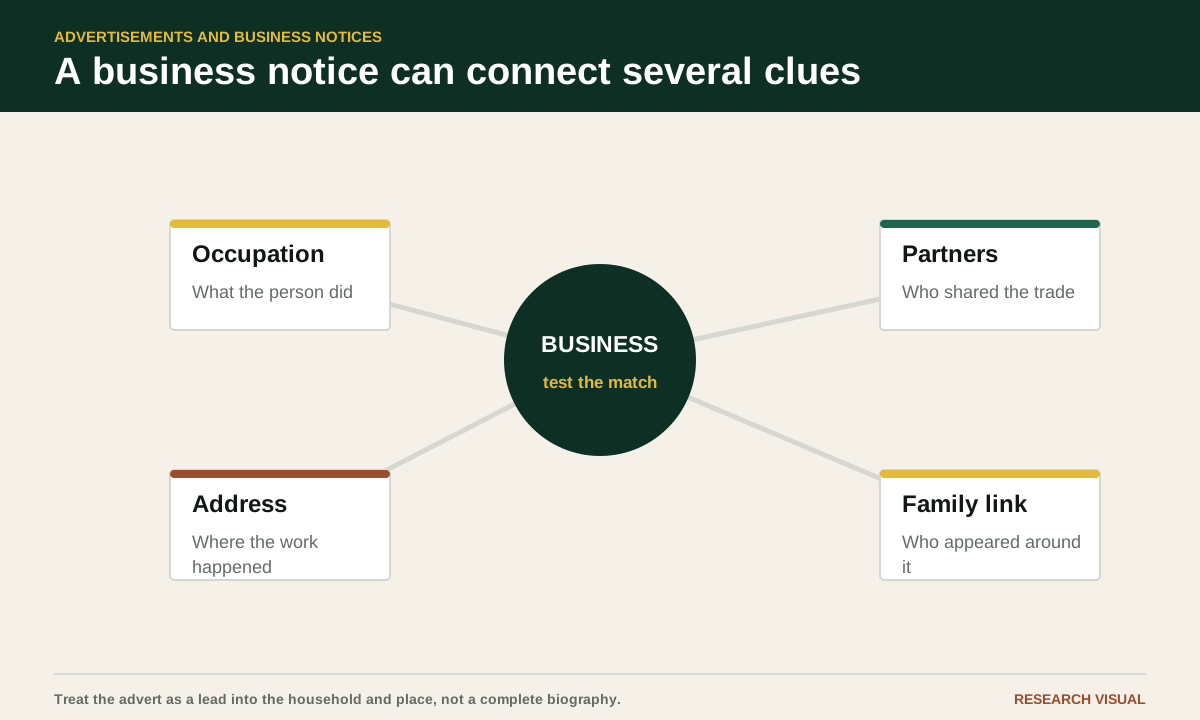
Partnership language creates some of the clearest family and business clues, but it needs careful reading. Phrases such as “in partnership with,” “under the style of,” “co-partnership,” “successor to,” “admitted into the firm,” and “the business will be carried on by” describe different relationships. Copy the phrase, not just the names.
A partnership notice may name two people who were not related but worked together. A later dissolution may show which partner left and who continued the firm. A notice saying “John Lane has this day been admitted as a partner” provides a dated change in the business arrangement. It does not necessarily say that Lane invested money, married into the family or became an equal owner.
The examples below are illustrative teaching scenarios, not transcriptions of retrieved historical advertisements. In one hypothetical case, advertisements using the name “Cole Brothers” appear at the same address. This is a lead for investigating the people and business arrangement; it does not by itself establish the named individuals, a partnership or a family relationship. Look for a notice that identifies the parties, then compare other records.
Treat auctions and dissolutions as turning points
Auction notices can mark a business transition even when they do not explain it. A notice may advertise the sale of stock, fixtures, tools, livestock, machinery, household goods or an entire premises. Read the list closely. It can identify the kind of work carried on, the scale of the stock and the physical equipment associated with the business.
Ask what the auction is actually selling. “Closing-out sale” may indicate retirement, removal, bankruptcy, death, a landlord’s change of use, or a temporary clearance. “By order of the executor” points toward an estate context, but it does not prove why the business ended.
Partnership dissolutions deserve the same treatment. Record the date the notice says the partnership ended, the firm name, the outgoing and continuing parties, the address and any instructions about debts or accounts. A later advertisement can show whether the continuing partner kept the name, changed the trade or moved elsewhere.
These notices can help explain a confusing occupation history. A person listed as a merchant in one record and a clerk in another may have left a family firm, joined a new partner or taken paid employment after a sale. The newspaper gives you possible dates and events to test against directories, probate, court records, tax lists and census entries.
Read business cards and local columns together
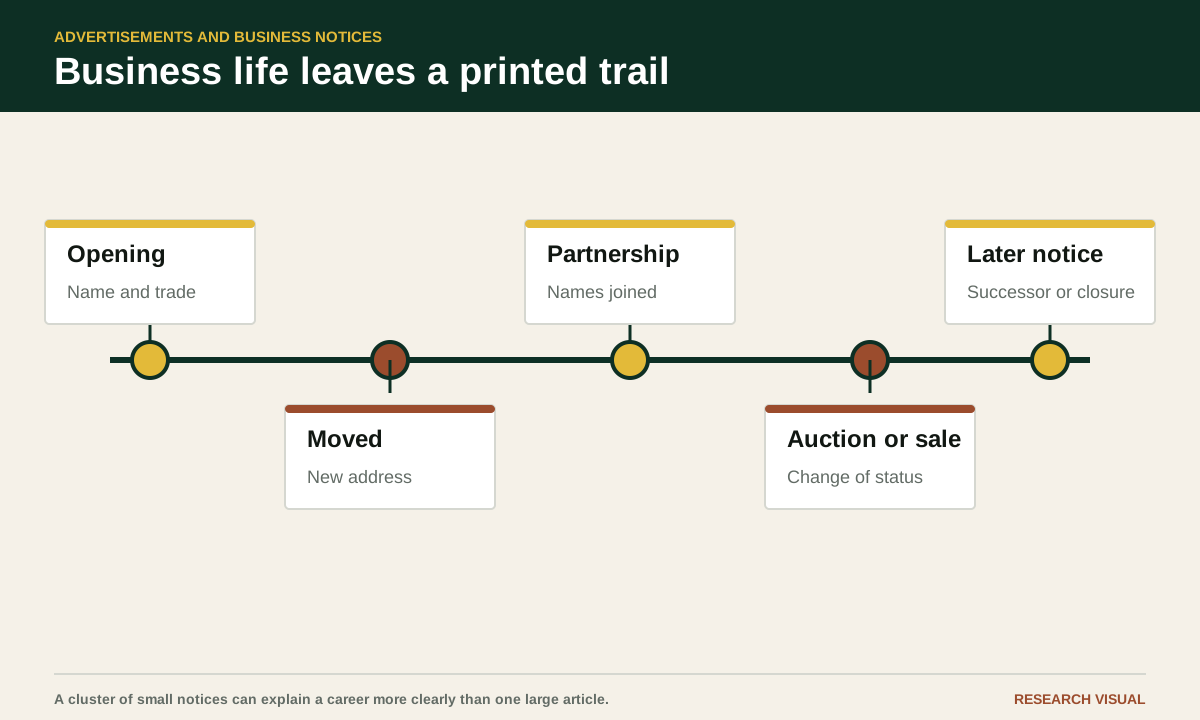
A run of cards documents that advertisements using a business name appeared in the issues you inspected. It can help trace changes in address or wording, but does not by itself show the exact opening or closing date or who operated the business. Record the first and last appearance you can find without treating either as the exact opening or closing date.
Compare a business card with local news from the same issue or nearby issues. A local column may report that a person visited another town, attended a trade meeting, opened a shop, purchased a building or moved a household. The Library of Congress guide to newspapers in house-history research notes that social and local items can connect residents with particular houses, streets and events. In business research, this can connect a proprietor with the premises or community where the firm operated.
Check employers, customers and neighboring trades
Not every family member owned a business. Advertisements can still reveal where a worker was employed. Search for phrases such as “wanted, assistant,” “apprentice,” “salesman,” “bookkeeper,” “manager,” “traveller,” “foreman,” “agent,” and “in the employ of.” Also search the names of prominent local firms alongside the person’s surname.
Employer clues are most useful when tied to a date and place. A notice about a clerk leaving one firm may explain why a later directory gives a new town. A company advertisement listing a manager may identify an occupation that a family source describes only as “merchant.” A trade article or local report may reveal the industry behind a vague label such as “works.” The Library of Congress guide to historical US newspaper collections notes that not all newspapers are digitized and that print or microfilm may still be needed. Treat an online absence as a limitation on what you searched, not proof that no notice existed.
Do not overread commercial praise. Claims about being the oldest, largest, best known or sole agent are advertisements, not neutral measurements. They may still help identify a business, but use restrained language in your notes: “The notice claims...” rather than “The firm was...” unless another source supports the claim.
Test the evidence against other records
A newspaper advertisement becomes stronger when it agrees with independent records. Compare the name, address, occupation and dates with city directories, census schedules, licenses, probate files, land records, court notices, trade registers, church material and surviving business stationery. You do not need every type of record. Choose the record that can test the particular claim.
For identity, compare given names, initials, residence, spouse, age and associates. For a business move, compare directories, property records and later advertisements. For a partnership, look for a dissolution notice, court filing, probate record or directory entry.
Check the newspaper’s date and edition carefully. A notice repeated in a weekly paper may describe an event that occurred days earlier. A regional paper may report a business in another town. A title may have changed or an issue may be missing. The Library of Congress's Chronicling America guide describes the searchable historic collection and points researchers to newspaper-title information and the directory for identifying titles and access routes. Its historical newspaper holdings guide explains that holdings may be in print, microfilm or digital formats and that not every newspaper has been digitized.
Preserve a citation that another researcher can follow. Include the newspaper title, publication date, edition if shown, page, column or item description, exact wording, image or stable link, and the date you accessed it. If you rely on a search-result transcript, check the page image before quoting a name or address. Record uncertainty rather than hiding it. For the page image, wording and limits to record, see the evidence-preservation guide.
A hands-on newspaper exercise for this week
Choose one ancestor or probable family business and a narrow period of five to ten years. You do not need a complete life story. Your target is a small commercial timeline. If the surviving issues or available access do not provide three distinct references, document the titles, dates and terms you checked, the coverage limits, and the next repository or route to try instead of inventing a quota.
Write a search brief with the person’s known name, two spelling variants, town, likely occupation, possible street, date range and three business terms. Add one event term such as removed, successor, auction, dissolved, opened or agent. Search the surname, then the business name or occupation, then the address or product. If possible, inspect commercial and local sections around a promising issue rather than relying only on exact text matches. For text-search variants and reading page images, see the OCR and page-image guide.
For every useful item, make a note with these fields:
- Date and newspaper title.
- Item type, such as display advertisement, business card, local column, auction or legal notice.
- Exact business and personal names.
- Address, branch or landmark.
- Goods, services, employer or partner language.
- What the item directly says.
- What you infer and how certain the inference is.
- A follow-up record that could test it.
Now arrange the items by date. Mark each change in address, firm name, partner, product or role. Look for a transition that the family story does not yet explain. Perhaps a person shifts from employee to proprietor, a firm changes from “and Son” to “& Co.,” or a shop disappears just before an auction. Choose one transition and search specifically for the notice that might explain it.
Finish by writing a short evidence paragraph. State what the advertisements establish, what they suggest, and what remains open. You might place a named person as a baker at a particular address, note a possible later partnership, and say that a similarly named person in the next town is not yet proved to be the same individual.
Advantages and limits of business notices
Business notices can fill gaps that ordinary family records leave behind. They may provide streets, business names, products, partners, employers, branch locations and dates of public change. They can show working life and help you find an ancestor who appears under a firm name or a role within someone else’s business.
They have limits. Advertising depended on money, custom, newspaper habits and local conventions, so many businesses left little or no advertising trail. Surviving issues may be incomplete, and digitization may favor some titles or years over others. Poor print, damaged pages and imperfect transcription can distort names and addresses. A business could operate without advertising, use a different name, or continue through a gap in the surviving paper.
The language can be ambiguous or promotional. A notice may omit women, junior partners, silent investors, employees and family members who worked behind the counter. A repeated trade name may outlive its original owner. A local report may contain a mistake. A short notice can be accurate about an address but vague about ownership.
Use the newspaper as evidence to weigh with other records. Let it generate questions, dates and search terms. Quote what it says, distinguish that from your inference, and give unresolved identities an honest status. The result is a documented account of how a business appeared to its community and how that public record fits the wider family evidence.
Sources
Using Newspapers & Trade Literature, Library of Congress Newspapers: House History, Library of Congress Chronicling America: A Guide for Researchers, Library of Congress Historical Newspapers, Library of Congress