
Addresses and local history
How to find an ancestor's address in old newspapers
Trace a historical address through newspaper notices and other dated records, with a worked example to guide your first search.

On this page
- Begin with one dated place clue
- Make your first name and street search
- Refine the search if results are missing or too broad
- Read who used the address and why
- Check the household as well as the name
- Compare the address with a census or city directory
- Put the dated addresses in order
- Check old street names and house numbering
- Find out what a missing result means
- Save the wording and the source details
- Try one address question this week
- Sources
To find an ancestor's address in old newspapers, search their name alongside a street clue, then read the complete notice on the page image. Take one dated record you already have and write down the town, the person's name and any street it gives. Those details form your first search.
If you have no street yet, search the name within the relevant town and years, looking for an item that supplies one. Before adding an address to your family history, check who the notice describes and whether it gives a home, workplace or place visited. This guide is for historical ancestors, not living people.
Begin with one dated place clue
Ask a manageable question: "Where was this person living around this year?" You can widen the period later. For now, one dated address gives you something specific to compare with a newspaper item.
Copy the address exactly from your starting record, including a direction such as North, a room number or a building name. Keep that version even if you shorten it for searching. Note whether you read the record image or only an index entry, a searchable summary made from a record.
Without a numbered address, use the strongest clue you have. A neighbourhood, occupation or relative's name can help you recognise a promising notice. Leave unknown details blank instead of filling them from a modern map.
Choose a newspaper serving the relevant place and check its available years. Our guide to finding the right newspaper for your ancestor's town explains how to identify a suitable title if that choice is uncertain. Record both the paper's publication town and the place named in the notice; they may differ.
Make your first name and street search
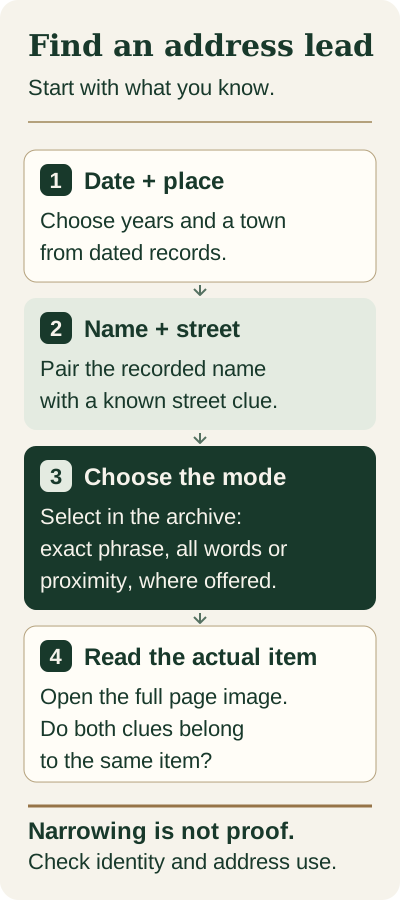
For a US search, try Chronicling America when it has relevant issues. The Library of Congress instructions for searching newspaper page text explain the route: open Collection Items, expand Advanced Search if needed and select Pages (Full Text). Titles searches newspaper names, not the words inside the paper. Use the place and date filters to narrow your question.
Consider Ellen Ward, a fictional dressmaker in a story set in Dayton, Ohio. Every person, newspaper title, address, date, quoted notice and research result in this example is invented. These are teaching records, not discoveries from a real archive.
Suppose an invented 1900 census entry recorded on 12 June lists Ellen with her husband Samuel at 14 Cedar Street. Try Ward Cedar with All of these words selected, limited to Dayton titles and 1900 to 1903. Leave out the house number initially so it does not exclude a useful result.
Imagine a notice in the invented Cedar Street Chronicle, 8 October 1902, page 4: "Mrs Samuel Ward received her sister at her home, 14 Cedar Street." Read the whole item on the image. Its wording reports Mrs Ward's home, rather than the visiting sister's address.
Before calling this Ellen's home, compare the household context. The husband's name Samuel fits the invented census household, and the street agrees, but a matched surname and address do not automatically identify Ellen. Check whether the notice could describe another Mrs Samuel Ward. Until that identity question is settled, your narrow conclusion is that the notice reports Mrs Samuel Ward's home at 14 Cedar Street. The census separately records Ellen's household there; neither record establishes continuous residence between their dates.
Now imagine an advertisement on 6 May 1903: "Ellen Ward, dressmaking, 22 Willow Street." It gives a place for the advertised service. Whether the advertiser is your Ellen, and whether she also lived there, need checking. A dated directory distinguishing her home from her business would help resolve the residential question.
Refine the search if results are missing or too broad
If Ward Cedar returns too many pages, try a proximity search, which looks for words near each other. Chronicling America's documented choices include These words within 5 words of each other and These words within 10 words of each other. This exact phrase requires neighbouring words in the stated order. Choose the mode in the form rather than assuming punctuation changes the search.
In the fictional notice, Ward Cedar as an exact phrase would miss "Ward received her sister at her home, 14 Cedar Street." A proximity search allows intervening words, although nearby terms can still belong to separate items. These choices are described in the Library of Congress search guidance; another archive may handle queries differently.
If the query is too restrictive, try the street without the number, then the surname without the street. Test an initial or a spouse's name when a notice suggests that form. Change one thing at a time and record the query, mode and filters so you can tell what you have already tried.
Searchable text is often OCR, short for optical character recognition: software's attempt to read the printed page. The Library's explanation of OCR errors describes how print and image quality can cause letters or numbers to be misread. Where the scan is legible, use what you can read there to check a garbled search snippet.
Our guide to searching newspaper OCR and page images covers spelling experiments and browsing when a straightforward query is not enough.
Read who used the address and why
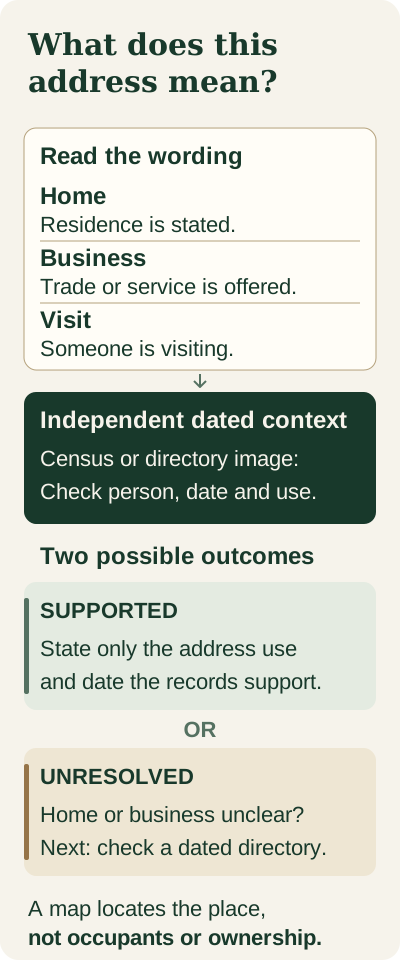
With All of these words, a result means the terms occur on the same page. Your surname might be in a social paragraph and your street in an unrelated advertisement. Zoom out to see the column boundaries, then read the candidate item from its beginning to its end.
The words around an address determine what you can say. "At her home" reports a residence. "Visiting her daughter at" gives the daughter's location unless the text says more. "Apply at" gives a contact point. An advertisement for dressmaking supplies a business clue without necessarily separating work from home.
In a sale or rental advertisement, check who is named and in what role. Someone offering premises or handling enquiries is not necessarily their occupant or owner. A familiar name beside a property address is a reason to investigate that role.
Copy enough of the sentence to preserve its meaning. "Ward, 22 Willow Street" loses both the occupation and the reason the address appeared. Keep "dressmaking" in your note and label the item an advertisement. Our guide to tracing a family business through newspaper advertisements is useful when the trail follows an occupation and you want to investigate the advertised premises.
Check the household as well as the name
An address identifies a location. Deciding who appeared there requires a comparison with details you have established elsewhere. Does the spouse fit? Does the occupation agree? Can you place the named relative in this family? A contradiction matters even when the street looks promising.
In the fictional story, "Mrs Samuel Ward" gives you a household clue to test against Ellen's husband. It does not name Ellen directly. If another household could fit, keep the newspaper entry under its printed name while you investigate. The later advertisement names Ellen and her trade, but says nothing about Samuel; it needs its own identity check.
Explain which details link the records and what still leaves room for another person. There is no fixed number of matching details that makes every identification reliable. Repeated surnames and repeated street addresses may all depend on the same uncertain assumption.
When namesakes are the main obstacle, our guide to identifying an ancestor with a common name develops that comparison. For this address search, a brief note of the supporting household detail and any conflict will keep your conclusion understandable.
Compare the address with a census or city directory
Look for a separately created record close to the notice's date. A census can place people within a household; a city directory may supply an address between census years. You are looking for evidence that can test the newspaper's wording and the person's identity.
The National Archives' description of the 1900 census records lists addresses, household relationships and occupations among the information recorded. It also describes house and street details on associated index cards where appropriate for urban residents. Use an index or card to locate the original census schedule, the completed census form, and read its full image.
Check the column headings before copying a number. A household or dwelling serial number used to organise entries is not automatically a street number. If the image supplies no street address, record that limitation. Also distinguish the date the census taker wrote the entry from the census reference date, the date the return is meant to describe.
For directories, ask a local library or archive about the town and exact years you need. The National Archives' older geographic research guide for the 1930 census explains how directories can supply street addresses and help locate an urban enumeration district, the area assigned to a census taker. Use it for that research principle, not as a promise of current access to a particular volume.
Read the directory's abbreviation key and check whether an entry separates residence from workplace. Keep its volume year and any stated compilation date. A later volume gives you another dated record, not the exact day a household moved.
Put the dated addresses in order
Make a short timeline with the exact address, evidence type and date each record describes. Keep the publication date separately when it differs from the event or record date. If a notice published on Wednesday describes a visit on Sunday, its address belongs to the reported Sunday visit; it does not necessarily establish residence on Wednesday.
The wholly fictional Ellen Ward timeline would contain:
- A 1900 census entry recorded on 12 June: Ellen with Samuel at 14 Cedar Street. Keep the census reference date separate from the recording date.
- An 8 October 1902 visit notice: Mrs Samuel Ward "at her home, 14 Cedar Street." The publication date is known; the quoted wording gives no exact visit date.
- A 6 May 1903 advertisement: Ellen Ward, dressmaking, at 22 Willow Street. Residence at the advertised service address remains unresolved.
Keep each item under its printed name until identification is settled. These dated records do not establish continuous residence between them.
The advertisement cannot by itself support "Ellen moved to Willow Street in May 1903." Seek a directory explicitly separating home and work, or another dated household record. If nothing resolves whether the premises served both purposes, keep the question open.
Repeated appearances of an identical advertisement show that it was printed again. They are not separately created household evidence. Keep them in the timeline as repeated advertising rather than treating them as extra confirmation of residence.
Check old street names and house numbering
Different addresses can indicate a move, a renamed street or changed numbering. Look for evidence connecting the descriptions before choosing an explanation.
A historic map may help locate the earlier address. Sanborn maps are fire-insurance maps, made to describe places for insurance purposes. The Library of Congress guide to interpreting Sanborn maps explains how street indexes can point to address ranges and sheet numbers. It also warns that street names and building numbering systems changed.
Begin with the map's coverage index and check that it includes your area. Find the relevant sheet and use that edition's key to interpret its symbols. A suitable map may not survive for the town or year, and a surviving edition may omit the neighbourhood you need.
Check revision information as well as the printed year. Some editions received pasted correction slips, so features visible on the scan may reflect later conditions. Record the revision dates; if you cannot date a particular correction, retain that uncertainty.
A map answers a question about the place. Even a building marked as a dwelling does not identify its household. To argue that an address was renumbered, seek dated numbering information or records connecting its old and new descriptions. Today's map showing the same address text is insufficient. Neither a newspaper notice nor an insurance map establishes ownership.
Find out what a missing result means
After an empty search, check which issues were available. Were the relevant months present? Did you search newspaper titles instead of page text? Could a place filter have excluded the paper carrying the notice?
The Library of Congress FAQ on selected newspaper content explains that relevant periods are not necessarily available in Chronicling America. A negative keyword search cannot show that an ancestor was absent from a street or that no notice was printed.
If an issue is available, browse local notices and advertisements, noting the pages examined. If it is missing online, ask about another copy or microfilm, photographic film containing newspaper pages, before paying for access elsewhere.
A useful library enquiry names the title, publication place, year and missing dates, then asks what survives and how to consult it. Our guide to free and library newspaper access covers those routes. Record "No result in these available issues with these queries" so a later search can build on yours.
Save the wording and the source details
While the page is open, save the newspaper title, publication place, issue date, printed page number, repository, page URL and access date. Distinguish a viewer's image number from the printed page number if they differ.
Keep a transcription, your copy of the wording, alongside the image where permitted. Mark unreadable characters as uncertain and retain the original address spelling, even if your query used a modern version.
Write your interpretation in a separate note. Say what kind of address the item reports, which date it describes and why you think the person belongs to your family. Record the next evidence needed if identity or residential use is still uncertain.
Our guide to verifying and preserving newspaper evidence provides a fuller citation and image-saving routine. Before sharing a scan publicly, check the repository's rights information. Permission to view an image does not automatically permit republication.
Try one address question this week
Choose one historical ancestor and a period with a town clue. Set aside a short research session and prepare a note with these prompts:
- What dated record am I starting from, and what address does it give?
- Which newspaper and available issues will I examine?
- What name and street query will I try first, in which mode?
- What does the candidate item say the address was for?
- What household detail helps identify the person, and which separate record could test the address?
If you lack a street clue, make finding one the aim. Search the name within the place and years, inspect a promising item, and record its context before using the address in another query.
Finish with a dated statement you can defend or a question you could not settle. "The advertisement gives a service address; residence needs checking" leaves you with a specific next enquiry without adding an unsupported move to the family history.
Sources
- Library of Congress: choosing full-text, phrase and proximity searches in Chronicling America
- National Archives: using city directories and addresses for geographic census research
- Library of Congress: OCR limitations and gaps in selected digitised newspaper content
- Library of Congress: interpreting Sanborn street indexes, numbering and revision dates
- National Archives: address and household information in the 1900 census and its index cards