
Names and identity
How to find an ancestor with a common name in old newspapers
Use dates, addresses and family connections to tell people with the same name apart, then check each promising newspaper mention against other records.

On this page
- Write down what you know, including dates
- Try a small search with the correct archive mode
- Check what the newspaper's location tells you
- Choose a clue that distinguishes the people in front of you
- Read the whole notice before you start comparing
- Give each plausible namesake a separate working record
- Compare the candidate with an independent record
- Explain disagreements and missing details
- Follow a fictional John Miller case to an honest outcome
- Change the question when the search stops helping
- Save a candidate note and choose one next action
- Sources
A result for John Miller may describe your ancestor, a neighbour or someone visiting town. Before opening more results, give yourself a few details that could distinguish them.
Your first action is to open a record you already trust and make a short search brief:
- Write the person's name as the record gives it.
- Record the place and date that the record actually supports.
- Add a useful identifying detail, with its source.
- Choose one question the newspaper might answer.
- Leave room to record other people with the same name.
This gives you a way to decide which hits deserve attention before a long result list starts making the decisions for you.
Write down what you know, including dates
Keep this short note beside your browser or notebook. Include sources you can reopen, rather than a list copied from an online tree. Note whether an address comes from a record image, a transcription or a family recollection so you know where to check it.
Attach dates to the details. A residence recorded in 1900 supports a search around that time; it does not establish where the person lived throughout the following decade. Mark an approximate birth year as approximate. Leave an unknown spouse or middle initial blank instead of borrowing one from a promising newspaper hit.
The John Miller examples throughout this guide are fictional. All people, addresses and records are invented teaching material, not findings from an archive. Here are the two men you will need to keep separate as the search develops:
- Your ancestor: John Miller, a carpenter at 18 Willow Street in Dayton, Ohio, in 1900, with wife Anna and daughter Clara.
- A namesake: another John Miller, also a carpenter, recorded at 42 Orchard Lane in 1902, with wife Louise. A namesake is simply someone with the same name.
A notice naming only John Miller, carpenter could fit either man. The addresses come from different years, so you would need records nearer the notice's date before ruling out a move. Your first question is whether a later newspaper mention describes the household you are researching. That tells you which details to look for.
Try a small search with the correct archive mode
For a US starting route, open the Library of Congress Chronicling America search guide. It describes opening Collection Items, expanding Advanced Search and selecting Pages (Full Text). Set a location and date range, after checking whether relevant titles and issues are available.
The Library's explanation of keyword search modes distinguishes an exact phrase, which requires adjacent words, from all-words searching across a page and proximity searching within a chosen word distance. An inserted initial can defeat an exact name phrase.
Select one mode, then copy only its fictional practice query into the keyword field:
- This exact phrase:
John Miller - These words within 5 words of each other:
John Miller - All of these words:
Miller carpenter
For this invented household, try 1900 to 1903 as a first window for the question about John's later work. That is a search limit, not evidence that he stayed in Dayton. The exact phrase explores that printed name; proximity allows room for an initial. The occupation query explores a different identifying clue. Do not assume another archive interprets these modes in the same way.
A page containing Miller and carpenter may contain unrelated items. Before making a candidate note, check whether the words belong to the same notice and actually describe the same person. Even a close name match still needs comparison with the brief.
Check what the newspaper's location tells you
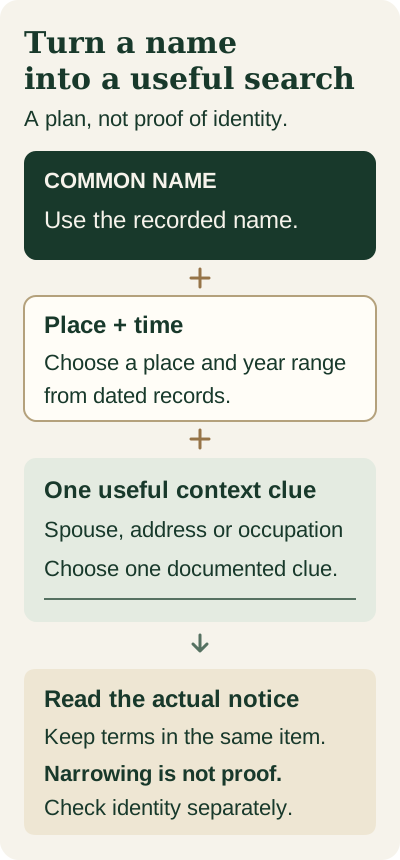
A publication-place filter helps contain the search, but it does not establish the residence of everybody mentioned in the paper. Ask whether the item describes a local person, a visitor, someone formerly resident there, or an event elsewhere. Read the place wording before assigning the notice to your ancestor's timeline.
If the newspaper itself is uncertain, the Library of Congress Directory search guide explains searches of newspaper title records and library holdings, rather than article text. It also advises attention to title changes. Use it to investigate a paper for the relevant place and years, then check actual issue availability with the repository.
Choose a newspaper because its place and period fit the question. A familiar town name in a catalogue does not tell you whether the needed issues are searchable. Our guide to finding the right newspaper helps with that title question.
For a move between towns, make separate search windows linked to the records documenting each residence. An item outside the first window may still matter, but you will have a clear question about how it connects.
Choose a clue that distinguishes the people in front of you
The best extra term is one that helps separate the plausible candidates. If both local John Millers are carpenters, carpenter will not do much of that work. An address or a named relative may be more useful. If the relatives also share common names, look for a relationship stated in the item, rather than merely another name on the page.
Use clues separately before combining them. Requiring a full name, spouse, occupation and street in every query would hide any notice that leaves one out. Your search terms need not include every detail you will use to evaluate the result.
Try the less common relative's name on its own when the target name overwhelms the results. Then read any relevant family context. You are investigating the same household from a different entry point, not assigning every result for the relative to your ancestor.
Keep a small working list of printed name forms actually encountered, with speculative variants marked as such. The newspaper name search planner can help organise possible queries. It cannot decide which results describe your ancestor. That decision depends on the context you read and the records you compare.
Read the whole notice before you start comparing
Open the page image and locate the complete item, including its heading and any continuation. Check whether a snippet has dropped a word connecting people, such as wife, employer or visitor. Those words change what the notice says about identity.
Distinguish a person's home from the place of an event. A report that someone attended a meeting at a hall does not give you their home address. Likewise, a witness named alongside your ancestor is not automatically a relative. Record the relationship actually stated, and keep any suggested connection in your interpretation. If a street becomes your main clue, find and check an ancestor's newspaper address before treating a business or visit as a residence.
Check which date belongs to which fact. The issue date dates publication. If the item describes something that happened earlier, give that event its own date or approximate timing. A person described as formerly of a town needs a different timeline note from someone described as currently living there.
Transcribe only the passage needed for the identity question, preserving uncertain readings. Save enough page context to revisit your interpretation. An unreadable initial should stay unreadable until you can resolve it from the image or another record; the initial you hope to see is not a transcription.
Give each plausible namesake a separate working record
Create neutral labels such as candidate A and candidate B. A notebook page, file or spreadsheet tab for each person will do. Put an address or occupation beside the label when documented, so you can recognise it without merging the newspaper mention into your family tree. Keep mentions you cannot yet connect to either person in a separate unassigned file.
Susan Skilton's RootsTech syllabus on sorting people with the same name, available as a PDF recommends correlating dates, places, relationships and occupations, investigating namesakes and building separate timelines. It notes that occupations can change and even relatives' names can coincide.
In your working records, keep what the document says separate from your suggested identification. For example, the fictional wording John Miller, carpenter belongs in the transcription field. May describe candidate A belongs in the interpretation field. You should be able to move the mention to another file without rewriting what the newspaper says.
Keep useful information about a namesake even after deciding a particular item belongs to them. Their employer or address may help you recognise later hits quickly. You do not need to reconstruct every unrelated person's life. Investigate enough to explain the distinction that matters to the current question.
Compare the candidate with an independent record
Choose the record that could answer the specific identity question. If the newspaper gives an address, look for evidence of who lived there near that date. If it names a spouse, compare the household relationship. A general name index may be less useful than a record image that supplies the missing context.
The National Archives description of the 1900 census lists names, addresses, relationships to the household head, birth month and year, and occupations among its fields. Those are potential comparison points, not a guarantee that a particular entry is accurate, complete or available for your person.
Write the comparison in ordinary sentences. In the fictional case, you might note that the household record describes John as a carpenter, while the newspaper describes its John as a carpenter but gives no address. The shared occupation makes the mention worth investigating; it does not establish that the two references describe one person.
Ask where each piece of information came from. If two newspaper items repeat the same report, record the repetition without treating it as independent confirmation. A copied tree entry is also not a new observation simply because it appears on another website.
Explain disagreements and missing details
A disagreement can point to another person, an error or a change in circumstances. Write down the discrepancy before deciding what it means. A different occupation years later deserves a question about employment; an incompatible household at the same time deserves investigation of a namesake.
Dates help you judge the problem. Two different addresses several years apart could describe a move. Addresses recorded close together need a closer look at what each source means by residence. Do not invent a move to repair a mismatch, but do not discard a candidate simply because a move remains possible.
Missing information is a separate category. A notice that omits a spouse neither agrees nor disagrees about that spouse. Similarly, a surname-only reference offers less identification than a full household description, even when both fit the place.
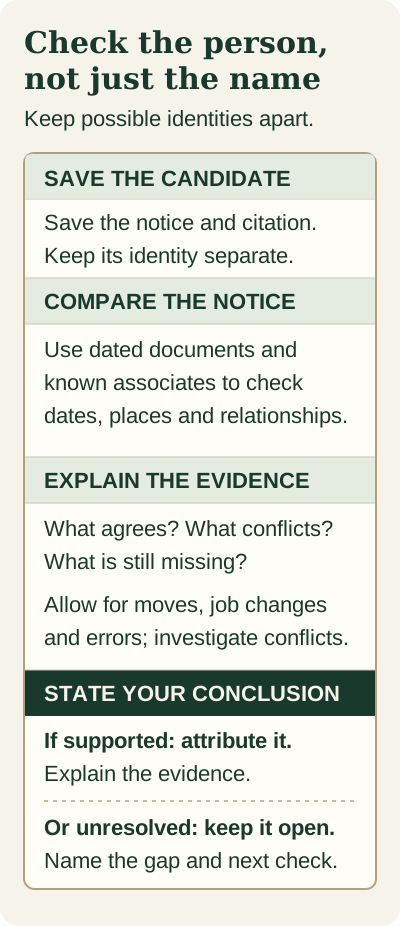
Matching details differ in usefulness and may depend on the same original report. Explain why the candidate fits, what competes with that explanation, and which record could resolve the difference. If an unresolved contradiction affects the identity, leave the mention unassigned.
Follow a fictional John Miller case to an honest outcome
Everything in this worked case is invented: the people, addresses, records, newspaper title, dates and outcomes. No archive search produced these items, and they are not claims about holdings.
Suppose an invented 1900 household record describes John Miller, born in October 1864, living at 18 Willow Street in Dayton, Ohio. It records carpenter as his occupation and lists Anna as his wife and Clara as his daughter. Your brief asks whether he continued working as a carpenter after 1900.
Now imagine reading a notice in the fictional Dayton Evening Ledger, 12 April 1902, page 3. It describes a carpenter named John Miller injured while repairing a roof. It gives no age, home address or relative. Candidate A is your household's John. The notice fits his documented occupation and general place, but its sparse description does not distinguish him from another local carpenter.
An invented 1902 directory entry introduces candidate B: John Miller, carpenter, at 42 Orchard Lane. Another fictional record identifies B's wife as Louise. This is enough to create a separate working identity; it does not tell you which carpenter the injury notice means. Keep the notice in the unassigned file while looking for a detail that would connect it to a household.
Imagine a second item in the same fictional newspaper, 15 April 1902, page 2. It describes John Miller of Orchard Lane recovering after a roof accident. Comparing the event wording makes it a possible follow-up to the earlier report. The address favours B, while candidate A's address is documented only in 1900. You cannot assume A remained there, or that he moved to Orchard Lane.
Your next check is a residence record close to April 1902, not another broad search for John Miller. If it documents A at a different address and B at Orchard Lane, it would help distinguish them. Until you have that evidence, record the proposed assignment and the unresolved residence question separately.
Finally, imagine a brief 1903 social item saying only that Mrs John Miller visited relatives. It names neither the relatives nor a street. You cannot choose Anna because she is the wife in your family brief. Keep this item unassigned too; familiarity with candidate A does not supply details absent from the notice.
The session ends with a useful partial result: the roof-accident reports appear more consistent with candidate B, subject to the residence check, while the social item remains unresolved. You have not answered whether A continued carpentry work. You have identified a competing person and the record needed next, which makes the next session narrower.
What would support identifying your John?
For a separate, wholly fictional example, imagine a notice in the invented Dayton Evening Ledger, 6 June 1903, page 4. It names John Miller, carpenter, of 18 Willow Street, and describes Anna as his wife and Clara as his daughter.
You then inspect an invented residence record from May 1903 that places your John at that address with Anna and Clara. A separate invented record from the same period places the other John at Orchard Lane with Louise. These records were not copied from the newspaper report. You check their wording, dates and household details and find no material disagreement about which man the notice describes.
Your note could read: this notice describes the Willow Street John Miller. Its address and stated family relationships fit his household close to the publication date, while the checked record for the other John describes a different household. On that evidence, I have attached this notice to my ancestor and saved the records supporting the decision.
That is a reasoned conclusion from the evidence examined, not a rule that an address and two relatives always prove identity. There is no fixed number of matching details. Record which alternatives you checked and revisit the conclusion if contradictory evidence appears. Identifying this 1903 notice would not also identify the sparse injury or social items above.
Change the question when the search stops helping
If every query brings back indistinguishable names, ask what missing detail would make a result useful. You may need a residence or family record before more newspaper searching. Follow that gap instead of adding increasingly elaborate keywords to the same uncertain brief.
When the relevant title or years are unavailable, record the access gap separately from the identity problem. Our newspaper coverage map guide shows how to organise that check. Check free and library newspaper access before purchasing access; if payment becomes the obstacle, use the paid newspaper archive comparison guide to check the exact coverage you need.
If you know the issue is available but suspect the name was not recognised, move to searching OCR and page images. Keep the identity brief beside that work. Finding additional text solves a retrieval problem; the resulting mention still needs comparison with the people it could describe.
Save a candidate note and choose one next action
Use this fill-in note for a promising mention. Keep it separate from a final family-tree assignment:
- Candidate label and research question:
- Newspaper title, issue date, edition and page:
- Repository, page URL and access date:
- Exact identity wording, with unclear text marked:
- Documented comparison facts and their sources:
- Other plausible person or conflicting detail:
- Current interpretation, including what remains unknown:
- Next record to check and the question it should answer:
For the fictional injury case, the interpretation could read: carpenter and publication place fit A, but the possible follow-up gives an address associated with B. A's residence in April 1902 is unknown. Do not attach the injury to A. Next action: locate a residence record near that date and compare both candidates' addresses.
Save the image and citation with the note, even if the identity remains open. Our guide to verifying and preserving newspaper evidence explains the record another researcher needs to check your reading.
This week, take a single documented residence from your own historical family research. Choose a suitable newspaper window, try the simple name query and a contextual query, and make a candidate note for a relevant item if one appears. If nothing useful appears, record the title, dates and query actually searched. Finish by naming the missing detail you will investigate next. That gives you a practical stopping point without converting uncertainty into a family fact.
Sources
- Library of Congress: Chronicling America search tips.
- Library of Congress: Tips for Searching in Chronicling America.
- Library of Congress: Directory of U.S. Newspapers search tips.
- National Archives: 1900 Federal Population Census, Part 1.
- Susan Skilton: Same Name, Different Person, RootsTech 2025 syllabus, PDF.