
Teachers
How to find an ancestor who was a schoolteacher in old newspapers
Use old newspapers to find possible teaching appointments, certificates and school locations, then follow the leads to county and education records.

On this page
- Search for teacher words and the school
- Worked example: turn teacher notices into dated school leads
- What newspapers reported about teachers
- Check what examination and certificate notices establish
- Read institute lists as attendance reports
- Distinguish an appointment from a completed teaching term
- Follow women teachers through name changes
- Teachers outside the United States
- Later notices that mention teaching
- Use newspaper clues to find official teaching records
- What to try if you find no teacher notices
- Record each item and its kind
- Save a dated notice and choose the next record
- Sources
If your ancestor taught school, a local newspaper may have mentioned their work. Depending on the paper, you might find examination results, attendance at an institute (a teachers' training gathering), an appointment or a term-closing report. Each could provide a dated lead to a school, district or county record.
Start with a county and one year supported by a census occupation, directory or another dated record. If all you have is a family story, use a documented residence as a starting place, not proof of a teaching appointment. Open the free collection linked from the Library of Congress guide to Chronicling America and search the county's papers for the surname near teacher or school. Widen the years as the evidence requires.
If you do not yet know a newspaper title, identify the paper that covered the place before searching.
Search for teacher words and the school
Teacher items may be short and tucked into local columns, so search for school words alongside the surname, then browse.
On Chronicling America, open Collection Items, expand Advanced Search and choose Pages (Full Text), as the Library of Congress explains in its tips for searching Chronicling America. Limit by state, the county's papers and a span of years. Then try:
- Your surname with
teacher,teachorschool, using These words within 10 words of each other. - Your surname with
certificateorexamination, using within 10 words. teachers institute(a teachers' training gathering) orteachers examinationwith These words within 5 words of each other, to look for reports of these events. Check whether a report names participants, then read any names for your ancestor's surname.- The name of a school or district with
teacherorterm, using within 10 words, if you know where your ancestor taught.
Single women teachers were often printed as "Miss" with a surname only, and married women sometimes as "Mrs." with a husband's name. Search with and without a given name. Our guide to finding female ancestors in old newspapers explains how to follow a woman through these forms.
If your state has its own free newspaper site, search it too. It may hold issues not available in Chronicling America; check the title and years before drawing conclusions.
Worked example: turn teacher notices into dated school leads
Everything in this example is invented: the person, Venmore County, the schools, the newspaper, the items and all dates. Venmore County is not a real place, no real jurisdiction is implied, and none of these items exists in any archive.
Suppose a family story says your great-grandmother Clara Whitcomb "taught school before she married". You have her in a census at nineteen, living with her parents, with no occupation recorded.
The family story gives no teaching dates, so this example uses a wider, exploratory window of 1890 to 1900. You search the invented Venmore Times, a weekly published on Thursdays, for Whitcomb with teacher or school within 10 words, and find three items.
On Thursday 30 August 1894: "The teachers' examination held at the court house on Saturday last was attended by thirty-one applicants. Certificates were granted as follows. Second grade: ... Clara Whitcomb ..."
On 6 September 1894: "Miss Clara Whitcomb will teach the Elder Creek school the coming term."
On 11 March 1897: "Miss Whitcomb closed a successful term at Elder Creek on Friday with an exhibition by the pupils."
In this invented notice, "second grade" describes the certificate category, not the grade of pupils she taught.
Here is what you can record. The Times of 30 August 1894 listed a Clara Whitcomb among those granted second-grade certificates at an examination held "Saturday last", which by the issue date was 25 August 1894. The issue of 6 September 1894 reported that a Miss Clara Whitcomb would teach the Elder Creek school that term. The issue of 11 March 1897 reported that a Miss Whitcomb closed a term at Elder Creek "on Friday", which by the issue date was 5 March 1897.
Here is what you cannot record. The 1894 notice says she "will teach", which reports a planned teaching appointment, not proof that she taught the whole term. The 1897 item gives only "Miss Whitcomb", so it may refer to Clara, a sister or another woman with the same surname. Neither item shows that she taught continuously from 1894 to 1897. The name and place make this a possible match, but the notices do not establish that she is your ancestor.
The useful outcome is a set of dated leads: an examination in August 1894, a named school and a term ending in March 1897. Each points to county superintendent records that may survive.
What newspapers reported about teachers
School news was local news. In her handout on school records, The ABC's and 123's of Researching Your Ancestor's School Records, Melissa Barker notes that "many of our local newspapers reported on the happenings at the local schools", including honour rolls, club reports, achievements and graduation announcements. Teachers appeared in the same kinds of columns.
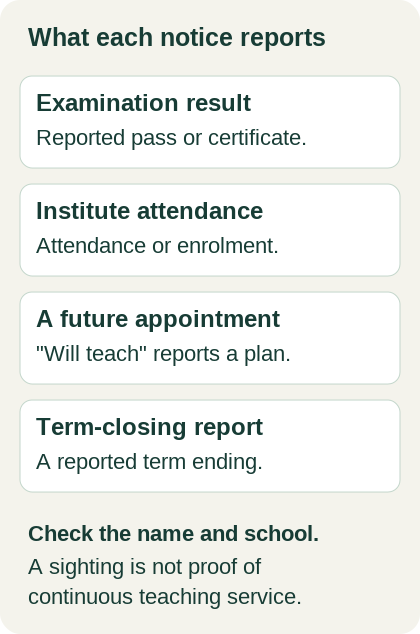
Items you may find include:
- Lists of applicants who passed a teachers' examination, sometimes with the grade of certificate.
- Reports of the county teachers' institute, a gathering for training, often with a list of those attending.
- Notices that a named teacher had been engaged for a particular school or district for the coming term.
- Items about a school's term opening or closing, sometimes with a list of pupils or an exhibition programme.
- Resignations, transfers, and obituaries noting years of teaching.
Not every paper printed all of these, and coverage varied from year to year. Read several issues around the school year to learn what your paper reported.
Check what examination and certificate notices establish
In many places, prospective teachers sat an examination, and those who passed received a certificate of a particular type or grade. The Wyoming and Colorado records described below show certificates with issue and expiration dates. Newspapers sometimes printed the names of those who passed, and occasionally their grades.
A newspaper list tells you that a person of that name was reported as passing or receiving a certificate on a particular occasion. It does not tell you that they then taught, or where. Some people sat the examination and never took a school. Others taught under an earlier certificate and do not appear in a given year's list.
The county superintendent's own records may hold more. The Wyoming State Archives describes the Carbon County superintendent's teachers' examination and certification ledgers, 1895 to 1934, as recording certificate number, type, issue and expiration dates and examination scores, arranged by surname, and notes that teachers' birth dates and assignments are not given. The Colorado State Archives describes historical teacher certificate lists for several counties, some giving name, date, certificate type and town of residence, and one giving age and nativity.
Read institute lists as attendance reports
Teachers' institutes were gatherings for lectures and training sessions. Look for reports that may name people attending or enrolled; the detail varies by paper and issue.
A transcription on the Tri-Counties Genealogy and History site of the Tioga County, Pennsylvania, section of the 1902 state superintendent's report shows the kind of activity a county superintendent reported: institutes, meetings, efforts to improve attendance, and the number of certificates issued during the year. The report names the institute instructors but not individual classroom teachers. A newspaper report is another possible place to look for names, but this transcription does not establish what the local newspaper actually printed.
An institute list tells you that a person of that name was reported as attending or enrolled. It is a good sign that they were teaching or intended to teach in that county that year, but it is not proof of a particular school.
Distinguish an appointment from a completed teaching term
Items reporting that a teacher "will teach" or "has been engaged" for a school are among the most useful, because they name a school or district. But they report an arrangement, usually before the term began. A later item about the term opening, a visit to the school, or a closing exhibition is better evidence that the teacher was actually there.
Read the dates carefully. A weekly paper's "Friday" or "last week" refers back from the issue date, and a term "closing" in March may have begun the previous autumn. Note both the issue date and the event date you calculate, and keep them separate.
School closing items sometimes list pupils with perfect attendance or those taking part in an exhibition. If your ancestor was a pupil rather than a teacher, these lists may help too, though our guide to finding ancestors in school newspapers covers student papers in more depth.
Follow women teachers through name changes
A marriage can change the name you need to search. A woman recorded as "Miss Whitcomb" may later appear under a married name. Do not treat a gap in school news as proof that she left teaching because she married. The sources used here do not establish marriage-related teaching rules for a particular school board; any such explanation needs local evidence.
A surname with "Miss" is not enough to identify a woman when sisters or cousins also taught. Look for a given name, a school, a home district or a parent's name in another item before attaching an item to your ancestor. "Mrs. John Dunning" in a later list is a courtesy name and does not by itself tell you which woman is meant. Our guide to marriage, birth and family announcements explains how to search for the marriage that may connect two names.
Teachers outside the United States
Teacher records and newspaper coverage exist in many other countries, though the systems differ. The State Library of Victoria's guide to researching teachers in Australia explains that registers of government school teachers were published in the Victoria Government Gazette every three years from 1885 to 1903, that the Education Gazette and Teachers' Aid from 1900 reported appointments, transfers, resignations and retirements, and that newspapers on Trove can give useful information on schools and teachers.
Library and Archives Canada's page on teachers says most older records relating to teachers are in provincial and territorial archives, with others held by school boards, education departments, universities, religious archives and local museums.
Whatever the country, the pattern is similar: an official record of qualification or appointment, and a newspaper that may report the same events with local detail.
Later notices that mention teaching
Teaching may also surface years later. An obituary or a golden wedding notice may say that someone "taught in the county schools for several years" or "was one of the early teachers at Elder Creek". A local history column may recall the first teachers of a district, and a former pupil's reminiscence may name a teacher remembered from childhood.
Treat these as leads written long after the fact. An obituary often depends on what the family remembered, and a phrase like "for several years" is rarely exact. Use the later notice to tell you where and roughly when to look, then search the papers of that time for the contemporary items described above. Our guide to finding obituaries and death notices explains how to read what an obituary claims.
If a later notice names a school you had not connected with your ancestor, add it to your list and search for it by name with teacher and term in the years before the notice.
Use newspaper clues to find official teaching records
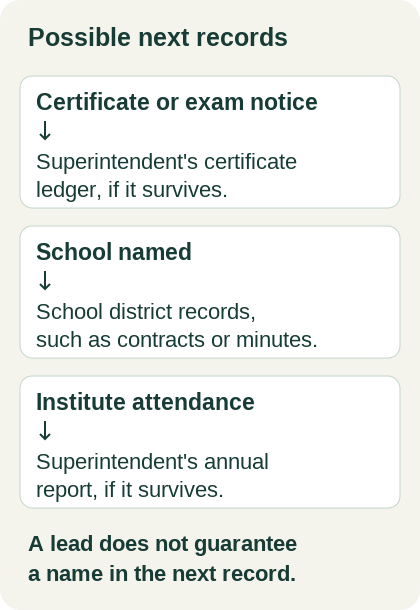
Use each newspaper item to target a record. An examination date points to a superintendent's certificate ledger for that year. A school name points to district records, which might include contracts, registers or minutes recording a teacher's hiring. An institute list points to the superintendent's annual report.
The Colorado State Archives notes that to find a record, a researcher must provide the county, school district name or number and approximate dates. It also lists county superintendent record books, which may include certificate renewals and teachers' names, and county superintendent annual reports from 1878 to 1958 with teacher information and salaries. Search your own state archives' catalogue for the county with "superintendent of schools", "teacher" or "certificate".
Barker's handout adds that school census records may include a list of teachers, and that grades may survive in teachers' ledgers.
What to try if you find no teacher notices
If you find nothing, check whether the county's papers survive for the years you need. Our guide to building a newspaper coverage map explains how. School news may have been printed in a correspondent's column for a small settlement rather than under a school heading, so browse those columns for the district where your ancestor lived.
Try the papers of neighbouring counties, since teachers often took schools away from home. Search without a given name, and with initials. Lists of examination results were often set in small type; our guide to searching when OCR gets names wrong explains how to read them from the page image.
Record each item and its kind
For each item, copy these fields into your notes:
- Newspaper title, issue date, page and column
- Item heading and name exactly as printed
- School or district
- Item type: examination, certificate, institute, appointment, opening, closing or resignation
- Event date as stated, or your calculated date with its reasoning
- What the item reports and what remains unproved
- The next official record to check
Keep interpretation separate: "Times, 6 September 1894: 'Miss Clara Whitcomb will teach the Elder Creek school the coming term.' Planned teaching appointment reported; actual teaching not established. Next: Venmore County superintendent records 1894 to 1897; Elder Creek district records." Our guide to verifying and preserving a newspaper discovery has a full checklist.
Save a dated notice and choose the next record
Save any promising notice with its issue date and what it actually reports. Use the school, district or examination date to identify the next official record to check, then note whether that record survives and how to access it.
Sources
- Melissa Barker: The ABC's and 123's of researching your ancestor's school records (handout, via SFBAJGS)
- Wyoming State Archives: Carbon County teachers' examination and certification ledgers, 1895 to 1934
- Colorado State Archives: School records
- Tri-Counties Genealogy and History: Tioga County section, Pennsylvania superintendent's report, 1902 (transcription)
- State Library of Victoria: Researching your ancestors' occupations, teachers
- Library and Archives Canada: Teachers
- Library of Congress: Tips for searching in Chronicling America