
School and campus research
How to find ancestors in historical school and college newspapers
A town paper and a student newspaper can preserve different glimpses of school life. Find the right publication first, search beyond a person’s name, and record exactly which issues you checked.

On this page
- Choose a school-years question and a date range
- Search the local paper and the student paper separately
- Identify the institution across names and locations
- Trace the newspaper title through its changes
- Search activities as well as names
- Read the complete page image
- Check identity with context and independent records
- Keep a coverage log, including gaps
- Look beyond a broad full-text archive
- Treat silence and celebratory notices carefully
- Try a short school-newspaper search
- What school and campus papers can add
- Sources and further reading
A school or college newspaper can put an ancestor into a particular place and moment. A notice about a debate, team, concert, club or graduation may add a date, an associate or an activity that does not appear in a census or directory. A local newspaper may cover the same event from the town’s point of view.
Begin with the person, then identify which publication covered the institution and when its title changed. Check which issues survive and whether a mention refers to your relative. Treat an item as a lead to other evidence.
Choose a school-years question and a date range
Start with a person you have already identified in other records. Write down the name they used at the time, their approximate age, the town or campus, and the years when they may have attended. A school newspaper search becomes much more manageable when you can explain why a particular person, place and period belong together.
Choose one question to investigate. Perhaps you want to learn whether a relative took part in a school activity, identify a college attended before a later move, or find out which name a student used in print. “What was my ancestor’s school life like?” is a good long-term aim. A narrower question gives you a way to judge whether each result is relevant.
Keep what you know separate from what you are testing. A family story that someone attended a college can suggest search terms, but it does not establish attendance. A record that places a person in the town can help set a sensible date range. Note both the source and the confidence level for each starting detail.
If you are still deciding which newspaper served the place, begin with our guide to finding the right newspaper for a family-history question. Search a school or campus publication alongside the town’s newspaper; each may have different coverage.
Search the local paper and the student paper separately
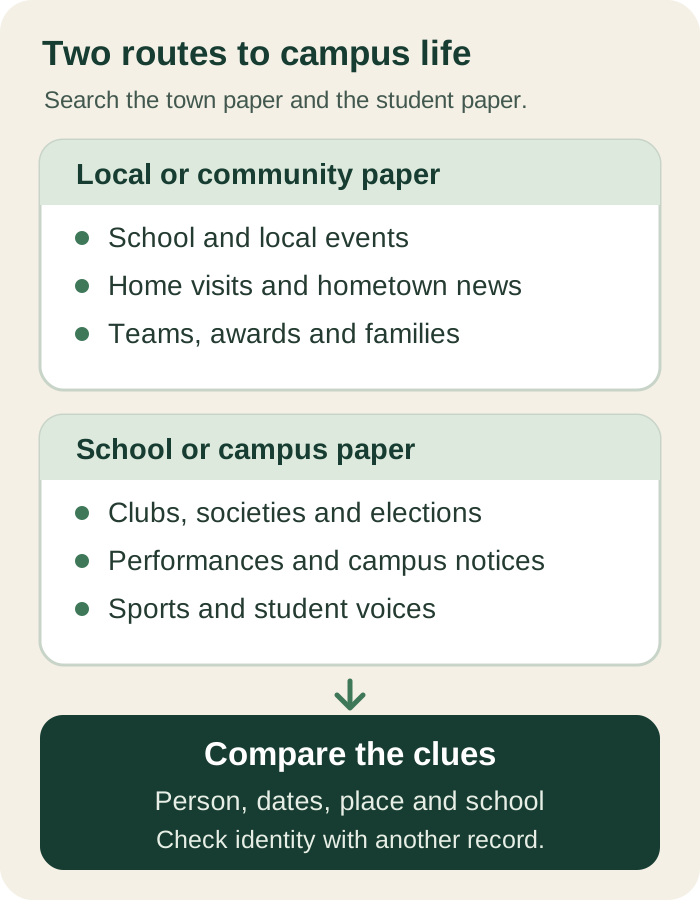
A town newspaper and a school or college newspaper may cover different parts of the same period. The local paper might report a school concert, a student’s visit home, a team’s trip, an award or a community event. A campus paper could carry club notices, student elections, performances, editorials, sports reports and campus announcements. Use these as possible search subjects. Coverage varied by publication.
Begin with the newspaper published nearest the school, then look for a publication produced by the institution or its students. Search the town paper even when you have found a campus title. It may name a student’s family or home community, while the student paper may use a campus organization or course that helps distinguish one person from another.
For a small school, there may not have been a separate student paper, or a surviving digital collection may not include it. A larger college might have several titles across a long period. In either case, search the institution’s library and archive catalog as well as broad newspaper databases. A result from one collection describes only the material that collection holds or indexes.
Identify the institution across names and locations
Before searching a campus paper, confirm what the school was called during the years you are researching. Institutions can change names, combine with another school, move, or operate a department under a name different from the one used later. A newspaper title may include an abbreviation or school name that is unfamiliar today.
Record the town and state, the dates when the institution used each name, and any predecessor or successor school that may matter. Search the exact name first, then try likely abbreviations and earlier names. If a person studied at a branch campus, training school or department, include that term in a separate search rather than assuming every item appeared under the main institution’s name.
A catalog record can help you distinguish the school’s name from the newspaper’s title. Check who published the paper, its place of publication and the date range attached to the record. If those details are missing or unclear, ask the archive or library that describes the collection. A search result that merely mentions a school is not enough to identify its newspaper.
Keep a note of the institution names you tried. That list is useful when you return to the search and helps prevent a familiar modern name from crowding out the name used in an ancestor’s time.
Trace the newspaper title through its changes
Student publications do not always keep one name for their entire history. A newspaper can change title, combine with another publication or be cataloged separately from its successors. Search by the title used during the years you need, and look for predecessor and successor titles before deciding that a run has ended.
The Library of Congress Directory of U.S. Newspapers search tips explain why title changes and place details matter when locating papers. Use its directory to discover titles associated with a location and period, then check the library’s catalog or archive description for the actual issues and access route. Search a title in quotation marks when you know its exact form; broaden the search when you do not.
A campus newspaper collection at the University of Iowa Archives is one example of a collection description that helps researchers follow student-paper titles and see which formats or dates are represented. Use its description as a prompt for what to look for in other catalogs, then check the dates and access routes for the institution you are researching.
When you find a likely title, write down its exact spelling and the years associated with it. Then search each known title along with the school name and town. If one title has a gap, check whether another publication took its place or whether the archive holds a separate run.
Search activities as well as names
Names are a natural starting point, but they can be hard for a search engine to read. A student may appear by initials, nickname, middle name, surname only or a spelling variation. Some OCR systems also mistake letters, punctuation and columns. Search a name in several forms, but do not make every search depend on it.
Try the institution name with a year, department, residence hall, club, society, sport, performance or event. Search words tied to the question you chose. For example, a question about a relative’s musical activity might suggest an orchestra, recital, chorus, instrument or concert. A question about a team might suggest the sport, a tournament, a score, a coach or a school rival. Use terms that fit the period and the paper’s own vocabulary.
Look at the publication itself to learn its section names. An item may be under campus notes, student life, athletics, alumni, class news or a local heading that is not obvious from the text. Headings and terminology can change, so inspect issues from more than one year when you can.
Try several searches with one variable changed at a time. Keep the exact phrase, date range and collection in your notes. That makes it easier to see whether a new search found a distinct result or simply returned the same issue again.
Read the complete page image
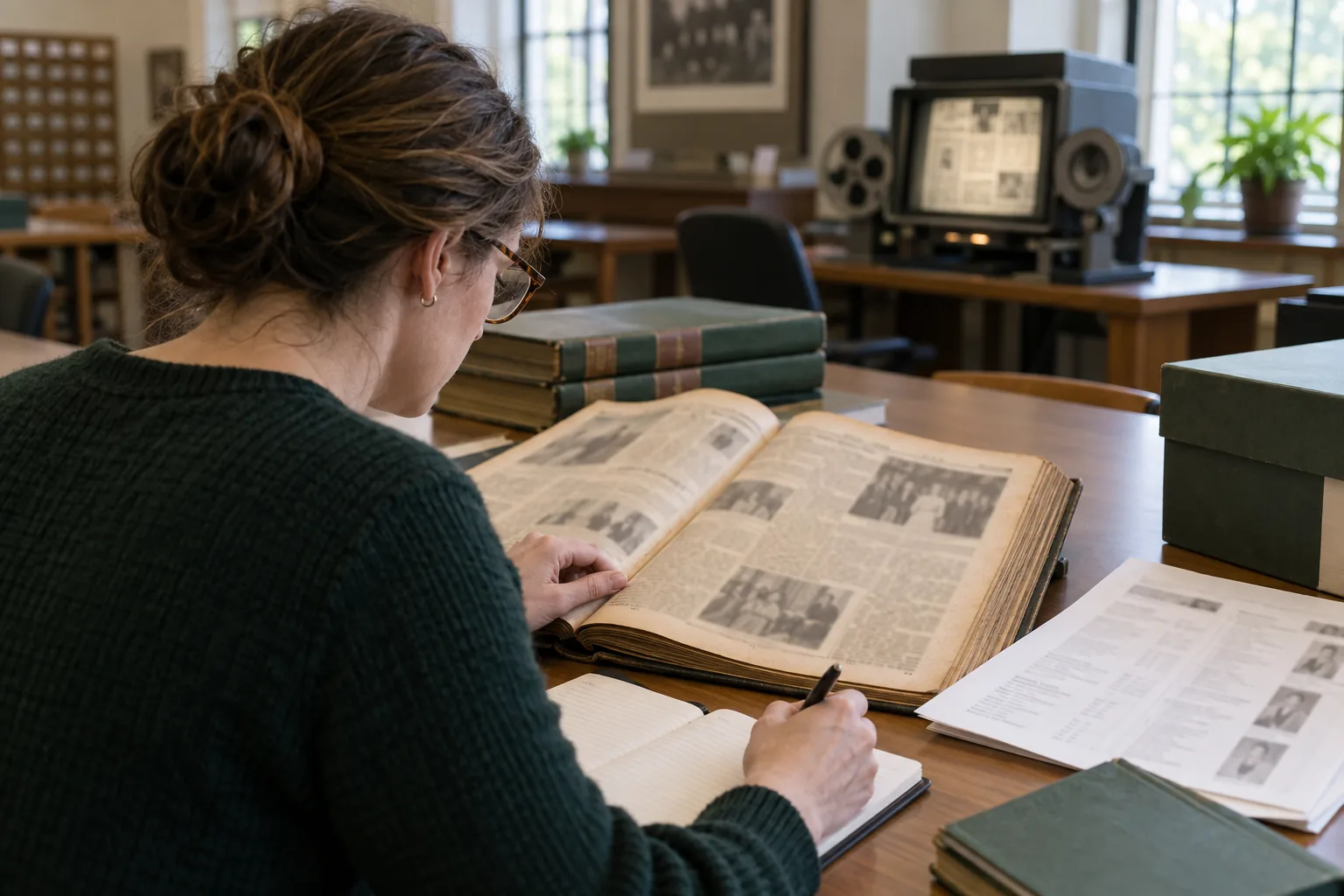
A text-search result points you to a page. Open the page image and read the surrounding text. The lines above or below may identify a class, club, town, relative or event that changes how you interpret a name. The page layout can also reveal a heading or caption omitted from the search result.
The Library of Congress explains that searchable text in digitized newspapers is produced with optical character recognition and can contain errors. Its Chronicling America technical information describes OCR as useful but imperfect. If a name search fails, try a variant, search a distinctive phrase, or browse likely issues and pages. Our guide to searching newspapers when OCR gets names wrong covers those techniques in more detail.
Do not assume that a page absent from a full-text result is absent from the issue. A poor scan, unusual type, a folded or damaged page, or narrow columns can interfere with recognition. Conversely, a text result can combine lines from different columns. Use the image to confirm the wording and identify the item’s page and date.
Save a citation while the page is open. Record the newspaper title, issue date, page number, column or section if visible, collection name and stable link or call number. That makes the finding easier to revisit and gives another researcher enough information to check it.
Check identity with context and independent records
A matching name can belong to another student. Before assigning an item to your ancestor, compare the person’s location, dates, school, family connections and other known details. A short notice that says “J. Miller won the debate” may be interesting, but it does not identify which J. Miller without more context.
Look for clues that can be tested elsewhere: a town of residence, a relative’s name, an organization, a class year, a later occupation or a specific event. Then check an independent record that can support the connection. Depending on what you are trying to establish, that might be a school catalog, a directory, a yearbook, a graduation program, a family record or another newspaper item with more identifying detail. Each has its own limits, so be clear about exactly what it confirms.
Watch for contradictions as well as matches. If the item places the student in a different state at the same time, or identifies a different family, do not set that aside just because the name is right. It may belong to someone else, or the date range you began with may need to be reconsidered.
Separate transcription from interpretation in your notes. Quote or transcribe only what the page actually says, then add a separate sentence explaining why you think it may refer to your relative. Mark uncertain connections as uncertain. This small habit makes it easier to revise a conclusion when a new record appears.
Keep a coverage log, including gaps
A search log should show the publications and issues you checked, not just the words you typed. Record each title, where it was published, the relevant date span, the repository or website, the issue dates you searched, and any missing dates. Note whether you searched text, browsed page images, or used a catalog record to locate a physical copy.
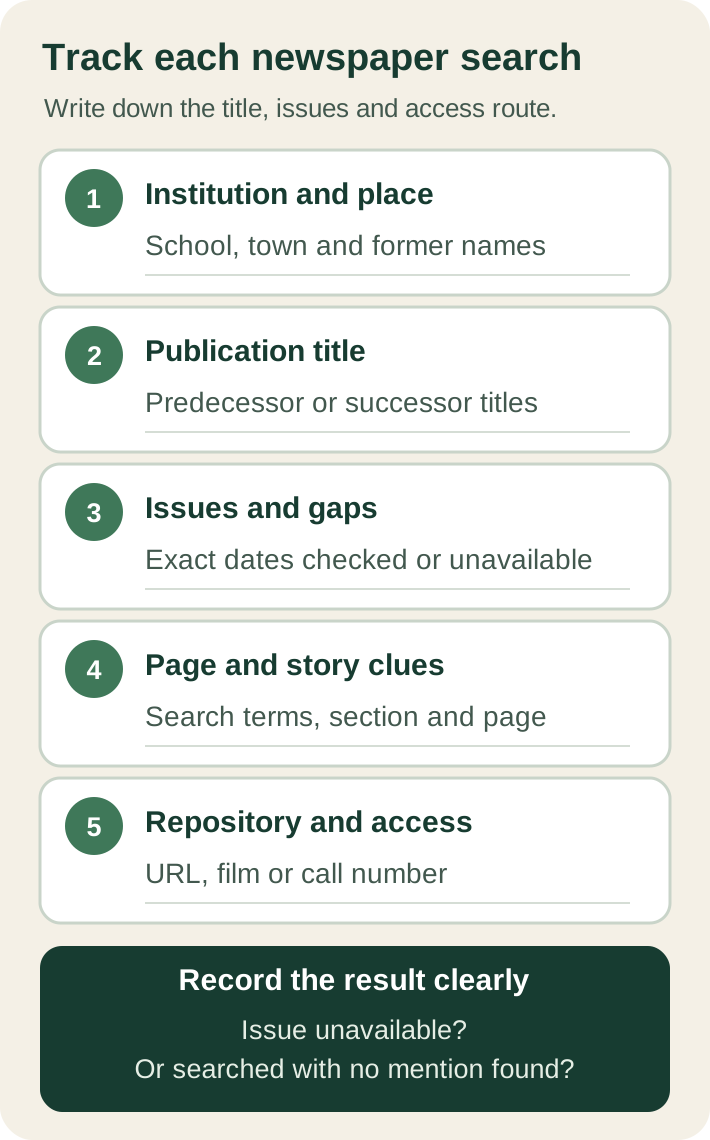
Use separate notes for three different outcomes: an issue was available and searched but no relevant item appeared; an issue could not be found in the collection; or a search returned a result that still needs identity checking. These outcomes do not mean the same thing. A missing date is a gap in the surviving or accessible run, not evidence that a person had no school activity.
The newspaper coverage map can help you track which titles cover a town and period. Extend that idea to campus publications by adding the institution, alternate titles and the issue dates you actually reviewed. Keep a copy of your search terms and links with the log so you can resume without repeating work.
Look beyond a broad full-text archive
A broad newspaper site may include only selected titles and issues. The Library of Congress advises that newspapers survive in print, microfilm and digital formats, and that not every U.S. paper is digitized or held by the Library. Its guide to finding a newspaper recommends using the U.S. newspaper directory when you know the place and period but not the title, then checking catalog records and holdings.
For a college paper, search the college library, special collections, archives and student newspaper archive pages directly. For a public or secondary school, try the local library, school district archive, historical society or state library. Ask whether a cataloged title has successor titles, what dates are actually available, and whether copies are digital, on microfilm or restricted to in-person use.
A catalog entry describes a collection. Check which issues are online, which require a visit, and which have access restrictions before planning a search. If a collection has no searchable text, an archivist may be able to tell you whether a finding aid, index, microfilm reader or reading-room copy can help.
Treat silence and celebratory notices carefully
A newspaper can show that a person was mentioned in a particular context. It cannot, on its own, give a complete picture of school attendance or explain everything a student did. Some events were not reported, some students received little individual coverage, and some issues may not survive. The paper’s editorial interests and the person’s social position can affect what appears in print.
A name missing from a digitized search has several possible explanations: the issue may not have survived, may not be online, may not be indexed, or the text may have been recognized poorly. The person may also simply not have been mentioned. A failed search alone cannot establish that a person was absent. Record the issue and terms you tested.
Celebratory reports deserve the same care. A sports result or honor may be reliable for the event described, but it may not establish a full name, family relationship or continuous attendance. Look for the paper’s source and wording, and check a consequential claim against records that answer that specific question.
Good research leaves room for uncertainty. It is useful to say “I found a notice that may refer to this person” while you look for another identifier. A careful lead is more valuable than a confident conclusion built on a shared name alone.
Try a short school-newspaper search
Choose one relative and write down a school, town and five-year date window that you can support from existing records. State a focused question, such as whether the person participated in a named activity during those years. List the names the person might have used and any relevant club, sport, department or event terms.
Find one likely local newspaper and one school or campus title. If you do not know the title, use the Library of Congress directory or the institution’s library catalog to identify candidates. Record the title and dates before opening the search interface. If a title changes, add its predecessor or successor as a separate entry.
Search the person’s name and two activity terms. Open any promising page image, read the complete item, and note the issue date and page. Then look for one independent record that could confirm the identity clue, such as the town, class year, organization or family connection. If no result appears, record which issues you checked and whether the relevant dates were available.
Finish by writing two short statements: what the newspaper actually says, and what you think it may mean for your ancestor. If those statements are nearly identical, add the missing verification step. If they are different, keep both visible in your notes. That is a practical way to turn a search result into a research question without overstating the evidence.
What school and campus papers can add
School and college newspapers can add texture to a family history and point toward people, places, activities and records worth investigating. Their value depends on identifying the right publication, understanding what survives and checking that the person in print is the person in your family tree.
Use the town paper and the student paper as related sources, not interchangeable ones. Keep an issue log, read page images where possible, and leave unanswered questions open. The strongest result may be a small, well-cited clue that sends you to the next record.
Sources and further reading
- Library of Congress, Directory of U.S. Newspapers search tips
- Library of Congress, How to find a U.S. newspaper
- Library of Congress, Chronicling America technical information
- University of Iowa Archives, Newspapers Collection