
Religious newspaper research
How to find ancestors in historical religious newspapers
A church newspaper can connect a name to a congregation, event or community without proving membership. Find the right title and issue first, then compare its exact wording with records made for another purpose.

On this page
- Begin with a place, period and possible community tie
- Match a paper's audience to the question
- Trace title changes before searching a surname
- Verify the issue rather than trusting a date range
- Look for the local life inside a denominational paper
- Read family notices for what they actually say
- Search the text, then inspect the page
- Test a church-paper mention against other records
- Preserve the title trail and the exact finding
- Try one focused religious-paper search this week
- Common questions about religious newspaper searches
- Sources and further reading
A relative may be named in a church paper even when the town's general newspaper never mentions them. A correspondent might report a congregation's anniversary, a reader might send an address change, or an event notice might name a host. Such items can point toward a place, an associate or a useful record. They do not automatically tell you which church a person joined.
The difficult part is often not the name search. It is working out which paper served a particular community, what it was called at the time, whether the issue survives, and whether the available copy can actually be searched. This guide concentrates on those problems. If you need the broader process of identifying a town's newspapers, use our guide to finding the right newspaper; here we follow a religious title through its publication history and surviving issues.
Begin with a place, period and possible community tie
Choose one ancestor whom another record places in a town during a limited period. A dated address, marriage record, family letter or church register might provide that starting point. Write down exactly what the record establishes. A street address does not establish a congregation, while a baptism entry can identify a religious setting for that event without proving lifelong affiliation.
Now pose a narrow question: “Did a paper serving this community report the congregation's move while my relative lived nearby?” or “Does a dated church report name this person in a role that another record can confirm?” If the congregation is not yet known, start with the documented neighborhood and a candidate title, not a presumed denomination. Keep “possible church connection” in a separate column from confirmed facts.
A surname appearing in a denomination's paper is not, by itself, evidence that the person belonged to that denomination. Someone could be a visitor, donor, contractor, relative of a member, subject of a reprinted story or simply another person with the same name. A mention is worth pursuing precisely because the relationship is still open to testing.
Avoid applying a family's later affiliation backward. A descendant's account that “we were always Methodist” is a clue to investigate, not a substitute for locating a particular congregation and date. Likewise, a building labeled as a church on a map may help establish a search area, but it does not place your ancestor inside it. Begin with what can be dated.
Match a paper's audience to the question
“Religious newspaper” covers publications with different publishers and reach. A local congregation's bulletin, a regional denominational weekly and a broadly circulated religious newspaper are not interchangeable. For each candidate, ask who issued it, where it was published and which communities it actually reported. Publication city, event location and a named person's residence may all differ.
Read the masthead or an institutional description rather than deciding the audience from the title alone. Notre Dame's introduction to its Catholic newspapers in microform describes a directory that is primarily of English-language Catholic newspapers but also includes publications in several other languages, along with a few non-newspaper works. Its scope is a useful reminder to check the form and language of a listed item instead of assuming every entry is the same sort of paper.
For a U.S. ancestor, try the documented town and nearby congregations first, then widen to a diocesan, state or regional paper if its coverage makes that plausible. In another country, look for the corresponding local or regional repository and the actual publication history before transferring any U.S. pattern. A title printed far from the household may still carry news sent by a local correspondent, but the possibility needs to be tested in issues, not assumed from a catalog label.
If you do not know the religious connection, a paper can still be worth checking when another record names a school, charity, employer, meeting venue or associate linked to it. Search the named institution before searching every denomination in the area. The aim is not to build a list of all church papers; it is to find one whose audience and time frame fit your question.
Trace title changes before searching a surname
A paper may continue under another name, merge with another title, change its publishing place, or issue a special edition. An archive search that covers only today's title can miss the years you need. Record the name printed on an issue, not just the modern collection heading, and write down the “continues” and “continued by” relationships in a catalog record.
Samford University Library's historical *Alabama Baptist* collection names several successive or variant titles, including *Alabama Baptist Advocate* and *South Western Baptist*, with date ranges for those names. It also describes the paper as carrying denominational as well as cultural and social news. This is a documented example of why a researcher should follow title history, not a model for the editorial content or title sequence of other denominations' papers.
If your target year falls near a reported name change, inspect the issue list on both sides of it. Note whether a catalog describes a true continuation, a merger or a separate paper with a similar name. Two titles called “Catholic Herald,” for example, need not be one publication. Notre Dame's directory explicitly distinguishes identically named papers by place or date and supplies fields for publication history, frequency, continuation notes and holdings. Use those fields to disambiguate before opening a search result.
Keep a compact title trail in your notes: exact title, publishing place, years reported, predecessor or successor, repository, and the years you actually need. Do not let an apparently continuous publication history become an assertion that every issue was preserved.
Verify the issue rather than trusting a date range
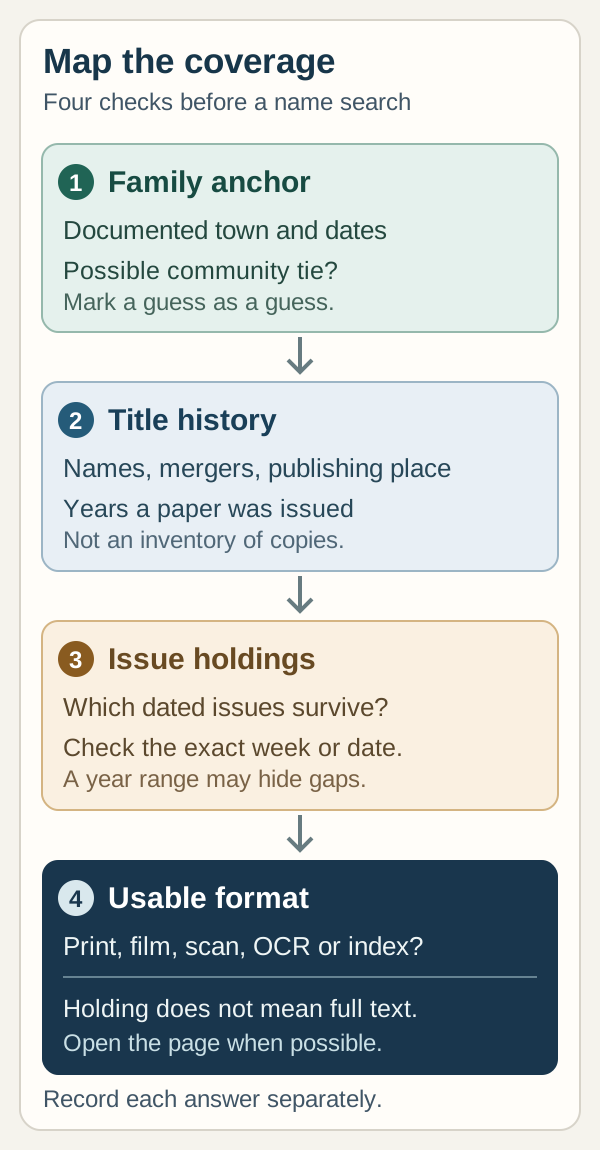
A title's first and last publication years answer one question: when the newspaper may have existed. A repository's holdings answer another: what copies it reports having. A digital collection answers a third: which pages it currently makes inspectable online. None of these alone says the exact issue and page you need is available as searchable full text.
Notre Dame's microform directory introduction makes the distinction unusually clear. It says its summary holdings use a year range to mean at least one issue held in each included year; the detailed holdings provide more precise volume, issue and date information. Its directory describes microfilm holdings, not an online corpus of newspaper page images. An older “currently received” statement or borrowing instruction on that historical introduction should not be treated as current service policy; ask the library about access now.
Samford's browse-by-year collection offers a different route: individual issues are listed online and described as keyword searchable, while the library warns that search results depend on the condition of the originals and microfilm. Its index is described as partial. On a live 1900 issue listing, dates appear individually, so you can check the target week rather than infer it from the year label. A missing date on one page is a question for the repository, not proof the paper did not appear that week.
Make a four-column note: title run, reported repository holdings, exact issue dates inspected, and usable format. Possible formats include print, microfilm, scanned page images, an OCR text layer or an index entry. Write “1900 year page located” differently from “April issue opened and read.” If a catalog says “1890 to 1910” but the specific issue has not been confirmed, mark its status as unknown. Our newspaper coverage map guide offers a fuller way to track gaps across repositories.
Ask a repository for the precise date or volume and issue, not merely “Do you have this newspaper?” A librarian may be able to identify another holding or explain how to request a readable copy. Access and reproduction rules can change, so check the current catalog or contact page rather than relying on an old directory's address or loan terms.
Look for the local life inside a denominational paper
Once you have an issue, do not read only the lead editorial or the headline about national church affairs. Browse for reports from named congregations and places. A local correspondent's note may identify an event's organizers, visiting speakers, a building committee, pupils, delegates or a person thanked for a specific contribution. The exact sections and wording vary by paper and year. Learn the layout from the issues in front of you.
Search a documented congregation name and its town, then try a street, school, mission, charity or associated surname. An event notice can tell you that an occasion was planned; a subsequent report may say what occurred. Keep those claims separate. A program listing all expected performers is not necessarily a record of who attended. A fundraising appeal may name recipients or officers rather than donors. Read the whole item and the heading that places it geographically.
Religious publications may also carry material from beyond one congregation. If you see a familiar name in a neighboring town's report, ask what connected that contributor and place to your household. A visiting relative or minister may travel across the paper's coverage area. The publication's circulation area is not a residence record for everyone mentioned in it.
A useful working note is “This issue reports X at Y on date Z,” followed by a separate “Possible connection to my relative.” That phrasing leaves room for a later correction. It also helps when a long piece blends a correspondent's observations, a forwarded letter and a reprint from another paper. Do not treat every sentence on a page as an independent eyewitness statement.
Read family notices for what they actually say
A death notice, marriage report or anniversary item in a religious paper can offer family names, an institution, a place and a date. The same item may have been supplied by a family member or copied from elsewhere. Before adding relatives to a tree, mark whose relationship is explicitly stated and to whom. “Sister” might appear in a church context as well as a kinship context; read the complete sentence rather than extracting a single label.
This guide is about finding a likely religious title and evaluating its community context, not a substitute for our guides to obituaries and death notices or marriage, birth and family notices. Use those when you need to untangle the form of an announcement. Here, also ask why it appeared in this particular paper. Was it submitted by a congregation, sent by a reader, or reprinted? If the source of the notice is unclear, leave it unclear.
A name in a list of memorial gifts might identify a donor, honoree or recipient. A notice mentioning “Mrs. Reed of Oak Street” might be promising if your records place a Reed household there, but it does not supply a given name. Do not upgrade that ambiguity into a certain identification because the denomination seems to fit the family story.
If you find a family notice, inspect neighboring issues. A later correction, follow-up report or fuller notice might alter the reading. The absence of a notice from the issues you can inspect is not evidence that no event occurred. Some issues may be lost, other publications may have reported it, and no one may have sent a notice.
Search the text, then inspect the page
Start with a few documented names: full name, initials, a known married name and a congregation or town. Try one variant at a time. Search for the institution even when the surname fails, because it may lead to the relevant issue. Keep guessed spellings labeled as guesses, especially when the scan or type is difficult to read.
An index, OCR result and page image are different kinds of access. OCR can misread a narrow newspaper column or a damaged frame; an index may cover only selected people or subjects. Samford explicitly warns that condition of the source and microfilm affects its searchable issues. A zero-result search does not establish that the person is absent from a readable page.
Open the issue and read its masthead, date, page, section header and adjoining text. If the hit is on a page with many short reports, check where one item ends and the next begins. Follow any continuation onto another page. Transcribe the printed name from the image, not the search snippet. Where a letter is genuinely unclear, preserve the uncertainty instead of completing it to fit the person you hope to find.
When there is no full-text search, choose a small run of issues around the dated event and browse. A weekly paper may report an event after it happened, and an undated family recollection may require a wider window. Note both the event date and publication date; do not silently make them identical. For more methods when text search fails, see our guide to OCR and page images.
Test a church-paper mention against other records
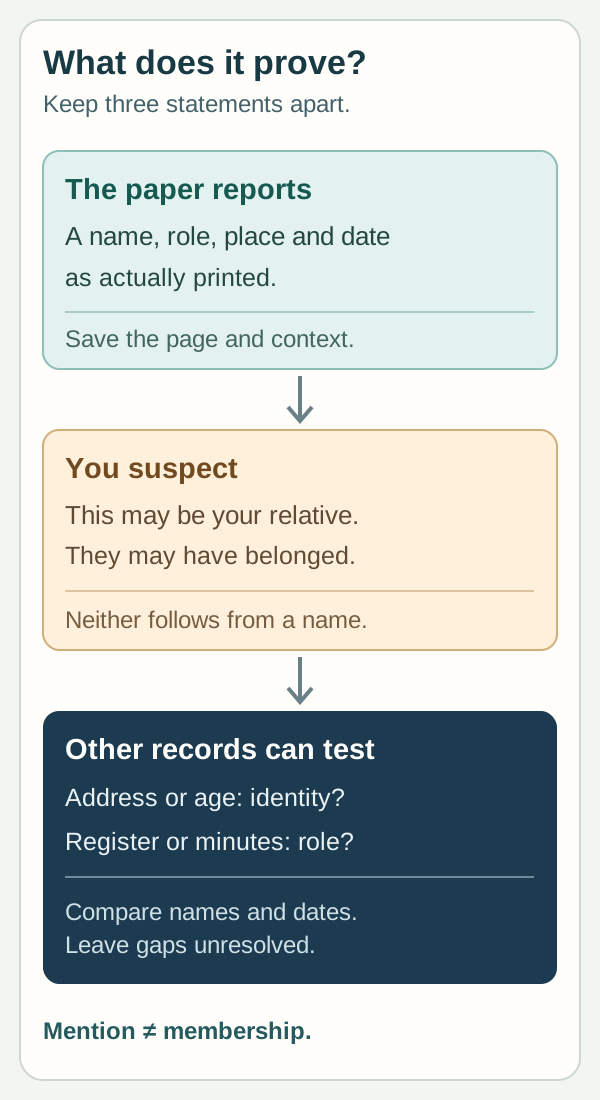
Write a literal summary first: “The paper names A in a report about B.” Then list what it does not establish. Being named as a speaker does not establish membership in the host congregation. A marriage announcement printed in a denominational paper does not, by itself, establish the couple's religious practice. A donation or address change may reflect a business or subscription relationship rather than a worshipping one.
Test the narrowest claim that matters. A church register may identify a person who took part in a rite, if you can establish that the register refers to the same person. A dated city directory might help distinguish two people with the same name by address or occupation. A congregation's minute book, where available, may be better suited to a question about formal membership. None of these records automatically answers every part of the question; compare dates, names, places and the purpose for which each was created.
Suppose a paper says “A. Morgan assisted at the chapel concert.” This hypothetical sentence identifies neither a given name nor a membership status. A separate record placing your A. Morgan in that neighborhood could make the match more plausible, but another person of the same name remains possible. The next useful question is which contemporary record could distinguish them, not how to make the newspaper wording stronger.
If another newspaper repeats the item verbatim, trace whether it credits or copies the first. Two printings of one correspondent's account are not two independent confirmations. If a later item changes a name or location, keep both versions and their issue dates rather than editing the earlier transcription.
Preserve the title trail and the exact finding
For a promising item, record the exact title as printed, publication place, issue date, edition if present, page and column or article heading, repository, format, stable link or call number, and the date you accessed it. Save a page image where the repository permits and keep enough surrounding material to see the context. If you used microfilm, record the reel identifier and frame or issue details available to you.
Keep a separate search log for title variants, years inspected and failed searches. “No result in the searchable index” is not the same as “read every available issue and found no mention.” Likewise, “the library reports microfilm for this year” is not the same as “I inspected the target page.” Distinguishing those outcomes will save you from repeating a search or claiming more than the evidence allows.
When you write up a conclusion, quote or accurately summarize the item's wording, explain which identifying details agree with separate records, and name any unresolved alternatives. Our guide to verifying and preserving newspaper evidence has a fuller citation checklist. If a collection page changes or a scan is replaced, your record of the title, date, page and holding institution still gives you a way back.
Try one focused religious-paper search this week
Choose a relative with a documented town and a two- or three-year window. Write one question about a possible congregation, school, charity or event, and label the connection provisional unless you already have a record for it. Find one candidate religious newspaper whose stated audience might fit that place. Record its exact title and any earlier or later names relevant to your window.
Check the reported holdings for one year inside your window. Can you identify an actual issue date, or only a range of years in a catalog? Note whether the usable copy is print, microfilm, a page image or searchable text. If an issue is accessible, search one documented name form and one institution or place term, then browse at least one whole page or one issue section even if the search returns nothing.
End with two sentences in your log: “The paper actually says…” and “To test whether this concerns my relative, I need…” Fill in the first only if you found an item; otherwise record the precise gap or unsuccessful search. Your result may be a promising mention, a confirmed issue holding, or a clear request to send a librarian. Each is more useful than an unsupported claim of membership.
Common questions about religious newspaper searches
Does an appearance in a church paper prove my ancestor was a member?
No. Identify the role the item actually names, such as visitor, speaker, contributor or participant, and compare it with a register or other independent record suited to your membership question. A paper's audience does not make every named person an adherent.
How can I tell whether a library has the issue I need?
Check detailed holdings or an issue-by-issue browse page, not just publication years or a summary holdings range. Ask the repository about the precise date when the online list is unclear. Confirm the format separately; a microfilm holding is not automatically an online page or full-text index.
What if the surname search returns nothing?
Try a recorded variant, the congregation, a place or a dated event, then inspect likely issues if page images or microfilm are available. Record whether the exact issue was missing, present but unsearched, or read without a match. Those are different findings.
Sources and further reading
- University of Notre Dame Archives, *Catholic Newspapers in Microform*: introduction and holdings explanation
- Samford University Library, historical issues of *The Alabama Baptist* and variant titles
- Samford University Library, 1900 issues of *The Alabama Baptist*