
Black press research
How to find ancestors in historic Black newspapers
A historical Black newspaper can open a route into the community around an ancestor and add leads to a name search. Start with the person, place and period, identify likely titles, then check what each surviving issue actually says.

On this page
- Begin with a person, place and date window
- Why add the Black press to a newspaper search
- Identify titles that served the place and period
- Follow titles through databases, libraries and archives
- Search more than one name and one kind of phrase
- Browse page images when text search stalls
- Interpret the item in the newspaper’s own context
- Verify the person, not just the name
- Keep a clear note for every issue you inspect
- Try a focused research exercise this week
- Know what a missing result can and cannot mean
- Sources and further reading
A name in a newspaper can feel like a family discovery, especially after a long search. The same name may belong to someone else, or a short item may leave out the detail that connects it to your family. Treat the first mention as a lead while you check the context.
Researching the Black press adds another useful question: which newspaper served the community, institution or city where your relative lived? African American newspapers have their own histories, title changes, coverage gaps and access routes. Finding the right title and issue is a separate task from deciding what a mention proves.
This guide shows how to build that search from a known person and place, use newspaper directories and digital collections, and preserve a careful record of what you find. It is about historical research, not locating or profiling living people.
Begin with a person, place and date window
Choose someone you have already placed in a particular community through another record. Write down the name they used at that time, the place, an approximate date range, and one event or question you want to investigate. A census entry, city directory, church record, school record or family document may help you set the boundaries. Keep each starting fact tied to its source.
A useful question is specific enough to guide a search: did a relative appear in a community announcement, work for a named business, take part in a local organization, or move between two cities? “Find everything about my great-grandfather” is too broad for one newspaper search. A smaller question helps you decide which titles and dates deserve attention.
Do not begin by assuming that the newspaper you have already searched was the only paper that mattered. A city could have more than one publication, serving different readers or covering different places and institutions. The nearest general newspaper may be a candidate, but it is not automatically the best one for every question.
If you are still identifying titles for a place and period, start with our guide to finding the newspaper that covered your ancestor’s town. Keep a newspaper coverage map as you go, so a missing issue is not mistaken for a search failure.
Why add the Black press to a newspaper search
The Library of Congress’s research guide describes African American newspapers as part of the Black Press and points to their value for studying African American social and cultural history. Its introduction traces the start of *Freedom’s Journal* in New York City to 1827. That history is a reminder that a family search should not be limited to the titles most familiar from a general newspaper database.
A newspaper published for or by a particular community may cover people, institutions and events differently from another title. Coverage varied by publication, so consider its audience and local relationships when choosing which paper to search.
Use “Black press,” “African American newspaper” and a known publication name as search terms. These are modern research descriptors, so avoid assigning them to every person or paper in an earlier period. Catalogues and mastheads may use language that is offensive today. Quote it only when necessary to identify a source, and make clear that the wording belongs to the source.
It can help to search both a community newspaper and other local or regional titles. They may supply different accounts of the same event. Compare the source, date and wording rather than assuming that one publication is complete or that a second report is independent confirmation.
Identify titles that served the place and period
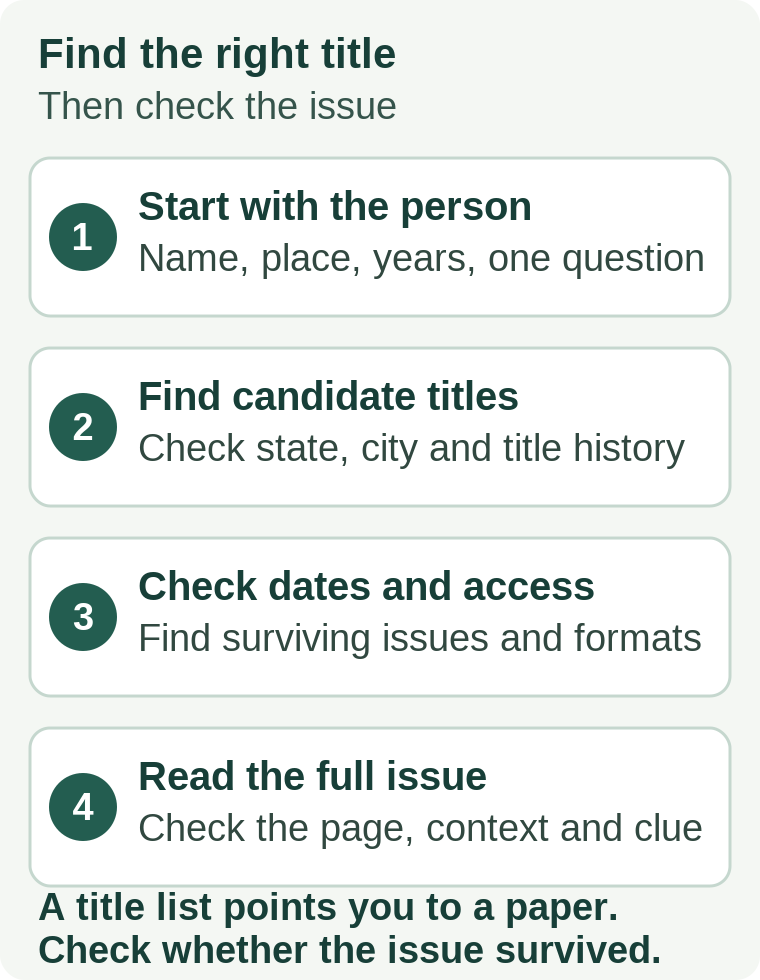
Start with the community’s historical name, county and state, then identify newspapers published there during the years you need. The Library of Congress’s African American Newspapers guide includes a state-by-state newspaper holdings and digital-access list. Its entries can help you find titles associated with a place and check whether a repository reports print, microfilm, database or free online access.
A directory gives you leads; verify the exact issue with the repository. Read the notes beside each title. “Scattered” holdings indicate gaps within a date span, and a listed date range does not prove that a particular week or page survives. Some formats and subscription resources may only be available in person at the holding library. The Library’s page also notes that microfilm may be available through interlibrary loan, but availability and conditions depend on the holding institution.
Check the title’s place of publication, start and end dates, frequency and any title-history notes. Look for predecessors, successors or variant titles. A paper may change its name or be listed under a form you would not guess from a family story. Search the title and location, not only the person’s name.
If the person lived outside a city, widen the map thoughtfully. A county seat, nearby town or regional center may have carried reports about the community. Use known addresses, workplaces, places of worship, schools and organizations to decide which additional places are plausible. Do not add every nearby paper without a reason; write down why each candidate might have covered the event.
Follow titles through databases, libraries and archives
After you have candidate titles, check where the issues can actually be consulted. The Library of Congress guide distinguishes its holdings and on-site database access from freely available digital issues, and links out to online material when known. Follow the title link and inspect the date notes rather than relying on a broad search result or a collection landing page.
For titles digitized in Chronicling America, the Library of Congress’s search guidance describes filters for location, date and ethnicity, alongside other search options. Interface details can change, so use the current help page if a control has moved. A filter can narrow the collection you are searching; it cannot show whether another archive or a local institution holds additional issues.
The Library of Congress also maintains a page of related African American newspaper resources, including subscription databases, free online resources, other research guides, libraries and related collections. Those lists are starting points. Open each repository’s own description to check title, dates, format, rights and access before planning a visit or making a payment.
A public library, university archive, historical society or state library may hold a title that is not freely digitized. Ask using the exact newspaper name, place and date range. If the catalogue shows microfilm or print, ask what a visitor needs to use it and whether remote or interlibrary access is possible. Our free and library newspaper access guide explains how to check those routes before paying for a personal subscription.
One example of a specialized resource is the New York Public Library’s African American Newspapers: The 19th Century, which describes a searchable full-text database of nineteenth-century African American newspapers. A database’s description does not establish that it has the title, date or access option you need. Check its current terms and ask your library which resources are available to you.
For ads placed by people searching for relatives separated by slavery, see our guide to information wanted ads for a careful search and evidence-checking method.
Search more than one name and one kind of phrase
Once a likely title is identified, make a short list of name forms. Try a full name, initials, middle name, maiden or married name when relevant, common spelling variations and names used by close relatives. A person might appear under a nickname or surname alone. A family story can suggest a form to search, but it does not prove that the person used it in print.
Search the place and time alongside the name. Add an occupation, business, congregation, school, club, lodge, public event or organization if it fits your documented question. A distinctive address or event phrase may be easier to find than a common surname. Change one search term at a time and record which title, dates and collection you used.
Historical newspapers may be difficult to search because printed type, page damage, multiple columns and scanning can affect text recognition. The Library of Congress’s Chronicling America tips show examples of OCR errors and describe narrowing searches by location and date. Search results are pointers to pages, not reliable transcriptions. Our guide to searching newspaper OCR and page images has more ways to work around missed names.
If a search interface provides an ethnicity or publication-type filter, treat it as one way to narrow that specific collection. Do not assume every Black newspaper has been tagged consistently, or that a filter searches material outside the collection. Search the title directly, too, and use the repository’s catalog when a title is not indexed in full text.
Browse page images when text search stalls
A zero-result search only means the system found no match for the terms and collection you tried. The issue might be absent, not digitized, missing from a run, indexed under another title, or present in an image whose text was not read correctly.
When dates and a title are known, browse issues around the event rather than repeating the same exact-name query. Check the masthead, page headings and neighboring columns. A brief item may be grouped under community notes, church news, school reports, business notices, society items or another local heading. Labels and page order varied by newspaper and period, so use the issue itself to learn where its material appears.
Look at the full page image before transcribing a result. OCR can merge columns, drop punctuation, or mistake one name for another. Record what the page visibly says, including uncertainty where the scan is unclear. If a word is illegible, mark it as such instead of filling it in from memory.
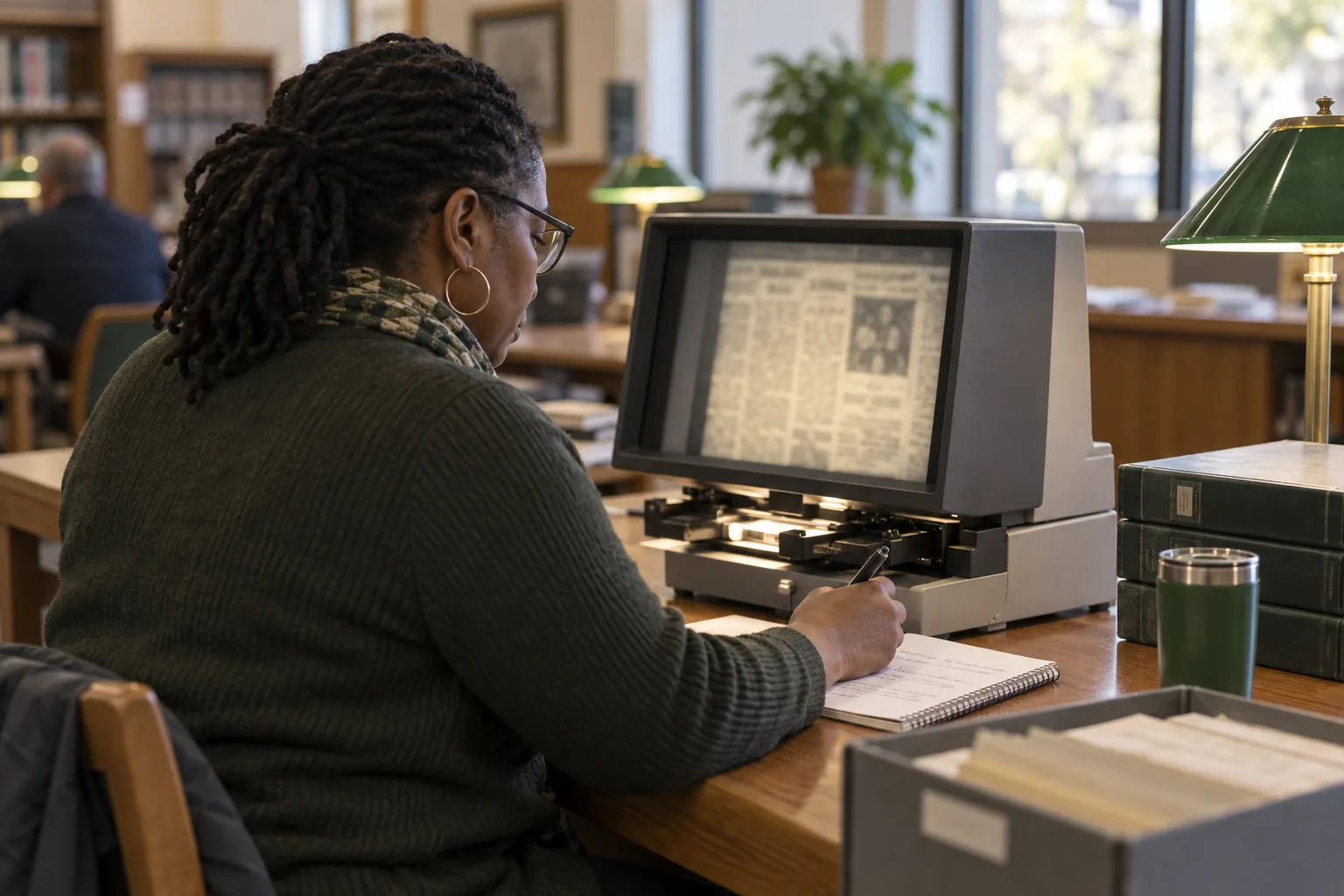
Keep the image or stable page link together with its title, date and page number. If you download or share a scan, follow the repository’s terms and rights guidance. A digital copy being viewable does not by itself mean it can be republished elsewhere.
Interpret the item in the newspaper’s own context
Read the complete notice or article and enough surrounding material to understand why it appeared. Is it a news report, an announcement submitted by a family, a reprinted story, an advertisement, a letter, an editorial or a brief community note? The source type affects what the wording can support. An advertisement may name a business owner, for example, while a paid notice may reflect what a family or organization chose to announce.
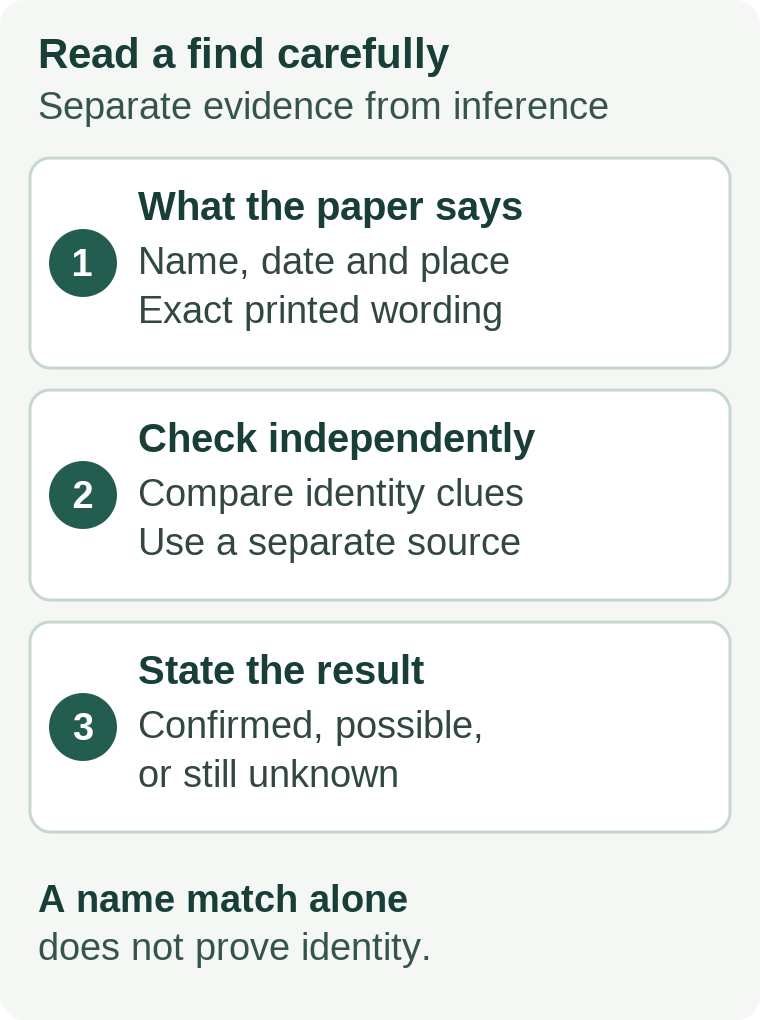
Keep the newspaper’s words apart from your interpretation. A report that names “M. Johnson” at a meeting shows that the paper printed that name in connection with the meeting. The item alone cannot identify which M. Johnson attended, establish a family relationship or verify every reported detail. Ask who may have supplied the information and whether another source repeats it.
Be attentive to the conditions under which the item was published. A newspaper could have its own editorial position, audience and limits. A report may preserve a perspective missing from another paper while still containing error, omission or bias. Compare accounts where useful, but do not treat multiple reprints of the same story as independent witnesses.
Some historical text includes racist language or descriptions. You can note that a source uses period wording without reproducing it in your own narrative. Quote only what is necessary to identify or interpret the record, mark harmful wording clearly when it must be retained, and explain whose language it is.
Verify the person, not just the name
List the details that would distinguish your ancestor from someone else with the same name: residence, age range, occupation, relatives, organization, school, address and dates. Compare each detail with records that do not simply copy the newspaper item. A city directory, church register, school record, census schedule, business record, family letter or another independently created source may help, depending on the question and what survives.
Do not require every source to tell the same story. A directory may confirm an address but not attendance at an event. A family record may establish a relationship but give an approximate date. The newspaper may supply a new clue without proving the identity. Record what each source can and cannot establish.
A second newspaper report can help if it provides a separate account or identifying detail. If it has the same wording, the same photograph or an explicit credit to the first paper, it may be a reprint. Count the information, not the number of search results.
If the evidence remains incomplete, keep the identification provisional. “This item may refer to my relative because the town and occupation fit, but it does not name a family member” is more useful than a confident conclusion that a later researcher cannot check.
Keep a clear note for every issue you inspect
A useful research note lets you or another family historian return to the exact item. Record:
- Newspaper title exactly as printed, plus any catalog title or predecessor title.
- City or town of publication, edition if shown, issue date and page or column.
- Repository or database name, collection title, stable URL or call number, and the date you accessed it.
- Search terms and date range, including variants that returned no result.
- The item’s wording, transcribed carefully, and a note about damaged or uncertain text.
- What the newspaper says, what you infer, which independent records you checked, and what remains open.
- Any access, download or reuse restrictions stated by the holding institution.
These notes are useful when a title has scattered issues or you move between a free digital copy, a library database and microfilm. They help you distinguish a new search from a different collection or a changed title label. Our guide to verifying and preserving a newspaper discovery gives a fuller citation checklist.
Try a focused research exercise this week
Choose one ancestor whose location and approximate dates are supported by a record you already have. Write a single question about a possible newspaper mention. For example: “Was my relative connected to the church fundraiser reported in this county during 1912?” Keep the event and year fictional if they are only a practice example; do not turn an unverified family story into a fact.
Before searching the name, list the town, county and state as they were known in the period. Look for African American newspaper titles associated with that place and date in the Library of Congress guide. Note the title, publication location, dates, holdings and access route. Add one nearby or regional title only if you can explain why it might have covered the event.
Choose one title and inspect its actual date coverage. Search the ancestor’s documented name forms and one or two event or organization phrases. If the search returns a result, open the page image. If it does not, browse likely issues when available and record what you checked.
Finish with a short note recording what the page says, which detail links it to your ancestor, and what you still cannot establish. If there is no mention, list the title, date range and issues you searched so you can describe the limits of that result.
Know what a missing result can and cannot mean
A newspaper search covers only the titles you searched, the issues a repository holds, the dates it digitized, the text it indexed and the terms you tried. A negative result cannot establish that an event never happened or that a person was absent from the community.
A newspaper mention has boundaries too. It records what that publication printed, not a complete life story. The item may be inaccurate, incomplete, promotional or copied from another source. Test identity and relationships with independent records, and keep the source’s wording distinct from your conclusion.
Your search may identify a useful title or document a gap in the available issues. Keep the issue and your reasoning together, including what remains uncertain, so another researcher can follow your work.
Sources and further reading
- African American Newspapers: Research Guide, Library of Congress
- Newspaper Holdings & Digital Access, Library of Congress
- Reference Sources, Library of Congress
- Tips for Searching in Chronicling America, Library of Congress
- African American Newspapers: The 19th Century, New York Public Library
- Related Resources, Library of Congress