
Searching for family
How to find relatives in old newspaper "information wanted" ads
Find "information wanted" family ads in the Boston Pilot, Lost Friends, Last Seen and free newspaper archives. Learn how to test each clue against independent records.

On this page
- What an information wanted ad usually contains
- Free collections to search first
- A fictional ad, read line by line
- Search general newspaper collections for the phrase
- Using indexes without losing the original ad
- Deciding whether the ad concerns your family
- Ads that ran more than once, or were answered
- Reading post-slavery search ads with care
- When you find nothing
- Record the ad so others can check it
- Try an information wanted search this week
- Sources
Before telephones and online searches, people who had lost touch with a relative often paid to put a short notice in a newspaper. These notices usually began "Information wanted of..." or appeared under column headings such as "Missing Friends" or "Lost Friends". They can name the person sought, the person searching, a place of origin, a date of separation and where replies should be sent. If your family was separated by emigration, war, slavery or a move west, one of these ads may record a link that no other document does.
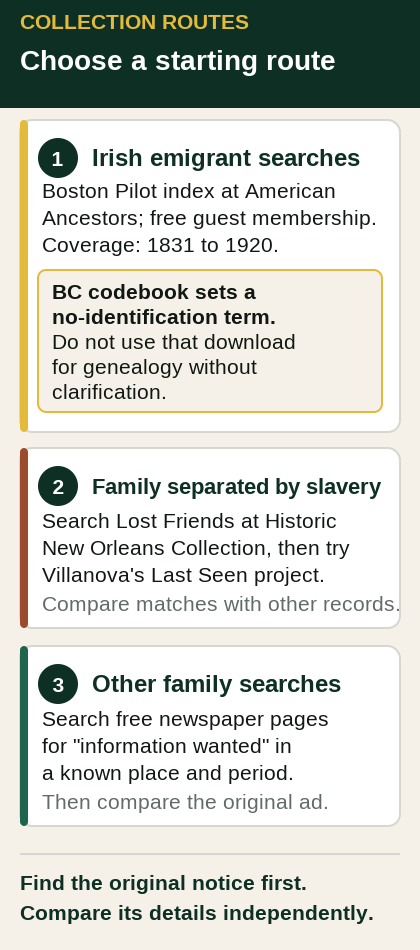
Start with a free, indexed collection rather than a general name search. If you are researching Irish emigrants, try the Boston Pilot "Missing Friends" index at American Ancestors, available with a free guest membership. For African American families separated by slavery, the Historic New Orleans Collection's Lost Friends database and Villanova University's Last Seen project offer specialized ad searches. For other families, search a free newspaper collection for the exact phrase information wanted within a known place and period.
This guide shows how to find these ads, how to read them, and how to decide whether an ad really concerns your family. It deals with historical notices, not with tracing living people.
What an information wanted ad usually contains
The ads were short and paid for, so writers packed in identifying details. A typical notice names the person being sought and gives a place where they were last known to be. It may name the person searching and their relationship, such as a sister looking for a brother. It often ends with an address for replies or a request that other newspapers copy the notice.
Many ads contain details that are hard to find elsewhere. A 2025 public radio report on the Last Seen project, discussed below, describes post-slavery ads that list the names of former enslavers as a way of identifying people, and some that describe when and where family members were sold.
The details came from the person who paid for the ad, often years after the separation and sometimes from childhood memory. Treat each detail as that person's account. Ages may be rough, spellings may follow how a name sounded, and places may be given as a county or a plantation name rather than a town. This does not make the ads less valuable. It means each detail is a lead to test against records created closer to the events.
Free collections to search first
Irish "Missing Friends" ads in the Boston Pilot
The Pilot, a Boston Catholic newspaper, carried a "Missing Friends" section in which Irish immigrants sought relatives and friends.
The searchable index Boston Pilot: Irish Immigrant Advertisements (Search for Missing Friends), 1831-1920 is available through American Ancestors. Its free guest membership includes this database. Try the person's name and any known place clue, then note the date, location, relationship and volume or page details shown on a promising entry. Some entries offer a page image. The searchable index title gives a range through 1920.
Boston College also deposited a separate downloadable table in Harvard Dataverse. Its included codebook says users must not attempt to identify study participants or use identities discovered inadvertently. Because the wording does not clarify whether genealogical searches of named historical people are permitted, do not use that download to identify a relative unless Boston College confirms that the use is allowed. This restriction concerns the separate Dataverse download. For family-history searches, use the American Ancestors index or original newspaper pages and follow each provider's own terms. An index entry is a finding aid, not the ad itself. Follow its volume and page details to the original page in a newspaper collection or library, and record whether you saw the original.
"Lost Friends" ads in the Southwestern Christian Advocate
The Historic New Orleans Collection's Lost Friends database presents ads from the Southwestern Christian Advocate, a New Orleans Methodist newspaper, placed by people searching for family members lost in slavery. The database page describes more than 2,500 ads from November 1879 to December 1900, with separate search and browse sections, and credits the digital reproductions to two libraries.
The Collection's First Draft blog post on what the Lost Friends ads reveal explains that the ads were typically read aloud in Black churches, so that community networks could help reunite families. It also notes that the database can be searched by name, city, state or county.
Ads across many papers in Last Seen
The Lost Friends database recommends Villanova University's Last Seen: Finding Family after Slavery for related searching. The project's site at informationwanted.org offers a map showing where ads were placed and where advertisers were located. A 2025 public radio report, published by WHRO, describes more than 4,500 ads collected by historian Judith Giesberg's team, dating from the 1830s into the 1920s and drawn from papers including the Southwestern Christian Advocate and the Chicago Appeal.
If your research concerns an African American family, our guide to finding ancestors in historic Black newspapers explains how to identify the community papers that served a place. Search ads may sit in those papers outside any project database.
A fictional ad, read line by line
Every detail in this example is invented: the people, the parish, the towns, the newspaper, the dates and the wording. Ballyfennick, Harlan Mills and Easton Quay are not real places, no real jurisdiction is implied, and the notice does not exist in any archive.
Suppose you know from a family Bible (also invented for this example) that your ancestor Owen Carrow was born in Ireland around 1840 and appears in an 1870 census household in Harlan Mills with a wife named Mary. The family story says Owen had a sister who stayed in New York.
In a Missing Friends index you find an entry that leads you to this notice in an invented paper, the Harbour Catholic Weekly, issue of 12 March 1868:
"INFORMATION WANTED of OWEN CARROW, native of the parish of Ballyfennick, who left home in 1857 and was last heard of in Harlan Mills in 1864. Any tidings of him will be thankfully received by his sister, CATHERINE CARROW, at 14 Orchard Row, Easton Quay."
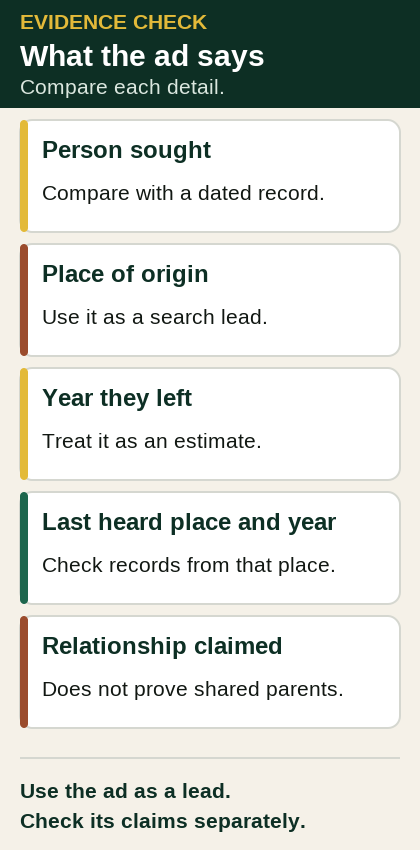
Read it as a set of separate claims, each made by Catherine:
- She was looking for a man called Owen Carrow.
- She believed he was born in Ballyfennick parish.
- She believed he left home in 1857.
- She had last heard of him in Harlan Mills in 1864.
- She described herself as his sister and gave an Easton Quay address in 1868.
Now compare. The name matches your Owen. Harlan Mills matches your census place, though the census is six years after the ad's last-heard date and two years after the ad was printed. The birth year is not in the ad at all. The sister matches a family story, which is not independent evidence.
What you can write is this: "In March 1868 a Catherine Carrow, describing herself as Owen Carrow's sister, sought an Owen Carrow last heard of in Harlan Mills in 1864. This may be my Owen, because the name and town fit." What you cannot yet write is that Owen was born in Ballyfennick, or that Catherine was his full sister. The ad states her claim, not a parish register entry, and "sister" in an ad could mean a half-sister or sister-in-law.
The next useful record would be one created independently of the ad: an Irish parish register for the named parish, a Harlan Mills record giving Owen's place of birth, or a later document naming Catherine and Owen together. If the parish register shows an Owen and a Catherine Carrow with the same parents, the ad becomes strong supporting evidence for the family link rather than the only evidence.
Search general newspaper collections for the phrase
Many search ads were never gathered into a project database. Local papers, immigrant-language papers and religious papers all carried them. To find these, search for the wording advertisers used rather than for your ancestor's name.
On the free Chronicling America collection, go to Collection Items, open Advanced Search and choose Pages (Full Text). The Library of Congress describes these options in its tips for searching Chronicling America. Limit by state and dates, then try:
information wantedwith This exact phrase selected.information wantedand your surname with These words within 10 words of each other selected.missing friendswith This exact phrase selected.last heardand a place name with These words within 10 words of each other selected.
The proximity option is useful because the surname often comes a few words after the heading. The Library's tips explain that the "within" options allow other words between your terms, while an exact phrase requires them to sit together.
Names in search ads were often printed in capital letters, which OCR can misread. If the phrase search finds ads but your surname search does not, browse the column where the paper usually placed them. Our guide to searching when OCR gets names wrong has more on working from page images.
Remember where the advertiser lived. A sister in one city looking for a brother in another might advertise in her own city's paper, in his, or in a paper read by her community. Search the places connected to the searcher, not only the places connected to the person sought.
Using indexes without losing the original ad
Indexes and catalogues are finding aids. An index entry may abbreviate the ad, standardize spellings, or split one ad into several entries for different people named in it. Before you rely on a detail, look at the ad itself if an image or a page reference is available.
When you open the original, check four things. First, confirm the issue date and whether the ad ran in several issues. Second, read the whole notice, including the reply address and any request that other papers copy it. Third, look at the ads around it, because relatives sometimes placed more than one. Fourth, note whether the index left out any details, such as a ship name or a second relative.
If the original page is not online, record the newspaper title and date from the index and ask a library whether it holds that issue on microfilm. Our guide to free and library newspaper access explains how to frame that request.
Deciding whether the ad concerns your family
Common names make this harder. There may have been many people with the same name who emigrated from the same county in the same decade. The details that matter most are the ones that narrow the field: a parish rather than a county, a named parent, a ship, an occupation, a specific last-known address, a named enslaver or a place of sale.
Make a short comparison table with three columns: what the ad says, what your independent records say, and whether they agree, conflict or say nothing. A conflict is not automatically fatal. An advertiser might misremember a year. But two or more conflicts on details that should be stable, such as a parent's name, are a strong reason to keep the ad separate from your family.
Be particularly careful with relationship words. "Brother", "sister", "mother" and "cousin" in an ad record how the advertiser described the relationship. They do not establish full siblings, biological parentage or legal relationships. To conclude that two people were full siblings, you need evidence identifying both of them and both of their shared parents, not just an ad in which one calls the other a brother.
If your ancestor's name is common, our guide to finding an ancestor with a common name explains how to keep candidate records separate until the evidence lets you choose.

Ads that ran more than once, or were answered
An advertiser could pay for a notice to run in several issues, and some asked other papers to copy it. When you find the same wording in several places, count it as one statement printed many times. Repetition shows how hard the advertiser was searching. It does not add independent confirmation of the details.
Later issues sometimes carried follow-ups: a second ad with new information, a note that the person had been found, or a letter thanking readers. Search the advertiser's name for a year or two after the first ad. A changed reply address can itself be useful, because it gives you a dated location for the searcher.
Outcomes are hard to know. The WHRO report quotes Judith Giesberg's estimate that the success rate for the post-slavery ads may have been as low as 2 percent. That is a reminder that most ads record a search, not a reunion. An ad without a known outcome can still tell you who was looking for whom, where, and when.
Reading post-slavery search ads with care
Ads placed by formerly enslaved people often name former enslavers, places of sale and the people who were sold. The Lost Friends and Last Seen collections preserve these details because the advertisers used them to be recognised. For a family historian, they can point toward plantation records, probate inventories and sale records that name enslaved people.
Those records were created by enslavers and their courts, not by the families themselves. When you follow an ad to such a record, keep the advertiser's own account at the centre of your notes. Record the names exactly as the ad gives them, including any surname the person used at the time, and note that surnames could change after emancipation.
Approach the matching with the same caution as any other ad. A shared first name and an enslaver's surname are leads, not identification. Look for a combination of details that fits, such as a family group sold together, an approximate age and a place. If you are working through these records for the first time, the Historic New Orleans Collection accepts reference questions through the address given on its Lost Friends page.
When you find nothing
An empty result has several possible meanings. Your family may not have placed an ad. They may have placed one in a paper that has not been digitised or indexed. The ad may be indexed under a spelling you have not tried. Or the person searching may have been someone you do not yet know about, such as an aunt or a former neighbour.
Try searching by the place of origin or the last-known place instead of the surname. In the American Ancestors database, try a place clue where the search form permits it, then compare the locations and relationship details shown on results. In a newspaper collection, search information wanted with the town name within 10 words.
Then record what you covered: the collections searched, the years, the spellings and the places. A negative result in one collection for one set of spellings does not mean no ad was placed. It tells you which route you have exhausted, and our guide to migration news may suggest other kinds of newspaper reports that could record the same separation.
Record the ad so others can check it
For every ad you use, record the collection or database name, the index entry exactly as given, the newspaper title, place of publication, issue date, page and column, and the date you consulted it. Transcribe the full notice from the image if you can see one, keeping capital letters, spellings and abbreviations as printed.
Then write your interpretation separately. Note which details matched independent records, which conflicted, which were silent, and what record you plan to check next. Record the collection name, the entry or page reference and the date you consulted it.
Try an information wanted search this week
Choose one ancestor whose family was separated, or who seems to have arrived without known relatives. Write down the place they came from, the place they were living and an approximate decade.
If the likely notice is from 1831 to 1920 and concerns an Irish emigrant, search the Boston Pilot Missing Friends index at American Ancestors, which is included with free guest membership. Note the entry's date, location and volume or page reference, then read the original notice if an image is available. If the family was separated by slavery, search Lost Friends by surname, place and any known enslaver's name, then search Last Seen. Otherwise, search Chronicling America Pages (Full Text) for information wanted as an exact phrase, limited to the state and decade, and then with your surname within 10 words.
For any promising result, find and read the original ad. Make the three-column comparison table: ad, independent record, agree or conflict or silent. Choose one independent record that could confirm or rule out the strongest matching detail.
If you find nothing, repeat the search using the place of origin or the last-known town instead of the surname, and note every collection and spelling tried. That record will tell you, next time, which collections and newspapers are still worth a look.
Sources
- American Ancestors: Boston Pilot: Irish Immigrant Advertisements (Search for Missing Friends), 1831-1920
- American Ancestors: Free Guest Membership
- Boston College Dataverse: Information Wanted dataset, version 2.0 and codebook
- Historic New Orleans Collection: Lost Friends database
- Historic New Orleans Collection, First Draft: "Lost Friends" ads reveal the heartbreak of family separation during slavery
- Last Seen: Finding Family After Slavery
- WHRO: After slavery, family members placed ads looking for loved ones (2025)
- Library of Congress: Tips for searching in Chronicling America