
Historical Newspapers
How military, legal, and migration news can reveal family history
Match military reports, legal notices, and migration stories to the newspaper sections and source types most likely to hold useful family clues.

On this page
- Start with the event, place, and time
- Military news often sits beside ordinary local life
- Read service details as clues, not conclusions
- Legal notices can name households that news ignores
- Migration stories reveal movement in ordinary language
- Match the event to the newspaper section
- Search OCR with period vocabulary and variants
- Treat absence and repetition carefully
- Try a hands-on newspaper exercise this week
- Cite the report and the inference separately
- Sources and further reading
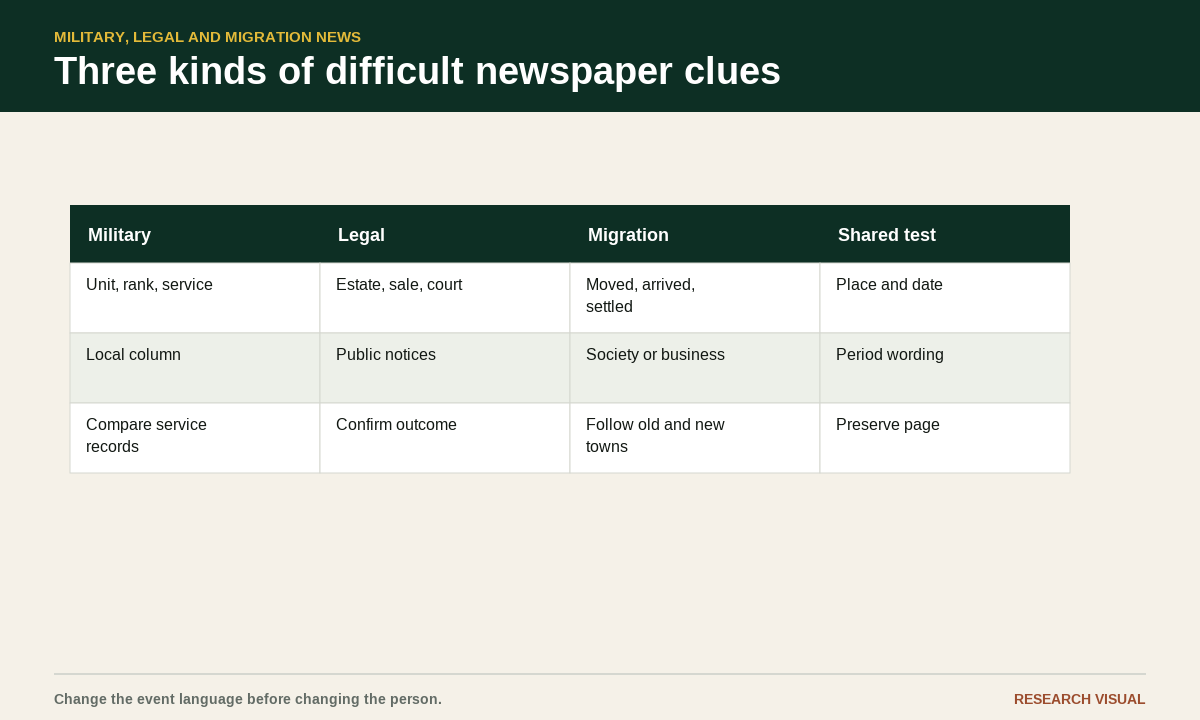
A family story can arrive in a newspaper wearing a uniform, a court heading, or the name of a train station. You may be looking for a soldier, a disputed estate, a tenant who moved, or a newcomer whose arrival changed the shape of a household. These stories rarely use the language of a modern family tree. They mention a regiment instead of a full biography, a sheriff's sale instead of a property record, or a county resident leaving for another state.
That difference matters. A search for a surname alone can miss the report entirely, while a search built around the event and the newspaper's habits can bring it into view. This guide helps you connect three difficult kinds of news to likely sections, phrases, and records. It also keeps the boundary clear between what the paper reports and what you later infer about identity.
Start with the event, place, and time
Before you search, write a short research brief. Name the person you are testing, the place where the event may have occurred, a useful date range, and the event you expect to find. Add two unknowns that could change the result. For example, you might write: "I am looking for reports about Charles W. Bell of Adams County, Iowa, during the years after 1917. Did he serve, move, or appear in a legal notice, and was he the same Charles Bell who married in 1922?"
This wording gives you several routes. You can search the local paper for a military term, inspect legal notices around a property or probate event, and follow later reports in the place where the family settled. If the question is still broad, the research-question guide can help you narrow the evidence target, while a coverage map can keep competing titles and date windows visible. It also keeps a tempting conclusion out of the question. You are testing whether the evidence connects two references, not asking the newspaper to prove a relationship by itself.
Record name variants before opening a database. Include initials, middle names, abbreviated first names, common misspellings, a spouse's name, a farm or business name, and the names of nearby towns. Older papers often shortened names in headlines and printed a person's full name in the article. A report may call someone "C. W. Bell" on one page and "Charles Bell" on another.
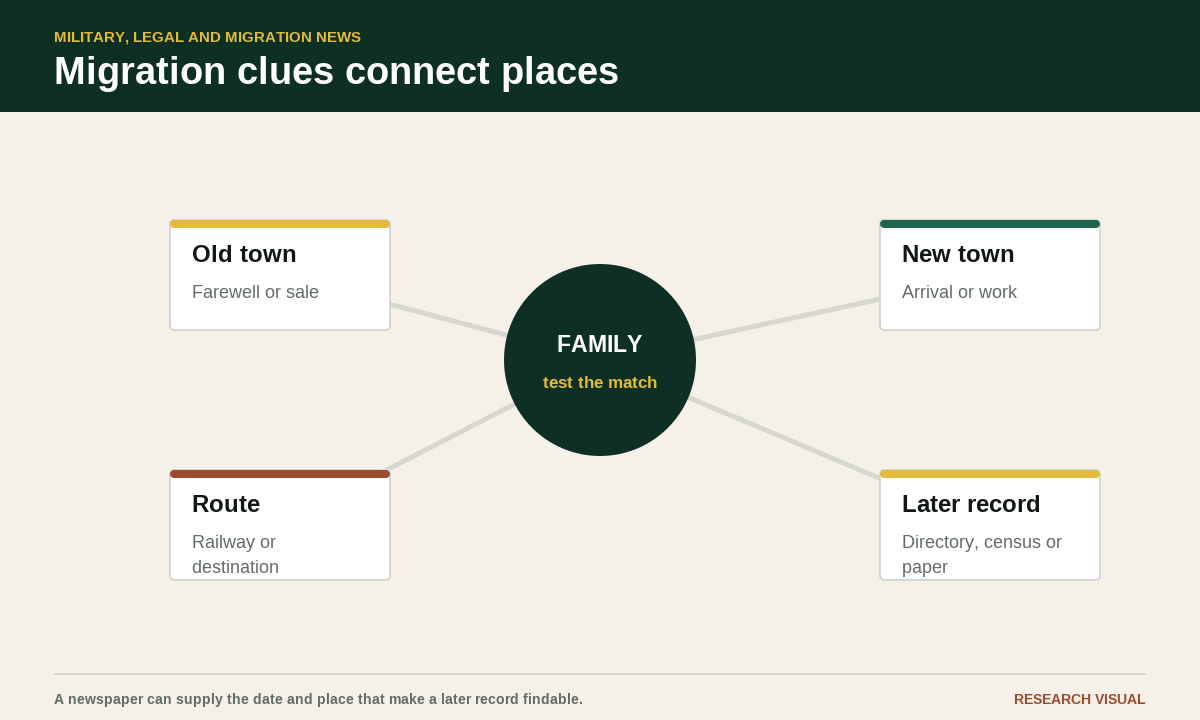
Keep a date window wide enough for publication delay. A military enlistment may appear quickly, while a death, pension, court ruling, or return from service may be reported months later. A migration story can appear first in a farewell item in the old town and later in a welcome, business, marriage, or land report in the new one. For a U.S. arrival by ship, our guide to searching newspaper shipping columns shows how to identify a likely vessel and arrival date before checking passenger records.
Military news often sits beside ordinary local life
A newspaper's military coverage is larger than battle reports. Local columns may mention enlistments, draft classifications, examinations, furloughs, promotions, transfers, wounded residents, prisoners of war, deaths, awards, homecomings, and memorial services. Short notices may appear under a town heading even when the event occurred far away.
Look for the paper's recurring labels. A weekly might have a column for local happenings, a county roundup, correspondence from nearby communities, or a page devoted to military news. During wartime, the same paper may publish official lists, letters from readers, recruiting announcements, casualty reports, and social notices about people leaving town. A report that seems too small to matter can provide a useful date, a unit, a parent's name, or a destination.
Search language from the period rather than relying on current terms. A paper may say "entered the service," "answered the call," "was inducted," "reported for duty," "mustered in," "received his discharge," or "returned from overseas." For earlier conflicts, try terms such as volunteer, company, regiment, battery, troop, encampment, furlough, veteran, pensioner, and soldiers' home. A newspaper may describe a woman through a husband's service or identify a family by the name of the enlisted person.
Military reports are especially useful for narrowing identity. A unit designation, rank, hometown, relative, occupation, or physical injury can distinguish two people with the same name. Treat each detail as a lead to compare with service records, draft registrations, pension files, cemetery records, obituaries, and later newspaper reports. The National Archives explains its military records research routes at Research Military Records, which is a useful companion to newspaper work.
A newspaper's wording also reflects its purpose. A patriotic report may praise a local resident and omit uncomfortable details. A casualty list may contain a spelling error. A letter published under a soldier's name may have been edited. The report can still be valuable, but use the page image and retain the exact wording before you turn it into a fact in your notes.
Read service details as clues, not conclusions
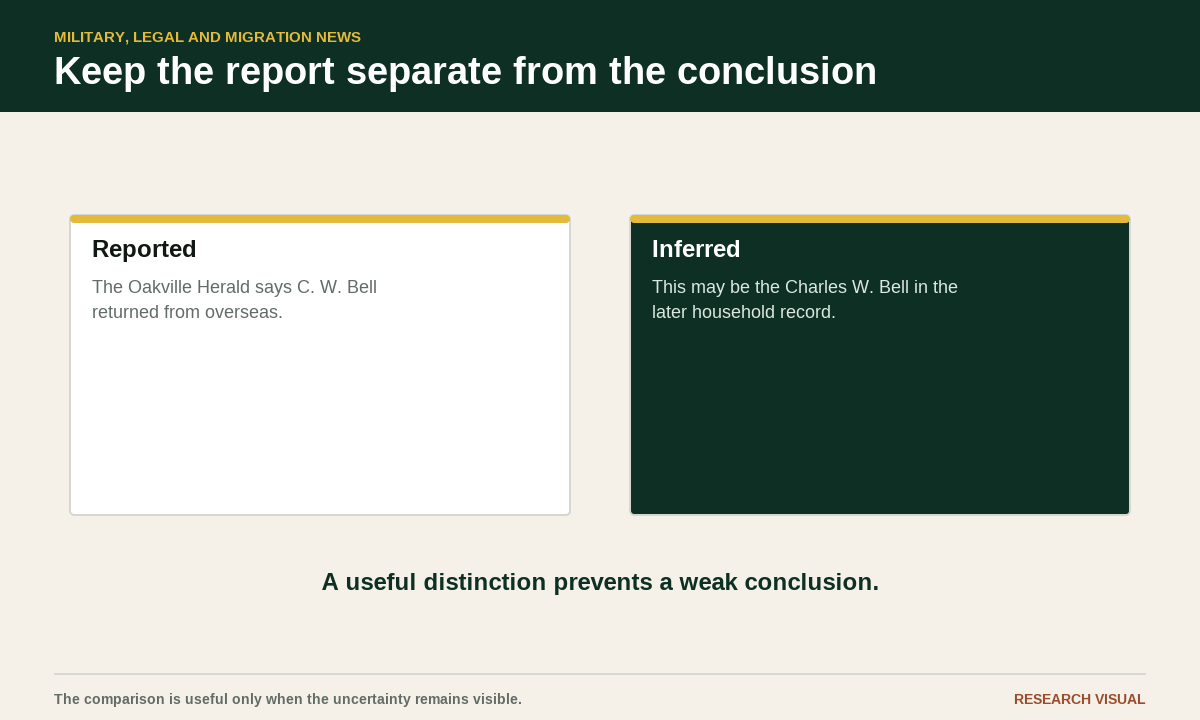
Military references invite quick identification. A distinctive unit can feel decisive, especially when the surname is uncommon. It is safer to treat the report as one piece in a comparison. Ask whether the age, residence, parents, occupation, and dates fit the person you know from other records.
Separate the newspaper's statement from your interpretation. Your notes might say, "The Oakville Herald reported that C. W. Bell of Oakville was in Company B, 168th Infantry, on June 4, 1918." A separate note can say, "This may be the Charles W. Bell who appears in the 1920 census with a military occupation listed." Keeping the two sentences apart prevents a plausible match from becoming a quoted fact.
Pay attention to changes in address. A soldier may be described as being from a hometown even after his parents moved. A reservist or veteran may appear in a paper where he worked rather than where he was born. A marriage or death notice may identify the same person through a different town. Newspapers often compress these distinctions because local readers already knew the background.
Use military stories to build a timeline. An enlistment notice gives a lower boundary for service. A furlough, promotion, or homecoming adds another point. A later report may mention a discharge, disability, pension, or veterans' organization. The timeline can expose a mistaken identity when two men with the same name appear in different places during the same period.
Legal notices can name households that news ignores
Legal pages are often overlooked because they look formal and repetitive. They can be some of the best places to find a person's full legal name, a property description, an estate relationship, or a temporary address. Search for probate, administration, guardianship, foreclosure, sheriff's sale, partition, divorce, naturalization, name change, incorporation, tax sale, delinquent taxes, notice to creditors, and sale of real estate. For tax lists and sheriff's sale notices, see our focused guide to finding an ancestor in newspaper tax lists.
For citizenship research, our guide to naturalization in old newspapers shows how to distinguish a session announcement from a report of admission and identify the court.
A legal notice may identify an estate through a deceased person's name, then list an administrator, executor, widow, heirs, or attorney. Our guide to finding an ancestor's estate notice shows how to search for one and use its court details to request the probate file. A guardianship notice may connect a minor to a parent or relative. A land sale can place a person on a particular street, lot, farm, or section of a township. These details are often absent from a brief social item.
For bankruptcy and insolvency notices, follow the court and case details into the surviving records.
Publication schedules matter. Some notices ran for several weeks because the law required repeated publication. If you find one notice, look at adjacent issues and later dates. The first appearance may contain the full wording, while later appearances are shorter or have a different layout. A final report may say that a sale was postponed, confirmed, or cancelled.
Legal language can be hard to search because OCR struggles with small type, columns, seals, and unusual names. Search a surname with a generic term such as estate or notice. Then browse the legal page for the date range even if the text search fails. A county weekly may put every legal notice in a predictable section, and a page image can reveal a name that OCR has turned into unrelated words.
Read legal notices as notices, not as judgments. A foreclosure notice does not prove that a person lost a home. A divorce notice does not explain the relationship. A notice to creditors does not list every asset. The document tells you what an action or proceeding was being announced. Confirm the outcome in a later issue or a court, land, probate, or vital record where possible.
Migration stories reveal movement in ordinary language
Migration news is often hidden in local reporting. A family may be described as moving to a neighboring county, leaving for a western state, visiting relatives before settling elsewhere, returning from a city, or sending for a household member. The article may never use the word migration.
Search for moved, removed, left for, located at, settled near, went to, departed for, returned from, came from, arrived, visiting, here from, homesteaded, took up residence, and accepted a position. Try destination names without the family surname. A column about residents leaving for Nebraska may contain only first names, while the destination and date make the item useful when matched to a later address.
Farewell parties, church reports, school notices, business advertisements and local business notices, railway news, and letters from correspondents can all record movement. A newspaper may say that a family sold its household goods before leaving, that a son went to work in a mill, or that a daughter was visiting from another state. Each sentence can provide a date to test against directories, land records, censuses, passenger arrivals, or later newspapers.
Migration stories also appear in ethnic, religious, labor, and agricultural coverage. A report may describe a colony, settlement, church group, mining camp, railway workforce, or seasonal labor route. Such context can lead you to a community newspaper rather than the largest city paper. It can also explain why a family appears in one place for a short period and then disappears from the usual local coverage.
Use destination reporting as a second search. If the destination was Australia or New Zealand, search Trove and Papers Past for destination reporting and family notices. If the family left Iowa for Colorado, search the Colorado town paper for the surname, the old town, a relative, an occupation, or a phrase such as "new arrival." The National Archives overview of immigration records explains how federal arrival records differ from local evidence. A newspaper story about movement is not an arrival manifest, but it can help you choose a port, date, or place to investigate.
Match the event to the newspaper section
When a search returns nothing, change the section before you change the person. Military material may be in local news, a county column, an editorial page, or a special wartime page. Legal material usually has a formal notices area, though a later outcome may appear in news. Migration items may be in society news, town correspondence, business news, or advertisements.
Make a small section map for the title you are using. Open three or four issues from the target period and note where each type of item appears. Record the section name, page, column position, and any repeated heading. This is faster than guessing across a large date range. A paper that labels its legal page "Official Proceedings" may never use the phrase legal notice in its OCR text.
The Library of Congress guide to Chronicling America describes a freely accessible collection of historic newspaper pages and provides guidance for searching and browsing. Its title and issue information can help you decide whether a paper is a good candidate. Coverage is selective, so an absent issue or absent title does not show that an event did not happen.
Look for sister papers and nearby titles. A county weekly may copy a military item from another town, while a city paper may publish a legal notice because an attorney placed it there. A migration report can appear in both the old and new communities. Repeated wording may help you find the original, but repeated wording is not independent confirmation. If the names are damaged in the index, use OCR and page-image searching to move from a weak hit to the actual page.
Search OCR with period vocabulary and variants
OCR is a finding aid, not a perfect transcript. It can split names, mistake initials for letters, and miss text in narrow columns. Use several short searches instead of one elaborate phrase. Search a surname, then a town, then a likely event word. Try initials and full names separately. Search the destination or unit without the surname when the name is common.
Browse issue dates around the event. Weekly papers often publish a local item a few days after the event, and a later issue may repeat the information in a different form. If you have a precise date from a family record, inspect at least one issue before and several after it. For a recurring legal notice, compare the first and last appearances.
Watch for spelling and typography. Old type can make a capital I resemble a J, and OCR may confuse a long word at a column break. Names may carry accents, apostrophes, or abbreviations that a search engine ignores. Search a distinctive neighboring word from the notice. Once you locate the page, read the surrounding column because the useful name may be outside the search hit.
Do not let a perfect OCR match outrank a poor image match. If the text and image disagree, record what the page actually shows and mark the uncertainty. A clipping without the masthead, date, and page is difficult to evaluate later. Save a citation as soon as you find the item, even if you plan to return for a clearer copy.
Treat absence and repetition carefully
A missing result has several possible explanations. The paper may not have covered the event, the issue may be missing, the title may have changed, OCR may have failed, or the item may be in a section you did not inspect. It may also be in a competing paper. Write down which possibilities remain before concluding that the event did not appear.
Repeated items have their own problem. A county paper may reprint an announcement from a neighboring title, and several sites may present the same digitized issue. Count the page and title, not the number of search results. A second paper can add independent detail, but a copied paragraph is still one report.
Bias matters as well. Legal notices favor events that required publication. Military columns favor people the editor or community considered newsworthy. Migration items may describe respectable movement while ignoring people who left quietly. The archive preserves what was printed, not a complete register of every resident's life.
Try a hands-on newspaper exercise this week
Choose one person and one event type. Give yourself a two-year window and one newspaper title. Write five search variants before you begin: a full name, an initialed form, a surname with a town, a likely event phrase, and a destination or unit. Then open three issues from the window and identify the section where that kind of material appears.
Search the phrase variants, but also browse the likely page in every issue you can access. For each candidate, record the title, publication date, page number, section heading, exact wording, and a short note about why it might refer to your person. Mark each detail as reported, inferred, or still uncertain.
Next, test the strongest candidate against one record type outside the newspaper. A military report might lead to a service file or draft record. A legal notice might lead to a probate or land record. A migration item might lead to a directory, census, passenger arrival, or later local paper. You are looking for agreement in place, time, relatives, occupation, or event, not a second document that merely repeats the same newspaper text.
Finish by writing two sentences. The first should state what the newspaper says. The second should state what you think it may mean and why. If the second sentence contains a word such as probably or likely, name the evidence that creates the uncertainty. This small habit makes later family histories easier to correct.
Cite the report and the inference separately
A useful newspaper citation names the title, place of publication, date, page, section if known, and the collection or repository. Add the issue URL or stable item link when one exists. If you saved an image, note its filename or location according to your own filing system. The evidence-preservation guide gives a fuller record for the page image, wording and limits. Keep the page image because a transcription can lose a column heading, an advertisement, or a continuation line.
Write an evidence note in plain language. For example: "The 12 May 1919 issue of the River County News reports that Charles W. Bell returned from overseas and was visiting his parents in Oakville. The report may refer to the Charles Bell in my 1920 household record because the parents and town match. His unit is not named, so military identity remains unconfirmed."
That note is stronger than a family-tree label that says "served overseas." It gives a future reader the report, the comparison, and the limit. Military news, legal notices, and migration stories are valuable because they catch people in motion. They become reliable research only when you preserve the wording and test the connection.