
Citizenship records
How to find naturalization records using old newspapers
Use historical newspaper notices to identify a possible naturalization court and date, distinguish applications from admissions, and locate the court record.

On this page
- Search for the session, not the name
- What a newspaper item can tell you
- Worked example: use a newspaper report to identify the court
- How naturalization worked, in brief
- Use the waiting periods to set a search window
- Reading the names and places in a list
- Wives, children and people who are not listed
- Find the court records behind the newspaper report
- What to try if you find no naturalization report
- Use a short personal notice to narrow the date
- Record what the report says, and what it does not
- Try a naturalization search this week
- Sources
Many local newspapers in the United States reported naturalization. Some printed the names of people about to be admitted as citizens at a court session, some reported the ceremony afterwards, and some listed people who had filed a declaration of intention, known as "first papers". For a family historian, one of these items can supply the thing that makes naturalization records findable: the court and the approximate date.
Your first action is to search a free newspaper collection for naturalization wording in the county where your ancestor lived, rather than for the ancestor's name. Start with the Library of Congress guide to Chronicling America and open its newspaper collection. Limit the search to that county's papers for roughly the first ten years after arrival, and search for "naturalization" or "naturalized" with "court". This is a starting window: widen the date range if you find no useful report or another record points to a different period. Once you find how the paper reported these sessions, read each report for your family.
Search for the session, not the name
Lists of new citizens were set in small type, often surname first. Typesetters could misspell names, and optical character recognition (OCR), the software that turns a page image into searchable text, can misread them. Find the reports first.
On Chronicling America, go to Collection Items, open Advanced Search and choose Pages (Full Text). The Library of Congress explains the options in its tips for searching Chronicling America. Limit to the state and the county's newspaper titles and a span of years. Try:
naturalization courtwith These words within 10 words of each other selected.new citizenswith This exact phrase selected.naturalizedwith All of these words, plus the county seat's name.first paperswith This exact phrase selected. These are declarations of intention, not proof that citizenship was granted.final papersorsecond paperswith This exact phrase selected. Look for a petition (the formal application) or a report of admission, and check what the item actually says happened.
Note when sessions were reported. If the court naturalized on particular days or terms, you can browse the issues just after each one rather than searching the whole span. Our guide to searching when OCR gets names wrong explains how to read dense lists from page images.
Do not overlook newspapers in your ancestor's own language. A community paper may have reported who among its readers became citizens, even if the English-language paper only gave a total. Our guide to immigrant-language newspapers explains how to search those papers and handle name forms across languages.
What a newspaper item can tell you
Newspaper items about naturalization usually fall into one of these kinds:
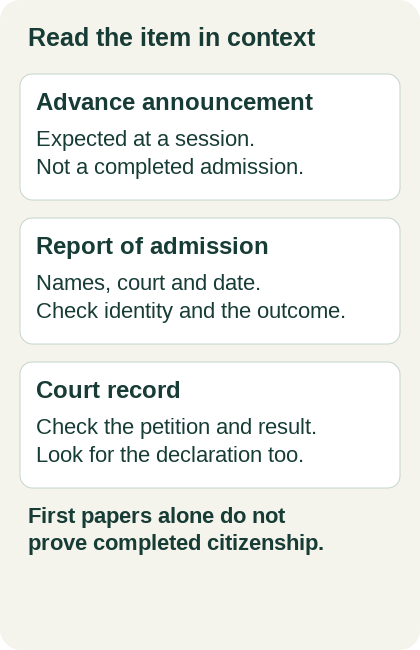
- An announcement that a court will hold a naturalization session, sometimes listing the people expected to be admitted.
- A report after the session, sometimes listing those admitted and those refused or continued.
- A report of first papers taken out, especially around elections or in wartime.
- An individual mention in a local column, such as "received his final papers".
A transcription on the OKGenWeb Oklahoma County site of an article in the Daily Oklahoman of 10 September 1924 is an example of the first kind. Its headline announces that eighteen men will be given naturalization papers at the courthouse on the coming Saturday, and it introduces a list of those "who will be naturalized". The names are missing from the online transcription, which is a reminder to look for the original page.
That example also shows the most important distinction. An announcement records an expectation. People listed in advance could be continued to a later session, refused, or fail to appear. A later report or the court's own records are needed to show that citizenship was actually granted, and on what date.
Worked example: use a newspaper report to identify the court
Everything in this example is invented: the person, Port Alder, the newspaper, the court, the names and the dates. Port Alder is not a real place, no real jurisdiction is implied, and these items do not exist in any archive.
Suppose a 1900 census entry (also invented) shows Jonas Velkner, a cooper born in "Austria" around 1868, in Port Alder with his wife Rosa and two children. The census says he arrived in 1891 and marks him as naturalized. You have searched federal court indexes without finding him.
You search the invented Port Alder Evening Star from 1893 to 1900 for naturalization court within 10 words and find that the paper reported each session of the county court's naturalization business. In the issue of 5 October 1896, page 3, under "New Citizens Made", you read:
"The following were admitted to citizenship by Judge Pell in the County Court on Saturday: ... Jonas Velkner, Austria; ..."
Here is what that supports. The Evening Star of Monday 5 October 1896 reported that a Jonas Velkner, described as from Austria, was admitted to citizenship in the County Court on the previous Saturday, which would be 3 October 1896.
Here is what it does not support. It does not prove that this Jonas is your cooper, though the unusual name and place help. It does not give the date of the declaration of intention or which court received it. And "Austria" in an 1896 report may describe a large empire rather than the place a family would name today.
The key result is the court. Because the naturalization was in a county court before 1906, the petition and related records should be sought among county court records, not federal ones. That explains why the federal index search found nothing.
How naturalization worked, in brief
You do not need to know every law to use newspapers well, but a few points from the National Archives change how you read a report.
The National Archives' overview of naturalization records describes a two-step process that usually took at least five years. In the usual pattern it describes, an immigrant filed a declaration of intention, known as "first papers", after two years' residence, and after three more years petitioned for naturalization, the "second papers". When the petition was granted, a certificate of citizenship was issued. The two steps could happen in different courts.
The same page explains that before 27 September 1906 any court of record could naturalize, so people often used the most convenient local court. After that date a fee structure encouraged a move to federal courts, though lower courts continued to naturalize for some time.
The National Archives' history of the declaration of intention notes that before 1906 any alien aged eighteen or older could file a declaration at any time, with no proof of eligibility, so the timing of first papers varied. It adds two cautions that matter for newspaper work. Declarants could file in a different court from the one that handled their petition, and many filed more than one declaration. And finding a declaration does not prove that the person was ever naturalized.
Use the waiting periods to set a search window
The waiting periods give you a practical way to decide which years of a newspaper to search. The National Archives' declaration history sets out the required interval between declaration and petition at different times: three years for declarations filed from 1795 to mid-1798, five years from mid-1798 to 1802, three years from 1802 to 1824, and two years for declarations filed from 26 May 1824 to 23 December 1952.
Combine that with what you know. Because a declaration could be filed early, sometimes soon after arrival, the petition is the step most tied to the waiting period and the required years of residence. If a newspaper gives you a petition or admission date, the declaration should be at least the waiting period earlier, possibly in another court. Neither limit tells you how long a person actually waited. Many people took years longer, and some filed more than one declaration.
Write your window down before you search, for example "declaration likely 1893 to 1896; admission likely 1895 onwards". If your search then turns up a report outside that window, it is a reason to check identity more carefully, not to discard the result.
The 1906 Basic Naturalization Act also matters here. The declaration history says it introduced standard forms and a seven-year limit, so declarations not followed by a petition in that time expired, and many people filed again. Two declarations for the same name years apart may be the same person starting over.
Reading the names and places in a list
Names in naturalization lists may appear in an anglicised form, in the form the clerk heard, or abbreviated. Compare the printed form with what you have from the census, church records and passenger lists, and keep each version exactly as recorded.
Countries in lists usually describe the sovereignty the person was renouncing at the time. An 1896 entry of "Austria", "Russia" or "Germany" tells you the state, not necessarily the town or the ethnic or language group. Keep the newspaper's word and look for a more specific birthplace in the court file or in records from the old country.
If your ancestor had a common name, a list of new citizens may contain several people with the same or similar names, sometimes across successive sessions. Our guide to finding an ancestor with a common name shows how to keep candidates separate until an occupation, address or family detail tells them apart.
Wives, children and people who are not listed
Most newspaper lists name the person who petitioned. Family members may not appear for several reasons. The National Archives overview mentions derivative citizenship as an exception to the two-step process. Under laws in force at various times, some wives and minor children gained citizenship through a husband or parent rather than by petitioning themselves.
The National Archives' declaration history notes that the Cable Act of 1922 waived the declaration requirement for women married to US citizens, and that many laws waived it for soldiers and honourably discharged veterans. These changes affect who appears in lists of first papers.
If a woman in your family petitioned in her own name after 1922, she may appear in a list. Before then, her status may have followed her husband's. Do not conclude from her absence that she never became a citizen, or from her husband's listing that she did, without checking the rules that applied and the records themselves.

Find the court records behind the newspaper report
Once a newspaper has given you a court and a date, the next step depends on which court and which period.
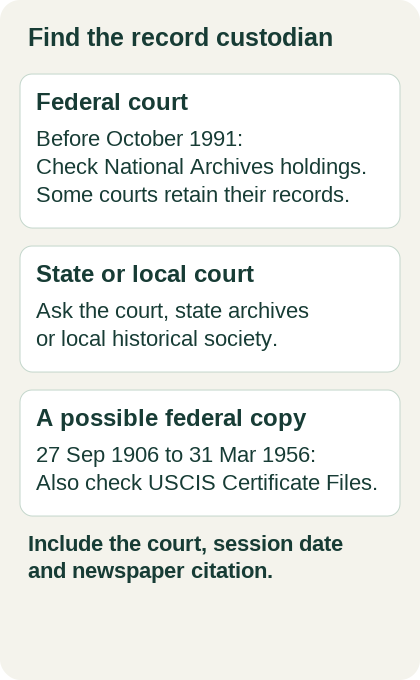
For federal courts, the National Archives overview says records such as indexes, declarations and petitions are usually held at the National Archives facility serving the state where the court sat, that there is no central index, and that federal naturalization records before October 1991 are generally sought there. Some courts retain their records: check National Archives holdings first, then ask the court if needed. For state and local courts, it says the National Archives generally does not hold the records, although some were donated or filmed. Check the state archives, the county court or the local historical society.
For naturalizations from 27 September 1906, there may also be a federal copy. The same page explains that the Immigration and Naturalization Service received a duplicate of each certificate, and that US Citizenship and Immigration Services now holds Certificate Files for 1906 to March 1956. The USCIS genealogy frequently asked questions explain that you may first need an index search to obtain a file number, followed by a record request, that fees apply to each, and that proof of death is required if the person was born less than 100 years before the request. The same page points researchers to courts, historical societies or the National Archives for naturalizations before 1906.
When you write to a court or archive, give the name as printed, the court, the session date reported and the newspaper citation. That lets staff check a docket or index for a specific date rather than searching years of records.
What to try if you find no naturalization report
There are many reasons a naturalization might not appear. The paper may not have reported sessions, or may have reported only totals. The court may have been in another county, perhaps where the person first lived or worked. Our guide to military, legal and migration news explains how to trace a family's earlier places through local reports. The issues may be missing online. Or the person may not have naturalized at all, despite what a census or family story says.
A census answer about citizenship was a statement to the enumerator, not a copy of a court record, and it could be mistaken. Treat "naturalized" in a census as a claim to test, and use the newspaper search as one way to test it.
If the issues you need are not online, our guide to free and library newspaper access explains how to request particular dates on microfilm. Record the titles, spans and search terms you used.
Use a short personal notice to narrow the date
A local column might mention that someone "took out his first papers" or "became a citizen" as a piece of personal news. A single mention like this may give a fuller name than a long list does, but it is less likely to name the court. Use it to narrow the date, then look for the session report or the court's records. Remember that "first papers" means a declaration of intention, which, as the National Archives notes, does not prove the person went on to naturalize.
Record what the report says, and what it does not
For each item, record the newspaper title, issue date, page and column, the heading, whether it is an announcement or a report of a completed session, the court and judge if named, the session date if stated or calculable, the name and country exactly as printed, and any other names around it.
Keep interpretation separate. For example: "Evening Star, 5 Oct 1896, reports Jonas Velkner, Austria, admitted in County Court on Saturday (3 Oct 1896). Identity with the 1900 cooper probable but unconfirmed. Next: county court naturalization records for October 1896."
When the court record arrives, note what it confirms and what it adds, such as the date of the declaration, witnesses, birthplace or date of arrival. Our guide to verifying and preserving a newspaper discovery explains how to keep the citation, page image and interpretation together.
Try a naturalization search this week
Choose one ancestor who arrived in the United States as an adult and later appears as naturalized, or who you suspect became a citizen. Write down the county where they lived for at least five years after arrival.
On Chronicling America or another free collection, limit to that county's newspapers and roughly the first ten years after arrival. Treat this as a starting window and widen it if needed. Search naturalization court within 10 words and new citizens as an exact phrase. When you find the first report, note how often and when the paper reported sessions, then browse every report in your span for the family surname.
If you find a name, record whether the item is an announcement or a report, and identify the court. Then check whether that court's records for that period are with the county, the state archives or the National Archives.
If you find nothing, repeat the search in any community-language paper for the area and in the county where the person first lived, and note what each search covered.
Sources
- National Archives: Naturalization records
- National Archives: History of the declaration of intention
- US Citizenship and Immigration Services: Genealogy frequently asked questions
- OKGenWeb Oklahoma County: 1924 list of naturalized aliens, Daily Oklahoman (transcription)
- Library of Congress: Tips for searching in Chronicling America