
Emigrant relatives
How to find a relative who went to Australia or New Zealand in Trove and Papers Past
Trace relatives in Australian and New Zealand newspapers using Trove and Papers Past. Check places, family notices and identity clues before drawing conclusions.

On this page
- Search Trove with phrases, proximity and categories
- Search Papers Past by name, date and title
- Worked example: assess a possible death-notice match
- What Trove and Papers Past contain
- Browse when search fails
- Family notices are the best first target
- Search shipping columns and early local news
- Use the gazettes as well
- Compare the notice with records from home
- Following a sister or aunt who married abroad
- Correcting text, tags and lists on Trove
- When the relative does not appear
- Record what you find
- Sources
Start with the free national collection for the country: Trove for Australia, or Papers Past for New Zealand. Search the relative's name, then use places and family details to test possible matches.
You can start with incomplete information. Note the name and whatever you know about departure, birthplace, parents or spouse, with a source for each detail. Leave unknowns blank rather than waiting for a complete profile.
Search Trove with phrases, proximity and categories
The National Library of Australia's guide gives several search techniques that work well for family history:
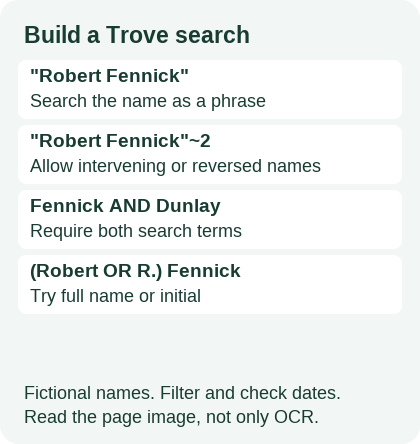
- Put a name in quotation marks to search it as a phrase, for example
"Robert Fennick". - Add a tilde and a number after the closing quotation mark to allow words in between. The guide says a value of about 2 allows a middle name or a reversed name such as
"Fennick, Robert". In practice this means typing"Robert Fennick"~2. - Use AND to combine a name with a town, OR to catch variants such as initials, and brackets to group OR terms. The guide warns that NOT can remove relevant articles as well as irrelevant ones.
- Filter by category, such as Family Notices, and by state, title and date range.
It also suggests trying initials, a wife's married name, nicknames and spelling variations, and starting broad before narrowing. A good sequence is the name as a phrase allowing a few words between the names, filtered to Family Notices; then the surname AND a parent's given name; then the surname AND the home village or county. If you know an event date, start around it. If you know only a departure period, leave room for notices much later in the person's life, as in the worked example below.
Search Papers Past by name, date and title
Christchurch City Libraries' Papers Past guide describes keyword searching and browsing by newspaper title and date. Use this separate New Zealand route rather than copying Trove's search syntax:
- Open the newspapers collection and try the full name as a keyword search, for example
Robert Fennick, using your own relative's name instead of this fictional one. - Try the surname with a known home place or relative's name. If nothing useful appears, try initials and spelling variants separately.
- Check the relevant newspaper's available dates. Narrow to a title and period supported by your records; if the event date is unknown, keep the exploratory date range broad enough to include later notices.
- Read a promising item against the page image and note its title, issue date and page. If you know an event date but search finds nothing, browse that title's available issues around it.
Search controls and labels may change. Do not assume Trove's ~2 query or Family Notices category works here; use Papers Past's own search options and help for more specialised searches.
Worked example: assess a possible death-notice match
Everything in this example is invented: the people, the town of Marralong, the newspaper, the notices and all dates. Marralong is not a real place, no real jurisdiction is implied, and none of these items exists in Trove, Papers Past or any other archive.
Suppose your family Bible records a brother, Robert Fennick, born in 1851 to James and Margaret Fennick of a Scottish village, with a note that he "went to the colonies" around 1875. Nothing more is known.
You search Trove for "Robert Fennick" and filter to the Family Notices category. Among several results is a death notice from the invented Marralong Advocate of 3 August 1912:
"FENNICK. On the 30th July, at his residence, Station Street, Marralong, Robert, dearly beloved husband of Ellen Fennick, and eldest son of the late James and Margaret Fennick, of Dunlay, Scotland, aged 61 years."
Here is what the notice supports. A man named Robert Fennick died at Station Street, Marralong, on 30 July 1912, described as the husband of Ellen Fennick and eldest son of the late James and Margaret Fennick of Dunlay, Scotland, aged 61.
Here is what it does not prove. The parents' names and the village match your Bible entry, and the age fits a birth in 1851. Those are strong matching details. But the notice was written by a relative or friend in Australia, the age may be approximate, and "eldest son" is their statement. It does not prove that he was the Robert born in your Bible, only that the person who placed the notice described him in a way that fits. A civil death registration or a probate record would give you a separately created account to compare.
The useful result is a death date, a wife's name, a street and a town. Those let you search for a marriage, children, a probate notice and an earlier arrival in the same papers, and give you a date to search for any report of the death in a newspaper near Dunlay.
What Trove and Papers Past contain
The National Library of Australia's guide to newspapers for family history, based on its 2020 webinars, explains that Trove's digitised newspapers start with the Sydney Gazette in 1803 and that most titles run to about 1954 because of copyright, with some later titles added with publishers' permission. It notes that Commonwealth and New South Wales government gazettes are also free on Trove. The State Library of Queensland's research guide to newspapers and family history describes Trove as covering all Australian states and territories, mainly from 1803 to 1954.
For New Zealand, start with Papers Past newspapers. Check each newspaper title's available dates before searching. The State Library of Queensland guide describes Papers Past's newspaper and periodical coverage, but collections grow: use the title's own date range rather than treating a collection-wide end year as a limit for every paper.
Both libraries stress that coverage is incomplete. A title may be digitised for some years and not others, and many papers are not digitised at all. Check the title's date range before deciding that a relative was never mentioned.
Browse when search fails
Both collections let you browse. The National Library of Australia explains that you can go from a title to a year, month, date and page, and use page thumbnails to spot family notices without opening every article. In Papers Past, start from the newspapers section and check the available titles and dates; the exact navigation labels may change.
If you know a death date from another source, browse the local paper for the days after it, then widen the period if needed. Family notices were often grouped on one page, which you can learn to recognise from the thumbnails. A report sent back overseas may appear later: the August to October search in the recordkeeping example below is a broader follow-up in the home-country paper, not the initial local-notice window.
The search text is machine-read. The National Library of Australia guide stresses that searches match the OCR text, not the page image, and that errors are common in older or faded scans. Our guide to searching when OCR gets names wrong explains how to work around misread names; the same principles apply to Trove and Papers Past, though their search syntax differs from American collections.
Family notices are the best first target
The State Library of Queensland guide lists details that newspapers may hold and that are not recorded elsewhere, including funeral notices giving burial place, last address, living relatives and the married names of women, as well as obituaries, marriage notices, shipping intelligence, inquests and social news. The Christchurch City Libraries page about Papers Past notes that shipping news and notices of births, deaths, marriages and divorce proceedings are useful for family history.
For an emigrant relative, a family notice can provide a useful connection to the family at home by naming parents or a birthplace overseas. Other reports, including local news and accounts of visits, may make that connection too. Our guides to finding obituaries and death notices and to marriage, birth and family announcements cover how to read these notices in detail.
The National Library of Australia also points to the Ryerson Index, a free index to Australian death, funeral and obituary notices. Use its dates and titles to locate the original notice. An index entry does not mean the newspaper is available in Trove: check the title and issue there, then ask a library about other copies if needed.
Search shipping columns and early local news
Shipping columns in Australian and New Zealand papers reported arriving ships, and the State Library of Queensland lists shipping intelligence among the useful kinds of item. A relative might appear by name in a passenger list printed in the paper, though, as in other countries, not every passenger was named.
Early years in a new country can also leave traces in local news, court reports and advertisements. Our guide to military, legal and migration news explains how to read reports of movement and court business without treating them as more than they say.
Use the gazettes as well
The National Library of Australia's guide notes that government gazettes on Trove include convict tickets of leave and pardons, government appointments, business and probate notices, professional registers and legislation. For a relative who held a licence, a government post or property, a gazette notice may record a date and place that newspapers did not.
Papers Past also includes parliamentary papers with reports presented to the New Zealand House of Representatives; check the available dates in that section. These are not newspapers, but they sometimes name individuals in lists and reports.
Compare the notice with records from home
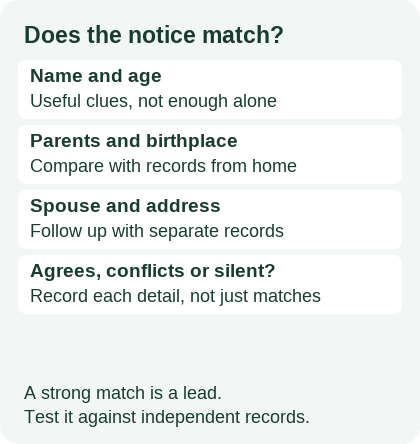
Emigrants often shared names with others from the same region, and a common name in a large colony can return hundreds of results. The details that matter are the ones a notice writer would have known from the family: parents' names, a birthplace, an age, a spouse, and a place of origin given as a village or county.
Make a three-column comparison: what the notice says, what your records from home say, and whether they agree, conflict or say nothing. Agreement on parents' names and birthplace is strong. Agreement on name and age alone is weak. A conflict in parents' names is a serious reason to keep the notice separate.
Remember that a family notice is written by someone after the event, often in grief and sometimes years after the person left home. Its age and family details are that person's account. Our guide to finding an ancestor with a common name explains how to keep candidates apart while you test them.
Following a sister or aunt who married abroad
Women who emigrated single often married within a few years, and from then on appear in the papers under a married surname you may not know. The National Library of Australia's guide suggests searching a wife's married name among your variants, and the State Library of Queensland lists the married names of women among the details that funeral notices can supply.
Our guide to finding female ancestors in old newspapers gives further name variants to try. Work from both directions. Search the maiden name with a parent's given name, using the Family Notices filter in Trove, in case a marriage notice names her father. Then, if you find a death or funeral notice for one of her parents' other children, read it for a line such as "Mrs." followed by a husband's name and a town. That line can give you the married surname to search next.
Be careful with what that line establishes. "Mrs. T. Walsh, of Marralong" in a list of mourners or surviving relatives identifies a woman only through her husband's initial and surname. It does not give her own given name or show which daughter she was if more than one sister emigrated. Look for a marriage notice or a civil marriage record that names her and her parents before you attach the married name to your relative.
Once you are confident of the link, a Trove tag recording her maiden name, which the National Library of Australia suggests as a use for tags, can help other researchers find the same article. Make sure any tag you add concerns someone who is no longer living.
Correcting text, tags and lists on Trove
Trove lets signed-in users correct the OCR text. The National Library of Australia's guide asks volunteers to make the text match the printed page exactly, without adding punctuation or improving the wording, and to focus on names and terms people are likely to search for. Your correction can help the next person searching for the same family.
Trove also offers tags, notes and lists. A tag might record a woman's maiden name so that she can be found under it. Lists let you gather all the articles about one person. The guide notes that public tags, notes and lists are visible to other users, and its speaker advised against listing living people in public lists. Do not put information about living relatives into a public list.
When the relative does not appear
Possible reasons include a title not digitised for the years you need, a misread name, a different spelling or name used in the new country, a move to a region whose papers are not online, or simply no newspaper coverage at all.
If a New Zealand title is missing online, ask the National Library of New Zealand or a local library about surviving paper or microfilm copies. The State Library of Queensland guide explains that most older Queensland papers are on microfilm and can be found through its catalogue. Other state libraries hold similar collections.
Record which collections, titles, years, search terms and filters you used. A clear note of what you searched will tell you what to try next, and our guide to building a newspaper coverage map shows a useful way to lay it out.

Record what you find
For each item, record the collection, the newspaper title, place of publication, issue date, page, and the article's permanent link. The National Library of Australia's guide says each Trove article has an identifier you can use for a permanent link. Transcribe the notice exactly, including abbreviations and any line about other papers.
Keep interpretation separate: "Death notice, Marralong Advocate, 3 August 1912: Robert Fennick, 61, son of the late James and Margaret Fennick of Dunlay. Parents and village match family Bible. Next: civil death registration; search Scottish papers near Dunlay, August to October 1912." Our guide to verifying and preserving a newspaper discovery has a full checklist.
Try a Trove or Papers Past search this week
Choose one relative and use the country-specific search route above with the facts you have. Save a promising notice, or record the titles, dates and searches that produced no useful match.
Keep the event date separate from the issue date. Compare the notice's family and place details with your records from home, note conflicts, and choose the next independent record to check. A matching name alone is not an identification.