
Ships and voyages
How to use old newspaper shipping news to find an ancestor's voyage
Use old newspaper shipping columns to identify a likely ship and arrival date, then see what printed passenger lists can and cannot establish.

On this page
- What shipping columns contain
- Where passenger names were printed
- Search for the column, then the ship
- Read an arrival entry
- Follow a fictional shipping clue to the next record
- What a printed passenger list can show
- From the newspaper to the official passenger list
- Before 1820 and outside the official lists
- Check departure notices and shipping advertisements
- Repeated reports and reprints
- When nothing turns up
- Record each item with the voyage details
- Try a shipping-news search this week
- Sources
Port newspapers printed a running record of ships coming and going: when each vessel arrived, where it had sailed from, how long the voyage took and who commanded it. Some of those columns also printed names of passengers. If you know or suspect the ship your ancestor travelled on, the shipping news can confirm the arrival date and describe the voyage. If you know only an approximate date, it can help you decide which ships to check in the official passenger lists.
This guide focuses on arrivals at U.S. ports and the passenger records held by the U.S. National Archives. Newspaper practices and surviving records vary by place and period.
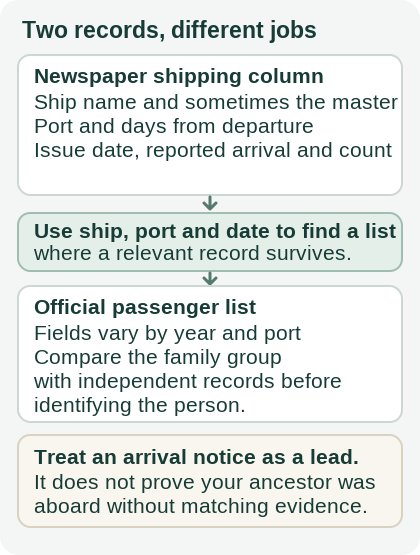
Set your expectations before you search. In many newspapers, especially the large New York papers, ordinary passengers were not named at all. Where lists were printed, they often named cabin passengers and gave only a total for steerage (the lower-cost passenger accommodation). So the newspaper is usually a tool for finding and dating the ship, with the official passenger list as the place to look for your ancestor's name.
Your first action is to search the free Library of Congress Chronicling America collection for the port's shipping column in the weeks around a possible U.S. arrival, then read the arrivals for that period. This guide explains what those columns contain, how to search them, what a printed passenger list can and cannot show, and how to connect a newspaper item to the passenger records held by the National Archives.
What shipping columns contain
The New York Public Library's research guide to maritime news in newspapers, updated in September 2026, lists what newspapers of the shipping era recorded about vessels: the port and date of departure, other ports called at, ships held at quarantine, the arrival date, the date a ship was "cleared" by customs, disasters at sea, the names of captains, cargo and passenger advertisements. It notes that in most New York City papers this information appeared near the back or on the last page, under headings such as "Ship News", "Shipping Intelligence", "Marine Intelligence", "Marine Journal", "Marine List" and "Harbor News".
The same guide says that passenger names were typically not listed, with two exceptions: a well-known person or society figure, and a death at sea. That is an important warning for anyone hoping to find an immigrant ancestor by name in a New York paper.
Practice varied between ports and periods. A New England Historic Genealogical Society class handout by Hallie Kirchner, Navigating Passenger Lists: Arrivals to the United States, describes arrival notices that may name cabin passengers, give the total number aboard, record births and deaths at sea and state the length of the voyage. It adds that partial passenger lists of wrecked ships were often published.
Where passenger names were printed
Some ports' papers printed fuller lists. A transcription on the Maritime Heritage Project site of the Daily Alta California's "Shipping Intelligence" for 17 June 1853 lists the steamer Sierra Nevada, arriving at San Francisco from San Juan via Acapulco with 400 passengers. Most cabin passengers are named, often with initials and entries such as a man with "wife and five children". The list ends with a count of 219 passengers in steerage, who are not named.
A transcription on SFgenealogy's California Bound pages of a list printed in the Stockton Daily Independent in August 1866 shows a different kind of item: a list sent from New York of people who had sailed for San Francisco on the steamship Northern Lights. It names individual passengers and notes that a large number in the second cabin and steerage also sailed without being listed.
These examples show a pattern worth expecting, though not a rule. Cabin passengers were named, families could appear under the head of household, and steerage passengers were counted rather than listed. A departure list printed in one place could also be reprinted elsewhere.
Search for the column, then the ship
Shipping columns were set in small type, full of abbreviations, ship names and captains' surnames. Searching for a passenger's name rarely works. Search for the column or the ship instead.
On the Chronicling America collection page, open Collection Items, expand Advanced Search and choose Pages (Full Text). The Library of Congress FAQ shows this route; its search tips explain phrase and proximity options. Limit by state, choose the port city's papers, and set a date range around the possible arrival. Then try:
- The ship's name alone, with All of these words selected. If the name is common, add the port of departure.
marine intelligenceorshipping intelligencewith This exact phrase selected, to find where the paper put its column.passengers arrivedwith These words within 5 words of each other selected.steeragewith the ship's name, using These words within 10 words of each other, for reports of voyages.
Once you know which page carried the shipping news, browse that page for every issue in your window. Note each arrival from the right part of the world, even if you are not sure of the ship's name. OCR (optical character recognition), the software that turns a scanned page into searchable text, can miss names in dense columns. Our guide to searching when OCR gets names wrong explains how to read the page image.
If your ancestor arrived at a port whose papers are not on Chronicling America, our guide to building a newspaper coverage map shows how to list the titles that served a place and check which issues survive.
Read an arrival entry
A typical arrival entry gives the type of vessel, its name, the master's surname, the number of days from the port of departure, the cargo and sometimes the consignee or agent, and the number of passengers. Abbreviations were common, such as "mdse." for merchandise. Copy the entry exactly before you interpret it.
Pay attention to the subheading and wording. An arrival date, a customs-clearance date and a sailing date are different events. The NYPL guide defines a ship being "cleared" as being allowed through customs. Record the exact heading before you interpret the date; only a line reporting an arrival tells you the ship reached that port.
The issue date is when the paper reported the arrival, which may be a day or more after the ship came in. If the entry says "arrived yesterday" or gives a day of the week, calculate the arrival date and record both.
Follow a fictional shipping clue to the next record
Everything in this example is invented: the people, the ship, the newspaper, the ports, the dates and the wording. None of these items exists in any archive, and no real port's practice is being described.
Suppose a family letter says your ancestor Agnes Morrow "came over with her two boys in the spring of 1868 on the Bellhaven". A later census entry gives her year of arrival as 1868. You have not found her in a passenger index.
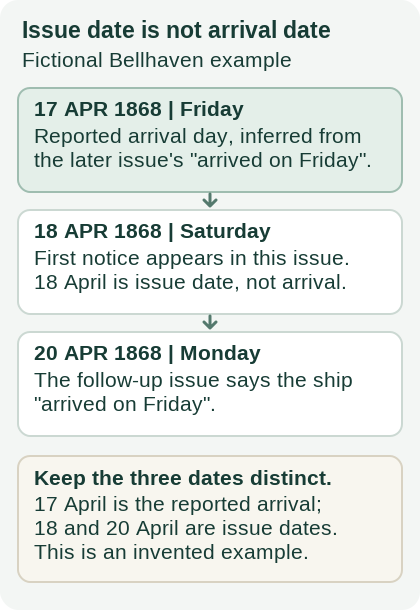
You search the invented Eastport Morning Courier for Bellhaven with the date range March to June 1868 and find two items. The first, under "Marine Intelligence" in the issue dated 18 April 1868, reads: "Arrived. Ship Bellhaven, Grant, 41 days from Greenock, with mdse. and 212 passengers." The second, in the issue dated 20 April 1868, is a short paragraph: "The Bellhaven, which arrived on Friday, reports two deaths and one birth among her steerage passengers on the voyage."
Because 20 April 1868 was a Monday, "arrived on Friday" points to Friday 17 April. In this fictional example, record 17 April as the arrival date reported by the follow-up, and 18 and 20 April as issue dates. The first notice appeared in the 18 April issue, so do not treat that masthead date as the arrival date. The two reports may describe the same arrival.
Here is what you can record. The 18 April issue reports the Bellhaven, master Grant, 41 days from Greenock, with 212 passengers. The follow-up in the 20 April issue says the ship arrived Friday, 17 April; it also mentions two deaths and a birth in steerage.
Here is what you cannot record. Agnes is not named. You do not know that she was aboard, that she sailed in steerage, or that this Bellhaven is the ship in the family letter, since more than one vessel could share a name. And "41 days from Greenock" describes the voyage the paper reported, not where Agnes boarded.
What the newspaper has given you is a port, a reported arrival date and a ship's name to guide the next search. Check the April 1868 passenger list for that port, if a relevant official list survives. If Agnes appears with two boys of plausible ages, compare the group with independent records; the newspaper is supporting context, not proof that she was aboard. If she is absent, record the search and check whether the list survives and is complete before treating it as a negative result.
What a printed passenger list can show
When a newspaper does print names, the list can be very useful. It may give a family group, a title such as "Mrs." or "Miss", or a place of origin. It is also limited.
The examples above show that a newspaper list may omit passengers or shorten family entries, so it may not match the official passenger list. Spellings can differ, and steerage passengers are often missing entirely. Family members may be reduced to "and family" or "wife and five children". A woman listed as "Mrs. J. Morrow" is identified only through her husband, which does not tell you her given name or show which Mrs. Morrow she was.
A name in a printed list is a lead. It shows that the newspaper reported a person of that name on that ship. Test it against the official list and other records before attaching it to your ancestor. Our guide to finding an ancestor with a common name explains how to keep similar names apart.
From the newspaper to the official passenger list
The National Archives' Immigration Records guide says passenger arrival lists from foreign ports cover about 1820 through December 1982, with gaps, and are arranged by port. Records older than 75 years are public, though online access varies; NARA notes that access to some later records is limited. For arrivals from December 1982 onward, it directs researchers to USCIS. The guide also says passenger lists generally were not required before 1 January 1820, with exceptions for New Orleans from 1813 and Philadelphia from 1800. It links to FamilySearch, a free resource, and subscription sites that are free to use in National Archives research rooms.
The NEHGS handout explains how the official lists changed. Under the Steerage Act of 1819, captains reported names, ages, sex and occupations. An 1835 act added the part of the vessel where each passenger travelled, and the 1882 Passenger Act added native country, intended destination and other details. The amount you can learn from the official list depends on the period.
When you search an index, use what the newspaper gave you. A port, ship name and reported arrival date help you find the right list if a name search fails. Check whether the site offers browsing by port and date. If the paper reported several ships from the same region arriving within a few days, check each relevant list.
Before 1820 and outside the official lists
For arrivals before 1820, outside the exceptions above, there may be no federal list. Newspapers can then be one of the few contemporary sources for a voyage. The National Archives page points to printed indexes and bibliographies for pre-1820 passengers, such as Filby's Passenger and Immigration Lists Index.
For any period, a newspaper may record a voyage that left little else: a shipwreck, a ship held at quarantine, a death at sea or a dispute aboard. The NEHGS handout notes that partial lists of wrecked ships were often published. Search the ship's name for several weeks after the arrival, because a later issue may report deaths, illness or legal action.
Check departure notices and shipping advertisements
Shipping news worked in both directions. The NYPL guide lists passenger advertisements among what the columns carried, and the NEHGS handout describes shipping companies and agents advertising departure dates, ticket prices and piers. These help you understand which lines ran from your ancestor's port of departure and how often.
If the ship sailed from Britain or Ireland, the departure may also have been reported in a home-town paper or a port paper there. Our guide to military, legal and migration news explains how departure and arrival reports can be linked across places, and our guide to immigrant-language newspapers covers community papers that may have reported arrivals among their readers.
Repeated reports and reprints
A ship's arrival might be reported in several papers in the same city, and a passenger list might be reprinted in other towns, as the Stockton example shows. Count these as one report printed several times, not as independent confirmation. A paper inland reprinting a port paper's list adds no new evidence about who was aboard.
A follow-up story can add new information, such as deaths or quarantine. Record it as a separate item with its own date.
When nothing turns up
If you cannot find the ship, check the basics. Was the port the one you think? A family story about landing in one city may describe the end of a longer journey through another port. Was the year right? An arrival year in a census was the household's own answer and may be approximate. Was the ship's name spelled differently, or abbreviated?
If the right papers are not digitised for your dates, our guide to free and library newspaper access explains how to ask a library for microfilm of specific issues.
Record what you searched: titles, dates, terms and pages browsed. "No arrival of the Bellhaven found in the Courier, March to June 1868, shipping column browsed" is a precise result that tells you where to look next.

Record each item with the voyage details
For each item, record the newspaper title, issue date, page and column heading, the subheading (arrived, cleared, sailed), and the entry exactly as printed: vessel type, name, master, days from port, cargo, number of passengers and any names. Note any later reports about the same ship.
Keep interpretation separate: "The Bellhaven, master Grant, was reported 41 days from Greenock with 212 passengers. The 20 April 1868 issue says it arrived Friday, 17 April; 18 and 20 April are issue dates. Agnes is not named. Next: check the April passenger list for the port, if one survives." Our guide to verifying and preserving a newspaper discovery has a full checklist for citations.
Try a shipping-news search this week
Choose one ancestor whose arrival year and port you know or suspect. Write down the source of each piece of information, and the ship's name if any record gives it.
Find the port city's newspapers for that year on Chronicling America or another free collection. Search marine intelligence and shipping intelligence as exact phrases to find the column, then browse it for a two-month window around the likely arrival. If you have a ship's name, search it with All of these words across the whole year.
List every arrival from the right region in your window: date, ship, master, days out, passengers. Mark any printed names that might be your family.
Then open the official passenger lists for that port, through FamilySearch or another index, and check the ships on your list. If the index search fails, browse the list for each ship's arrival date.
If you find nothing, widen the window by three months on each side, consider a different port, and record which papers, dates and ships you have checked.
Sources
- New York Public Library: Maritime news, newspapers for genealogy research guide
- New England Historic Genealogical Society (Hallie Kirchner): Navigating passenger lists, class 1 handout (PDF)
- Maritime Heritage Project: Daily Alta California shipping intelligence, 17 June 1853 (transcription)
- SFgenealogy, California Bound: Northern Lights passenger list, Stockton Daily Independent, 1866 (transcription)
- National Archives: Immigration Records
- Library of Congress: Chronicling America FAQ
- Library of Congress: Tips for searching in Chronicling America