
Estates and probate
How to find an ancestor's estate notice in an old newspaper
Find administrator's and executor's notices in old newspapers, read their dates and names carefully, and use them to locate the probate file behind them.

On this page
- Search for the legal wording, not just the name
- Worked example: turn an estate notice into a probate-file request
- What an estate notice usually tells you
- What the probate file may contain
- Browse the legal page once you know where it is
- Read the several dates separately
- Do not assume the administrator or executor was family
- "Late of" a place is a claim about residence
- Find the records holder and request the probate file
- When you cannot find a notice
- Record the notice and the trail it opens
- Try an estate notice search this week
- Sources
For historical US research, start with the free Chronicling America newspaper collection.
- Choose the likely county and newspaper titles. If you do not know which papers served the town, first identify the likely newspaper titles.
- In Pages (Full Text), search your surname with
deceased, choosing All of these words. - Start with the suspected death year and the following three years. Widen the window if the date is uncertain or later estate activity is relevant.
If Chronicling America lacks the newspaper or years you need, find your state's free historic newspaper collection before widening the search elsewhere.
Keep a note of the title, date range and query. A notice can identify a court and appointment date even when it does not identify a spouse or give the death date.
When someone died owning property or owing money, the person handling the estate often had to tell the public. In many places that meant a short notice in the local newspaper, usually headed "Administrator's Notice", "Executor's Notice", "Notice to Creditors" or simply "Estate of ..., deceased". These notices can survive when no obituary was printed. They name the person who died, the person appointed to settle the estate and a date, and they point you toward a court file that may hold far more.
Search for the legal wording, not just the name
Estate notices sit among dense legal advertisements in small type, so name searches often fail. Search for the words the notice had to contain, then narrow by surname.
On Chronicling America, open Collection Items, expand Advanced Search and choose Pages (Full Text). The Library of Congress explains the options in its tips for searching Chronicling America. Set the state, the newspaper title and a date window running from the likely death to three years afterwards. Then try:
- Your surname and
deceased, with All of these words selected. - Your surname and
estate, with These words within 5 words of each other selected. letters of administration(court authority to administer an estate), with This exact phrase selected, then browse the results by date.notice to creditors, with This exact phrase selected.letters testamentary(court authority for an executor to act under a will), with This exact phrase selected, for estates with a will.final settlementorfinal account, with This exact phrase selected, for later stages.
Try a search without apostrophes. "Administrator's Notice" may be indexed as "Administrators", "Administrator s" or something garbled. Proximity changes the allowed spacing between your required words, not their spelling. Try shorter terms or spelling variants as separate searches when the machine-read text is wrong.
If your surname is common, add a given name with "within 5 words". If it is unusual, try it alone with estate across a wide window. Optical character recognition (OCR) is the machine-generated text from page images. Our guide to searching when OCR gets names wrong explains how to work from page images when the text layer fails.
Worked example: turn an estate notice into a probate-file request
Everything in this example is invented: the people, Dunmore County, the newspaper, the court and all dates. Dunmore County is not a real jurisdiction, and no record of these people exists in any archive.
Suppose your family notes say Josiah Pellerin, a blacksmith, died "about 1871". You have him in an 1870 census household with a woman named Ruth, aged 45, and three children. You have no death record and no obituary.
You search the invented Dunmore Sentinel for Pellerin deceased across 1870 to 1873 and find this notice on page 3 of the issue of 9 March 1871:
"ADMINISTRATRIX'S NOTICE. Estate of Josiah Pellerin, late of Harrow Township, deceased. Letters of administration on the above estate having been granted to the undersigned by the Probate Court of Dunmore County at its February term, all persons indebted are requested to make payment, and those having claims will present them duly authenticated for settlement. RUTH PELLERIN, Administratrix. February 28, 1871."
Here is what you can safely record:
- The Sentinel of 9 March 1871 printed an administratrix's notice for the estate of Josiah Pellerin, described as late of Harrow Township.
- The notice is dated 28 February 1871 and says letters of administration were granted at the court's February term.
- "Administratrix" is the historical female form of administrator. This notice does not mention a will; the title does not establish whether a will existed.
And here is what you cannot yet record: an exact date of death, that Ruth was Josiah's wife, or the names of his heirs. The death happened before the February term, but the notice does not say when. Ruth's surname and the 1870 census household make her relationship worth testing, but neither this notice nor the 1870 US census household establishes that she was his wife. The 1870 schedule has no relationship-to-head column. Look for a probate petition or marriage record that actually states the relationship. An administrator could also be a grown child, another relative or a creditor.
The next action follows directly from the notice. Write to or search the holdings of the court or archive that kept Dunmore County probate files and ask for the estate file of Josiah Pellerin, administration granted February term 1871. That file may contain a petition naming his widow and heirs, an inventory and a final account.
What an estate notice usually tells you
Look for these details in the notice you find; not every notice contains all of them:
- The name of the person who died, sometimes with "late of" a place.
- The name of the estate representative, described as an administrator or executor.
- The court and the term or date when that person was appointed.
- A deadline or instruction for creditors and debtors.
- A date when the notice was signed, separate from the newspaper's issue date.
DoHistory's guide to probate records, produced with help from the New Hampshire State Archives, explains the basic vocabulary. An executor is usually named in a will; an administrator often handles an estate without a will. These are starting clues, not conclusive findings. The California Courts explanation of estate representatives shows that a court may also need to choose a representative when a will names nobody able to act. Historical terminology and rules varied. An administrator's title alone does not establish whether a will existed. Check the appointment and probate file. "Testate" means the person left a will and "intestate" means they did not.
What the probate file may contain
An obituary depended on someone deciding a death was newsworthy. An estate notice depended on a legal process. That means someone with modest property may appear in the legal notices even if the paper never reported the death in its news columns.
The notice also gives you a route into court records. Probate courts kept files with inventories, accounts and the names of heirs. The Delaware Public Archives' catalogue description of New Castle County estate files lists inventories, lists of sales, debts, administration and distribution accounts, guardian accounts and administrators' bonds among what such files can contain. The same description says entries name the heirs. A newspaper notice usually does not.
So treat the notice as a pointer. Its value lies in the name of the court, the date of appointment and the name of the person in charge, because those let you find the file.
Browse the legal page once you know where it is
Most county papers grouped legal notices together. Once you have found one estate notice in a paper, note the page and column where the paper placed them. Start by browsing a few nearby issues and record where you stop; expand through the window as time and surviving issues allow, because the next notice for your family may be unreadable to the search engine.
Our guide to military, legal and migration news points out that some notices ran for several weeks because the law required repeated publication, and that the first and last appearances may differ in layout. For estate work this matters in two ways. You may see the same notice repeatedly; mark these as repeat appearances, not independent corroboration. And the run of repeats can help you find the first appearance, which may be closest to the court appointment.
Look for other notices about the same estate months or years later. Depending on the place and period, you might see a notice of an appraisal, a sale of personal property, a petition to sell land to pay debts, a guardian's appointment for minor children, or a call for final settlement. Each later notice may add a name or a date.
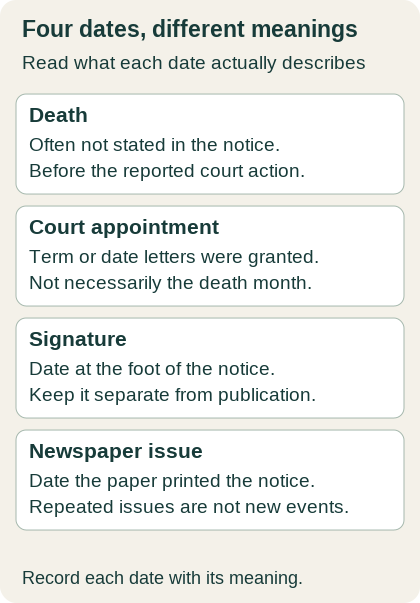
Read the several dates separately
An estate notice can carry four or more dates, and each means something different.
The date of death is rarely stated. The notice tells you only that the person had died before the court acted.
The court date is given as a term, a session or a specific day when letters were granted.
The signature date is the date written at the foot of the notice by the administrator or executor.
The issue date is the date of the newspaper in which you found it, and it may be one of several weeks the notice ran.
If you need the death date itself, the notice narrows the search for an obituary or death notice, a burial record or a death register. Start before the court term, but do not rule out later newspaper reports: an estate may be opened long after the death.
Do not assume the administrator or executor was family
The person who signs the notice was appointed by the court, but the notice rarely says why. A widow, an adult child, a brother, a son-in-law, a neighbour or a creditor could all serve, depending on the law and the family's situation. The notice gives a name, not a relationship.
When the signer shares the deceased's surname, it is tempting to call them the spouse or child. Keep that as a hypothesis. A woman described as "administratrix" with the same surname might be a widow, a daughter or a daughter-in-law. If the probate file includes a petition, it may state her relationship and list heirs. That is the record that answers the question.
When more than one person signs, as co-executors or co-administrators, record all names exactly. They may be relatives, but they may also be trusted local men named in a will. Do not build a sibling group or a list of children from the signers alone.
If the deceased had a common name, check that the "late of" place and the timing fit your ancestor before you attach the notice to them. Our guide to finding an ancestor with a common name shows how to keep candidates separate while you check.
"Late of" a place is a claim about residence
Many notices describe the deceased as "late of" a township, town or county. That phrase usually indicates where the person lived at death, which can be useful when you have lost track of an elderly ancestor. Treat it as the administrator's statement, made for a legal purpose, and check it against a census, a tax list or a burial record.
The place in the notice may also differ from the place of the newspaper. A county paper might carry notices for people from every township, and a person who died away from home might have their estate handled where they owned property. Our guide to finding an ancestor's address explains how to keep dated place clues in order without assuming they describe continuous residence.
Find the records holder and request the probate file
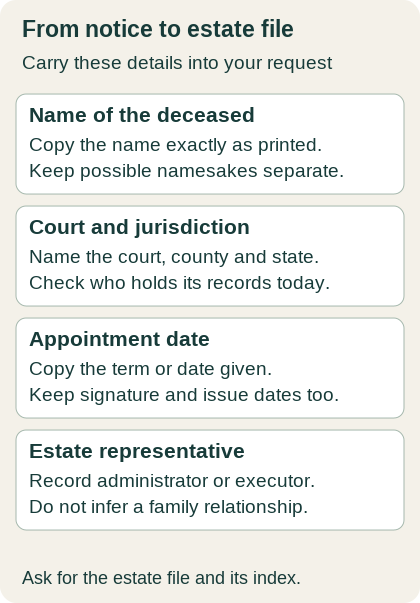
Write down the court named in the notice, the term or date of appointment, the name of the deceased and the name of the administrator or executor. Those four details are what a court clerk or archivist needs.
Then find out who holds the records today. Arrangements differ between states and periods. Older files may have moved to a state or local archive, while later files may remain with the court. Confirm the county, state, court and period with the holding institution; do not assume one state's arrangement applies elsewhere. Search for the state archives' probate guide and the county court's records page before you write.
When you request the file, give the notice's details and ask what the file contains and how it can be consulted. Some files have been microfilmed or digitised. Others must be requested from the court. If the clerk cannot find a file, ask whether docket books or record books list the estate. A New England Historic Genealogical Society class handout on locating probate records advises checking probate record books when file papers are listed as missing.
You can adapt this request, replacing the brackets with your own details:
"Please check your probate index for [full name], whose estate was handled in [county, state], with administration or an executor's appointment reported as [date or court term]. The newspaper notice names [representative's name]. If you locate an entry, please tell me the estate-file reference, how I can consult or obtain a copy, and any fees."
When you cannot find a notice
There are several reasons a search may come up empty. The paper may not survive for the relevant months, or may not be digitised. The notice may have run in a different paper in the same county, especially if there were rival papers. The estate may not have gone through probate at all, perhaps because there was little property or because land passed in another way. Or the requirement to publish may not have applied in that place and period.
Check the court's own records as well. A docket index or an index of estates can tell you whether an estate existed, and then the date of appointment can send you back to the newspapers with a precise target.
If the issues you need are not online, our guide to free and library newspaper access explains how to ask a library about microfilm for specific dates.
Record exactly what you searched: titles, date ranges, search terms and pages browsed. "No estate notice found in the Sentinel, issues January 1871 to December 1873 browsed, legal page" is a precise negative result. It does not show that no estate existed.
Record the notice and the trail it opens
For each notice, save the newspaper title, place of publication, issue date, page and column, the heading as printed and the full text. Note every date in the notice with its meaning. List each appearance separately, then mark them as repeats of one notice.
Keep your interpretation in a separate note. For example: "Ruth Pellerin was appointed administratrix of Josiah's estate at the February 1871 term. Relationship not stated in the notice. Next: request the estate file to check the petition for her relationship and the heirs' names."
When you obtain the probate file, note which details confirm, add to or contradict the notice. If the file names Ruth as widow, you now have a court record for that relationship rather than an inference from a shared surname.
Try an estate notice search this week
Choose one ancestor who died owning a farm, a house or a business, and for whom you have an approximate death year and a county.
Check which newspapers served that county in that period and whether any are free online. In Chronicling America Pages (Full Text), limit to those titles and a window from the likely death year to three years after. Search the surname with deceased using All of these words, then the surname with estate within 5 words, then letters of administration as an exact phrase.
When you find any estate notice, even for another family, note where the paper placed legal notices. Start with a few issues and expand through the window as time and surviving issues allow; record which you actually inspected.
For any notice about your ancestor, record the court, the appointment date, the signer and all dates as printed. Then look up who holds that county's probate files for the period, and write a request naming the estate and the term.
If you find nothing, search the county court or state archive for an estate index first, then return to the newspapers with the appointment date in hand.
Sources
- DoHistory: Probate records
- Delaware Public Archives: New Castle County Register of Wills, estate files (series description, PDF)
- Library of Congress: Tips for searching in Chronicling America
- New England Historic Genealogical Society (Melanie McComb): Class 3 probate handout, PDF
- California Courts: Estate representative, current California example