
Debt and bankruptcy
How to find an ancestor's bankruptcy notice in old newspapers
Find an ancestor's bankruptcy or insolvency notice in historical US newspapers, identify the court and follow the case into surviving records.

On this page
- Search names with bankruptcy and insolvency terms
- When federal bankruptcy law applied
- What a bankruptcy notice usually tells you
- Worked example: an incomplete court name needs more research
- Separate newspaper dates from court dates
- Check the debtor's identity and other names
- What the federal case file may contain
- Find the records holder and request the bankruptcy file
- State insolvency between the federal acts
- If your family was in Britain
- When you find nothing
- Record the notice and the case trail
- Sources
A bankruptcy notice can name a court and a case number, giving you a route to records of an ancestor's debts and property. It does not, by itself, explain why a business closed or prove how the case ended. This guide focuses on historical US records, with a separate British route below.
Start with a place and a five-year window around the suspected trouble:
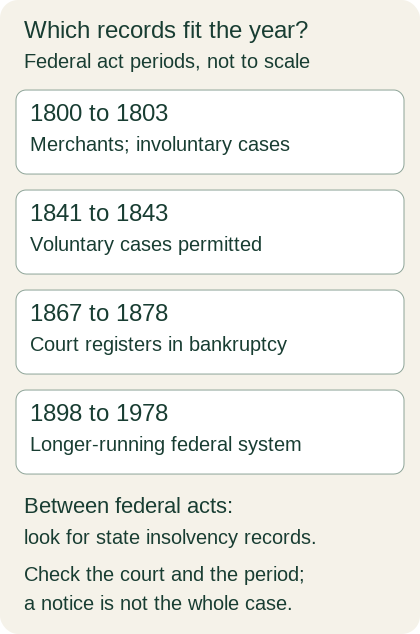
- Check when federal bankruptcy law applied. Between those periods, look for state insolvency records instead.
- Start with the official Chronicling America search guide, which links to the free newspaper collection. In the collection, choose Collection Items and search Pages (Full Text).
- Try your ancestor's surname with
bankruptwithin 10 words, limited to the state and your five-year window. Between federal acts, also tryinsolventandassignment(property transferred for creditors' benefit). If nothing appears, broaden the years and check other titles.
Search names with bankruptcy and insolvency terms
Bankruptcy notices were usually legal advertisements in small type. Search for the words the notice had to use, then narrow by name and place.
On Chronicling America, open Collection Items, expand Advanced Search and choose Pages (Full Text). The Library of Congress explains these options in its tips for searching Chronicling America. Limit by state and set a date range covering the years before and after the trouble you suspect. Then try:
- Your surname and
bankruptwith These words within 10 words of each other selected. in bankruptcywith This exact phrase, then browse results by date for your county.adjudged a bankruptwith This exact phrase.meeting of creditorswith your surname or town, using These words within 10 words of each other.petition for dischargeordischargewith your surname, within 10 words.- For state insolvency,
insolventorassignmentwith your surname, within 10 words.
Once you have found one notice, note where the paper printed legal notices and browse that page in later issues. A case might produce several notices over months or years. Our guide to searching when OCR gets names wrong explains how to read dense legal columns from the page image.
Look at news columns too. A local paper might report a business failure or a creditors' meeting as news, which can give you a date to search the legal notices around.
When federal bankruptcy law applied
The United States did not have a permanent federal bankruptcy law for most of the nineteenth century. A National Archives handout by archivist Jessica Hopkins for the 2015 Virtual Genealogy Fair, on bankruptcy records, sets out the main federal acts:
- The 1800 act was limited to merchants and to involuntary cases, and was repealed in 1803.
- The 1841 act allowed voluntary bankruptcy for any individual, with discharge of debts, and was repealed in 1843.
- The 1867 act allowed involuntary bankruptcy for any individual, created registers in bankruptcy appointed by the courts, and was repealed in 1878.
- The 1898 act allowed individuals to file voluntarily, allowed anyone owing $1,000 or more to be declared bankrupt involuntarily, and remained in force until 1978.
The handout explains that between federal acts, states ran their own systems for insolvent debtors. So a debt crisis in 1810, 1855 or 1885 would usually have been handled under state law, and the notices and records would be different.
Two terms recur. A voluntary case was one the debtor began. An involuntary case was one the creditors began. A notice may not tell you which, so do not assume your ancestor chose to file.
What a bankruptcy notice usually tells you
Bankruptcy cases moved through stages, and newspapers printed notices at several of them. Hopkins lists newspaper articles as a clue to bankruptcy and shows, as an example, a 1923 notice announcing the first meeting of creditors in the case of Laugh-O-Gram Films, with an affidavit confirming publication in Kansas City newspapers.
The exact notices varied with the law and the court, so treat this list as possibilities to look for rather than a fixed sequence:
- A notice that a person has been declared bankrupt, sometimes with a warning not to pay debts to the bankrupt or deliver property to them.
- A call for creditors to meet, prove their debts and choose an assignee or trustee, the person appointed to manage the property.
- A notice of sale of the bankrupt's property.
- A notice that the bankrupt has applied for discharge (release from debts covered by the order), giving creditors a date to object.
- A notice of discharge, or of a final meeting.
A notice may name the debtor, residence or occupation, court, case number or docket reference, and one or more dates. Not every notice supplies all of these details. Some name the officer who handled the case. None of them is the whole case.
Worked example: an incomplete court name needs more research
Everything in this example is invented: the person, the business, the town, the court district, the newspaper, the case number and all dates. No real court or person is described, and none of these items exists in any archive.
Suppose a family story says your ancestor Elias Varne "lost the hardware store" in the early 1900s and the family moved west soon after. You have him in a 1900 census entry as a hardware merchant in the invented town of Carroway, and in 1910 as a clerk in another state.
After an initial 1900 to 1904 search finds no notice, you broaden the years. You search the invented Carroway Weekly Mirror for Varne bankrupt with These words within 10 words of each other, for 1900 to 1910, and find this on page 6 of the issue of 14 March 1905:
"IN BANKRUPTCY. In the District Court of the United States for the Eastern District. In the matter of Elias Varne, bankrupt, No. 1142. To the creditors of Elias Varne, of Carroway, hardware merchant: Notice is hereby given that on March 6, 1905, the said Elias Varne was duly adjudged a bankrupt, and that the first meeting of his creditors will be held at the office of the referee on March 24, 1905, at which time the creditors may attend, prove their claims, appoint a trustee, examine the bankrupt and transact such other business as may properly come before said meeting."
Here is what you can record. The Mirror of 14 March 1905 printed a notice that Elias Varne, described as of Carroway, hardware merchant, was adjudged bankrupt (formally declared bankrupt by the court) on 6 March 1905 in the federal district court, case number 1142, with a first meeting of creditors set for 24 March 1905.
What the notice does not establish on its own: The notice does not say whether Elias filed himself or whether creditors forced the case. It does not list his debts, his creditors or his property. It does not tell you whether he was later discharged, or whether the family's move west followed from the case. The case file and later notices may help answer those questions; do not assume every answer survives.
The useful result is a partial court name, a case number and a date. "Eastern District" alone does not identify a court. Establish the state and full federal district before requesting a file, and check whether a division is needed. In this deliberately incomplete fictional notice, the state is not supplied. In a real search, check the complete notice, other notices in the case and court indexes to establish it. Treat these as starting identifiers to check against the archive's requirements, not a guarantee that a file survives.
Separate newspaper dates from court dates
A single notice may contain several dates: when the person was adjudged bankrupt or when the petition was filed, when a meeting or hearing would take place, and when the notice was signed. The newspaper's issue date is another. Notices often ran for more than one week, so the same text may appear in several issues.
Record each date with its meaning. In the fictional example, the adjudication was on 6 March, the notice was printed on 14 March, and the meeting was set for 24 March. None of these is the date the business failed or the date the case ended.
Identify the stage of each notice. A first-meeting notice is near the start. A notice of application for discharge is near the end. If you find only a late-stage notice, search backwards for the earlier ones.
Check the debtor's identity and other names
Bankruptcy notices name the debtor and sometimes officers of the court. They rarely name family members. A wife may appear only if she was a party in her own right, as a co-owner, creditor or claimant. A notice naming only "Mrs. Varne" does not establish her first name, her identity or her relationship to the debtor.
If the debtor was a partnership or firm, the notice may name the firm and its partners. Partners were not necessarily relatives, even if they shared a surname. Our guide to tracing a family business through newspaper advertisements explains how to read partnership, dissolution and auction notices, which often appear around the same time as a failure.
If your ancestor's name was common, check that the residence and occupation in the notice fit before attaching it to your family. Our guide to finding an ancestor with a common name shows how to keep candidates separate.
What the federal case file may contain
The court file is where the detail is. Hopkins' handout lists what files may include: petitions, schedules of debts with creditors' names and addresses, inventories of real and personal property, creditors' claims, testimony transcripts, court orders, final decrees and discharges. She describes the schedules as detailed lists of assets and liabilities filed with the petition.
The National Archives' page on bankruptcy case files at its Kansas City facility says the files can show everything an individual owned and to whom they owed money. That can reveal a farm's livestock, a shop's stock, household furniture, and debts to relatives or neighbours, all with names and amounts.
Read those details as the debtor's sworn statement in a legal process. Values could be estimates, and some property might have been claimed as exempt. A relative listed as a creditor may have lent money, or may have been owed wages. The schedule tells you there was a claimed debt, not the story behind it.
Find the records holder and request the bankruptcy file
The National Archives' Kansas City page describes about 125,000 cubic feet of bankruptcy case files from federal district and bankruptcy courts. It asks requesters for the court name, the case number, the names of the parties and the filing period, and says cases filed from 1940 also need a transfer number from the original court. It also notes that bankruptcy files from 1940 and earlier are generally permanent records, while some later files were sampled.
Hopkins' handout explains how to find a case number if the newspaper did not give one: through case indexes, docket books arranged by case number, minute books searchable by date, and final record books, which sometimes contain information missing from the case file. It recommends the National Archives Catalog for locating the series for a particular court and period.
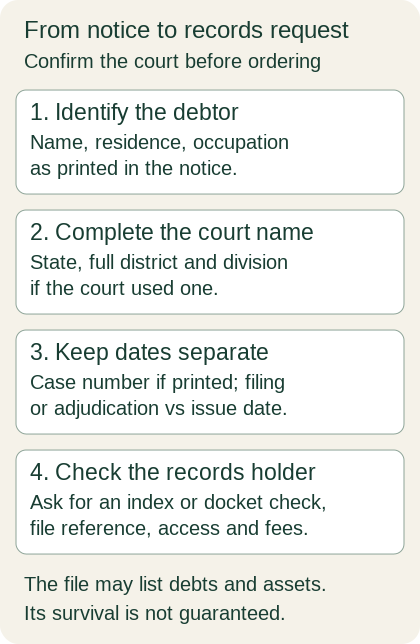
Confirm the state, full district and any division before choosing a repository. Then check that it holds that court's records for the relevant period. Do not assume every federal file is at Kansas City. Include the debtor's name, court, notice date and case number if known. Fees and procedures change, so check the archive's current instructions before ordering.
You can adapt this request once you have identified the court:
- Debtor: [name, residence and occupation as printed].
- Court: [state, full district and division if applicable].
- Case number: [number, or unknown].
- Dates: [filing or adjudication date if known; newspaper title, issue date and page].
- Request: Do you hold this court's bankruptcy records for this period? If so, could you check the index or docket for a file reference and advise on access, copy options and fees?
This asks the repository to check; it does not imply the file has already been located.
State insolvency between the federal acts
Outside the federal periods, look for state insolvency proceedings and for assignments for the benefit of creditors, in which a debtor transferred property to someone who would sell it and pay creditors. The records will be in state or county court collections, not the federal ones.
Search your state archives' catalogue for "insolvency", "insolvent debtors" or "assignments" for the county and period. A newspaper notice of an assignment or insolvency hearing gives you the court and date to look for.
If your family was in Britain
For ancestors in the United Kingdom, the official place for many bankruptcy and insolvency notices was not a local paper but the official Gazette. Paul Blake, writing for Who Do You Think You Are? magazine in 2024 on using the London Gazette in family history, explains that insolvency and bankruptcy notices appear there, that the Gazette's website is free to search, and that poor print quality makes OCR unreliable, so including several search criteria helps. Local papers may also have reported the case as news.
When you find nothing
Several explanations are possible. The trouble may not have reached a court at all: a business could close, sell up or settle privately with creditors. The case may have been in another county or district, or the notices may have run in a different paper. The issues may be missing online. Or your dates may fall in a period without a federal law, so the case would have been a state matter.
Check the court indexes as well as the newspapers. If the newspapers for your dates are not online, our guide to free and library newspaper access explains how to request microfilm of specific issues.
Record which titles, years and terms you searched. A precise negative result is useful, but it does not show that no case existed.
Record the notice and the case trail
For each notice, record the newspaper title, issue date, page and column, the heading, the court, the case number, the debtor's name, residence and occupation as printed, every date in the notice with its meaning, the stage of the case, and any other names. Note each issue in which the same notice appeared.
Keep interpretation separate: "Elias Varne, Carroway, hardware merchant, adjudged bankrupt 6 March 1905, case 1142, first meeting 24 March. Voluntary or involuntary unknown. Court: Eastern District, state and full district still unconfirmed. Next: establish the jurisdiction and records holder before requesting a case file; search for discharge notices from 1905 to 1907." Our guide to verifying and preserving a newspaper discovery has a full citation checklist.
Try a bankruptcy search this week
Choose one ancestor whose business or farm seems to have ended suddenly. Write down the county and a five-year window around the change, and check which bankruptcy law, if any, was in force in those years using the list above.
On Chronicling America, or the state's free newspaper site, search your surname with bankrupt within 10 words for that state and window. If the window falls between federal acts, search your surname with insolvent and with assignment instead.
When you find a notice, note the court, case number and stage. Browse the legal notices page forward through the next two years for later notices in the same case.
Then look up which archive holds that court's records for the period, using the National Archives Catalog for federal courts or your state archives' catalogue for state courts, and prepare a request with the details from the notice.
If you find nothing, check the court indexes for the district or county, then return to the newspapers with any case number or date you find.
Sources
- National Archives (Jessica Hopkins): Bankruptcy records, 2015 Virtual Genealogy Fair handout (PDF)
- National Archives: Bankruptcy case files at the National Archives at Kansas City
- Who Do You Think You Are? Magazine (Paul Blake): The London Gazette in family history (2024)
- Library of Congress: Tips for searching in Chronicling America