
Community sport and local papers
How to find an adult amateur athlete in old newspapers
A team name can be a better starting point than a surname. Follow an adult community side through its fixtures and reports, then check whether a player named in print is actually your relative.

On this page
- Start with a season, place and question
- Identify the adult team before chasing a player
- Find the papers that printed local sport
- Use fixtures to build a calendar
- Read match reports for roles, not just scores
- Treat rosters as dated snapshots
- Search name variants without inventing an alias
- Separate a sports-page mention from an identified relative
- Choose records that can test the right claim
- Record gaps and preserve each dated item
- Try one team-to-player search this week
- Common questions about amateur athletes in newspapers
- Sources and further reading
A family story says a relative played for the town team, but there is no trophy or program left. A local newspaper might hold the next clue: a fixture, a score, a short match report, or a list of players. You do not need a famous athlete or a major league to begin. You need a plausible place and season, and a way to tell one player from another.
This guide is about adult amateur, community and town teams, including clubs connected to a neighborhood, workplace or congregation. It is not a guide to school athletics or to identifying people in old newspaper photographs. A sports-page name is a lead. Even a repeated name in several reports does not, by itself, identify the person in your family tree.
Start with a season, place and question
Write down the facts you can already support outside sports coverage. Where did your relative live as an adult? What years can you place them there? Is the sport or club name in a dated family letter, an oral account, a program, or only a later guess? Give each fact its own source. A directory entry from one year does not prove residence throughout an entire playing career.
Turn the hunch into a question small enough to test: “Did an adult named M. Rivera play for the East Ward club during the season when my relative lived nearby?” That example is fictional, not a historical team or a reported newspaper item. “Was my ancestor a great athlete?” is much harder to answer and may invite you to read praise in a match report as biography.
Make a research note with separate fields for the relative's known name forms, town, possible age, address, employer, sport and date window. Put the remembered team name in a column marked unconfirmed until a contemporary source establishes it. An adult side might be labeled by its district, sponsor, workplace, ethnic association or home ground instead of the name used in family memory.
If you do not yet have a documented place and period, first frame a narrower newspaper research question. Resist searching every “Rivera” in an entire state. The team and season can give a common name the context it needs.
Identify the adult team before chasing a player
A name such as “Athletics” can describe more than one club. Record the printed team name exactly, then look for the town, neighborhood, home field, league, club officers, sponsor and opponents. Those details help you decide whether two mentions refer to the same organization. Do not merge two sides because they share a nickname or uniform color.
Check what kind of side the item actually describes. A factory club, church league, adult town eleven, independent baseball nine or recreational basketball team fits this search. A high-school varsity report does not become evidence about an adult player because the surname matches. College, junior and school teams have different research routes. A “city team” may also have fielded reserves or a second squad. If the article does not identify the age or affiliation, leave that question open.
The sport's own terminology may change from place to place. A baseball notice might call a side a nine; a football or soccer report might call it an eleven. Search the phrase the newspaper printed, not only the modern label you would use. A team can be mentioned in notices about grounds, travel, a benefit or a social meeting without any player list. Such items may still clarify which club played where.
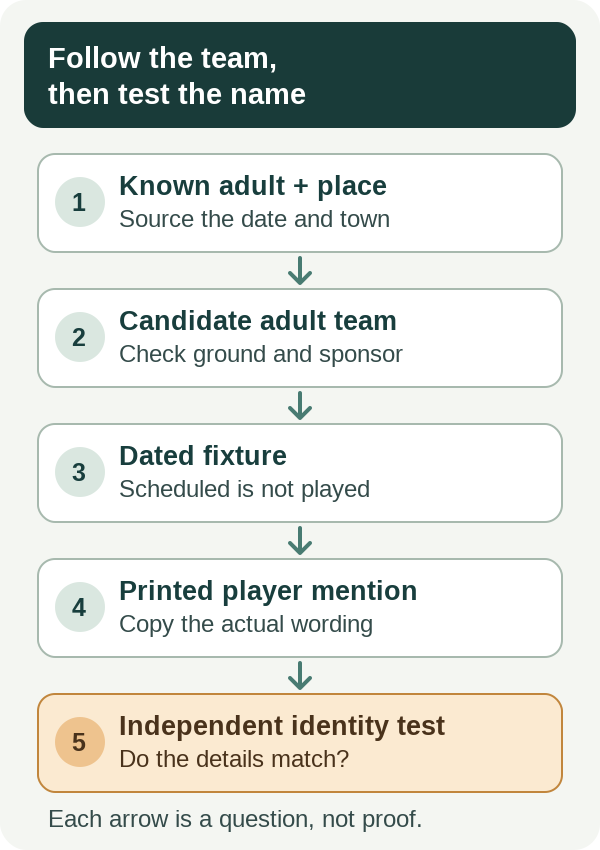
Draw a short trail: known adult and place → candidate team → dated fixture → report or roster → identity test. The arrows mark questions, not proven links. Do not write the person's name into the team box merely because a match happened nearby.
Find the papers that printed local sport
Look first for titles serving the team's actual community during the likely seasons, not a national sporting paper by default. A weekly from the home town may print a fixture or neighborhood result that a metropolitan daily ignored. A paper near an opponent's ground may supply the return match. Different communities could have their own press, so consider an additional community title when its readership and place fit the team you are tracing. If several titles seem plausible, choose the newspaper with a reason to cover that community before searching every archive.
The Library of Congress baseball holdings guide identifies newspapers as a research resource and specifically notes that its coverage for smaller minor-league cities is less comprehensive than for major cities, with state libraries often a more consistent route. That observation is about its holdings, not a promise that a state library has your town's paper. Adult amateur coverage may be smaller still. Check a state or local library's catalog, historical society and newspaper holdings before assuming a general database is complete.
For U.S. titles, the Library of Congress Directory of U.S. Newspapers search tips explain searching by title and filtering by place and date. Use the directory to locate candidate titles and holding libraries, then establish whether the particular season's issues survive and how to see them. A cataloged run is not a guarantee of every issue, and a digitized issue need not have usable searchable text. Our newspaper coverage map helps distinguish titles, actual dates inspected and missing weeks.
The University of Notre Dame's Sports Studies guide to historical newspapers and periodicals distinguishes open-access sporting publications and newspaper collections from subscription resources. Treat it as a route to possible sources, not evidence that a named team was covered. Before paying or requesting access, check which title, place, issue dates and page images a collection actually offers. For UK, Irish or other research, apply the same title-and-issue test at the relevant local library or newspaper repository rather than assuming a U.S. directory covers it.
Use fixtures to build a calendar
A fixture is a scheduled game, not a result and not proof that any particular person played. Search a likely title for the team, opponent, ground and dates near the season you can document. Short notices under “Saturday's games,” “coming matches” or club news may give a venue and time when they omit players. Write the planned game date separately from the newspaper issue date.
Build a small table with announced date, opponent, venue, source issue and what remains unconfirmed. Then inspect the issue after the scheduled match, allowing for the paper's publication rhythm. A weekly may carry a report several days later. If you find no report, do not silently promote the fixture to a completed game. Weather, postponement, travel or a printing gap may explain why a schedule and result do not line up; you need a source for whichever explanation you choose.
Try the opponent's name and neighboring towns if the home team produces no search result. A match can be reported from the visitors' point of view. When two papers describe the same encounter, compare date, score, field and team names before treating them as the same game. A result in one paper may amend an announced fixture in another. Keep both documents and your reconciliation visible.
This calendar does more than generate search dates. If a team name is common, a sequence of distinctive opponents and grounds helps identify the right side. If one report uses “East Ward” and the next “Wardmen,” their shared fixture may support a connection, but do not assume nicknames match without the contextual details.
Read match reports for roles, not just scores
Open the full page after a promising search hit. Read the headline, column heading, item boundaries and nearby results. A name beside a score may belong to the opposing side, a referee, umpire, manager, substitute, correspondent or scorer. In a brief item, “Rivera” might be a player; in a line of local notices it could be a sponsor or venue owner. Transcribe the wording before supplying a role.
A match report may offer several independent clues within the same item: an opponent, ground, position, score and a player's full name. These details can help connect reports across issues, but they all come from that one report. A report can also repeat a club's submitted account. Two newspapers using nearly identical prose may be copies rather than two independently observed games.
Be cautious with adjectives. “Veteran,” “star” or “local favorite” may describe how the reporter presented a player, not a verified age, residence or long career. A reported performance says what the paper claimed about that game. It does not establish the player's full identity or all games they played that season.
The Library of Congress Chronicling America FAQ explains that its searchable text comes from optical character recognition and can contain errors. Inspect the printed page image, especially for short names and scores. If a letter remains unclear, record the possible readings instead of silently correcting it to the surname you expect. Our OCR and page-image guide offers more ways to search around bad recognition.

Treat rosters as dated snapshots
A list headed “probable lineup,” “selected side,” “team for Sunday” or “players expected” describes a plan. A list printed after the game may give starters, substitutes or everyone who traveled, depending on the paper's wording. A season-end team list may refer to regular members, invitees or officials. Do not treat these forms as interchangeable, and do not assume everyone named took the field.
Record the list's heading, order, abbreviations and date. If positions are given, copy them. Then check a match report from the same fixture for confirmation that a named person actually appeared. Even agreement on a name may not settle a common-name identity. A player could switch sides, play for both a workplace and town club, or appear under an initial in one issue and a nickname in another. Those are possibilities to test, not extra biographical facts to assign.
If you find a club program or archive, read its description closely. The Smithsonian's finding aid for the Gilbert L. Friedlein Papers describes a semi-professional baseball connection alongside newspaper clippings, personal papers, photographs and a baseball contract. That is an example of types of records that can coexist in one sports-related collection, not proof that your own relative is in it, nor proof of what any individual clipping says. Semi-professional also is not the same status as amateur; use the finding aid to imagine record types to seek, not to relabel a team.
Search name variants without inventing an alias
Try full name, initials and surname, a plausible shortened forename, and documented spelling variants. Search the team and venue without the person's name too. A family member might be indexed as “M. Rivera,” printed with a middle initial, or described only as “the catcher.” A one-letter OCR error can bury a name, while a search for a role plus team may lead to the correct page.
Keep a note of where each variant came from. A nickname written in a relative's letter is different evidence from a nickname you guessed because it sounds likely. Search broadly, but do not add an unverified variant as a fact in your tree. If a match report prints “Rivers” where a later report prints “Rivera,” compare the team, position, opponent and date before deciding whether it is a misprint or two players.
Names can be abbreviated differently for women, immigrants and people whose names a local editor did not know well. A married name, maiden name or transliteration may matter, but the record has to support the connection. Our guide to finding women in old newspapers can help you keep those forms distinct. Do not infer that a woman named in a social notice is the player named only by surname in a sports item.
Separate a sports-page mention from an identified relative
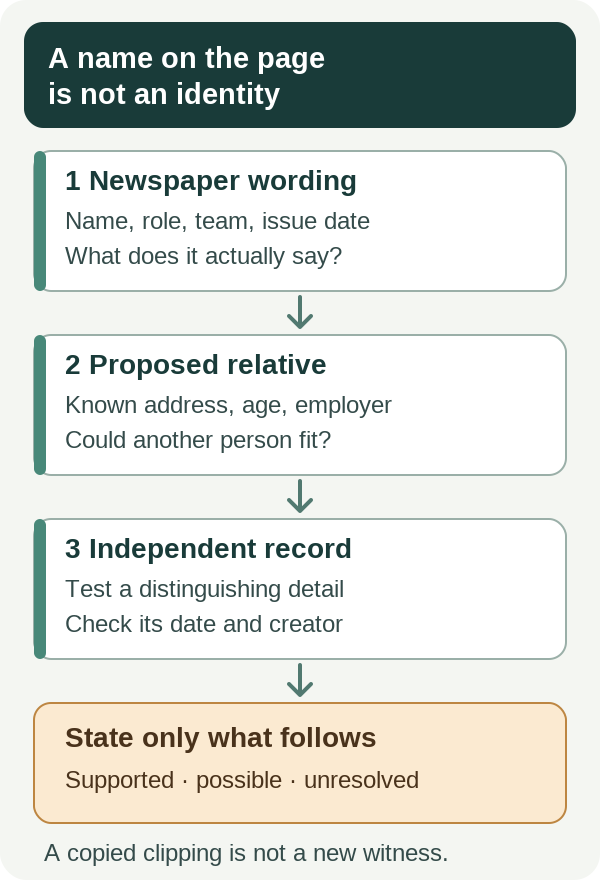
For a candidate hit, write three statements. The page says: quote the exact name and role, with title and issue date. The person I am researching: list independently sourced age, residence, occupation or family links. The unresolved match: say which detail actually connects the two and which detail could distinguish another person of the same name.
Imagine a fictional notice that says “M. Rivera, East Ward, at second base.” It could establish that the paper associated an M. Rivera with that side on that date, if the page really existed and read that way. The imagined notice here is only a teaching example; it is not a transcribed newspaper discovery. Even a real notice like it would not establish a full forename, address, kinship or an entire playing career. Finding three copies of the same surname does not fill those blanks.
Identity becomes stronger when several *discriminating* details agree: a full name and a street, an employer and club sponsor, or a known relative mentioned in an independent item. Date and town alone may be weak if the surname is common. Evaluate contradictions, too. If the likely player was reported in a different city while your relative was clearly elsewhere, preserve both candidate people instead of explaining away the conflict.
Choose records that can test the right claim
Match the outside record to the uncertainty. A census, city directory, residence record or dated letter might place a person in the community, but not prove they played a specific game. A club membership list, team minute book, dated program, employment record for a workplace side or signed personal paper may address different links. A surviving contract might speak to semi-professional status, whereas an unsigned clipping could simply repeat a reporter's label. Check who created each record and when.
The Smithsonian finding aid is useful precisely because it lists clippings and personal papers in separate folders. A collection description tells you what is broadly held; it is not a transcription of a particular document. If a repository lists records for your team, ask about the dates and specific box or folder. Do not assume a photograph's subjects have been identified or use it as a shortcut around the textual identity test. Newspaper photographs require their own evidence checks.
When two sources agree, ask whether they are genuinely independent. A club program copied into a newspaper and an archive file containing that newspaper clipping may be one underlying account, not two. A directory made for household or business listings could offer a different kind of evidence, though its date may be too broad for one season. Say what each source supports rather than giving a single all-or-nothing verdict.
Record gaps and preserve each dated item
A failed name search is not proof that someone never played. The title may not cover the town, the relevant week may be missing, the page may have no searchable text, or the paper may have printed only the result. Record which titles and issue dates you actually inspected and which dates were unavailable. Keep “searched and found no mention” separate from “issue not consulted.”
For each useful item, retain the exact newspaper title, publication town, edition if shown, issue date, page or column, item heading, repository and stable link or call number. Save a full-page image or reference when permitted, not only a cropped name. Note the game date separately from the issue date and your access date. Our guide to verifying and preserving newspaper evidence provides a fuller citation checklist.
A careful final note might say that a particular issue names a player with the same surname on a named town side, while identity remains unproved. That is a useful result. So is locating a surviving run, reconstructing a fixture calendar or establishing that the crucial issue is missing. A small, honest finding gives the next search a better starting point than an unsupported family legend.
Try one team-to-player search this week
Choose one adult relative you can place in a town during a reasonably bounded season. Write the source for that place and period, then write the family claim about sport as a separate, still-testable statement. List one candidate community team and its possible alternate name, with a note explaining how you found each form.
Identify one local paper whose actual issues overlap the season. Search the team name and ground or opponent first; find a dated fixture. Look in a later issue for the report, browsing the sports or local-news page if text search fails. If you encounter a roster, label it as planned or retrospective according to its heading. Do not stretch the exercise to every game at once.
Finish on a single page: source citation, fixture date, printed wording about the team or player, and a sentence explaining whether you can identify your relative yet. Name one independent record that would help with the missing link. If no game report survives, record exactly which issues and searches you tried. The week's result can be a well-defined question rather than a confirmed athlete.
Common questions about amateur athletes in newspapers
Does a lineup prove my relative played that match?
Not necessarily. A prospective lineup shows selection or expectation, not that the game took place or the named person appeared. Compare it with a retrospective match report or a different dated club record, then test whether the player is your relative.
What if I know only the team nickname?
Search the nickname with the town, ground, sponsor and opponent. Compare fixtures before merging it with a formal club name. A shared nickname alone is not enough to establish one team.
Can a match report establish amateur status?
A report may label a club “amateur,” but that is the paper's description in that issue. Do not infer the status of every player or every season from one label. Seek a dated club or governing record if the distinction matters to your question.
What if the search box finds no player name?
Browse the issues around a known fixture, search team and opponent without the surname, and check whether the week survives. A missing issue, OCR error or unnamed report can all produce a blank search. None proves that the person did not play.
Sources and further reading
- Library of Congress, Baseball Holdings by Library Division
- Smithsonian Institution, National Museum of American History Archives Center, Guide to the Gilbert L. Friedlein Papers
- University of Notre Dame Hesburgh Libraries, Sports Studies: Full-Text Historical North American Newspapers and Periodicals
- Library of Congress, Directory of U.S. Newspapers: Search Tips
- Library of Congress, Chronicling America: Frequently Asked Questions