
People and places in print
How to find ancestors in historical newspaper photographs
A face in an old newspaper can feel like a family discovery. The photograph becomes useful when you can trace where it came from, what its caption actually says and which independent clues support the identification.

On this page
- Begin with the source of the photograph
- Decide what you want the image to help establish
- Search for the issue as well as the image
- Read the caption in its original setting
- Look for a newspaper photo morgue
- Follow the people, places and events around the picture
- Test the identification against independent evidence
- Record what the source says and what you infer
- Try a one-photograph research exercise
- Know when the photograph cannot answer the question
- Sources and further reading
A portrait, team photograph or crowded street scene can bring a newspaper story closer to home. You may recognise a building, uniform or face. You may also find a caption naming someone who shares your ancestor’s surname. Those are good reasons to investigate, but a resemblance or caption alone may not settle who is pictured.
Newspaper photographs survive in more than one way. Some remain on the page where they were printed. Others are held in picture files assembled by a newspaper, sometimes called a photo morgue. A picture may be kept with a clipping, caption, subject label or archive description that differs from what a later reader expects. Finding the image and assessing its identity are related tasks, but they are not the same task.
This guide shows how to follow both trails, preserve the details around a photograph and test a possible identification without asking the image to prove more than it can.
Begin with the source of the photograph
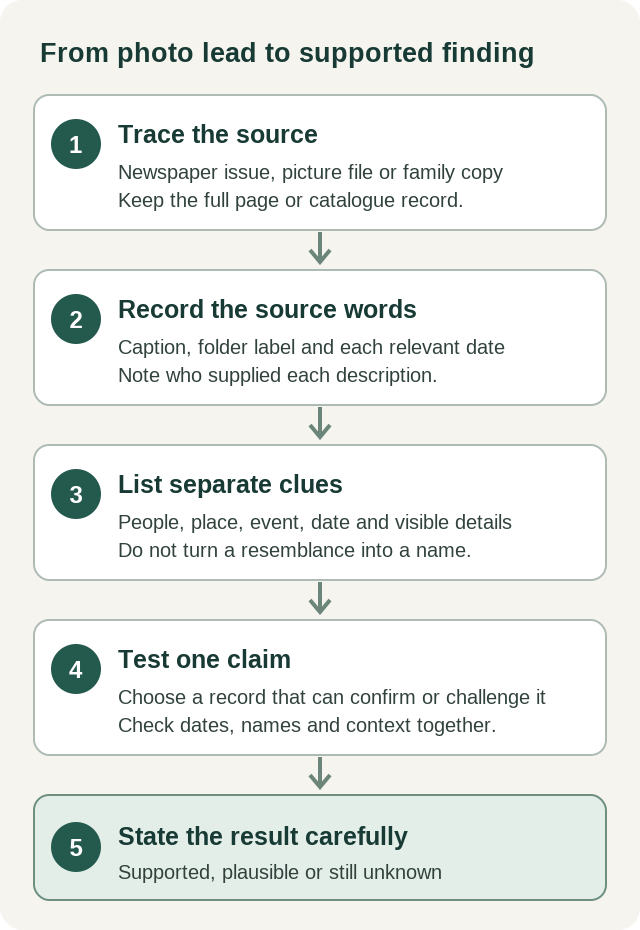
First work out what you have found. Is it a photograph reproduced on a particular newspaper page, a loose print in a newspaper’s picture files, a clipping saved by a relative, or an image shared online without its original context? Each has a different path back to its source.
A printed page can tell you the newspaper title, issue date, article, caption and nearby text. A separate archival print may have a collection record, folder heading or staff description, but not the full article that once accompanied it. A clipping may preserve some of the story while losing the masthead, date or page number. A standalone online image may have lost all of those details.
For a cutting without those source details, use our guide to identifying and dating an old newspaper clipping. Matching its wording and surrounding print to a complete issue can recover the context needed to assess the photograph.
Keep the object and its description separate in your notes. “The archive catalogue labels this folder ‘Mrs. A. Bell’” is not the same as “the pictured woman is my great-grandmother Alice Bell.” Record who supplied each name: the newspaper, a photo editor, an archivist, a family member or a later researcher.
Decide what you want the image to help establish
A broad question such as “Is this my ancestor?” can pull you toward a quick yes or no. Make the question smaller. You might be testing whether a named person attended a particular event, whether a building is the family business, or whether a group photograph was taken in the town where your relative lived.
Write down what you already know from records that do not depend on this photograph. Include the person’s name variants, approximate age, places, dates, occupation, relatives and documented associations. Then name the missing detail the photograph might help you investigate.
For example, if a newspaper story reports that a local club held a meeting in 1932, the photograph might help you identify the building or organisation. It would not, by itself, establish that a particular relative was a member. If the caption names “E. Morgan,” the next question is whether the place, event, date and other people fit the documented E. Morgan you are researching.
Search for the issue as well as the image
When you know a likely event date or newspaper title, look for the complete issue. Search the person’s name with a town, organisation, occupation or event phrase. Then browse the issue around any promising result. The photograph may sit beside a report whose text is searchable even when the image itself is not indexed. Also check special and anniversary newspaper editions, which may pair a portrait with a short biographical profile. Our guide explains how to find the edition and test the profile's claims.
If you do not know the title, use the place and period to identify candidate newspapers first. Our guide to finding the right newspaper and newspaper coverage map can help you record likely titles, date ranges and repositories before searching.
Digitised newspaper access is incomplete. The Library of Congress explains that researchers may need to check several sources for digitised issues, and that relevant newspapers may instead be held in print or microfilm. A missing online photograph or issue therefore describes the limits of the collection you checked, not the absence of the event or image everywhere. See the Library’s historical newspaper holdings guide for its distinction between digital and microfilm collections.
When text searching misses a name, vary initials, spelling, nearby places and the words used for the event. Then inspect page images directly. Our OCR and page-image guide explains how to widen a search when recognition errors hide a useful item.
Read the caption in its original setting
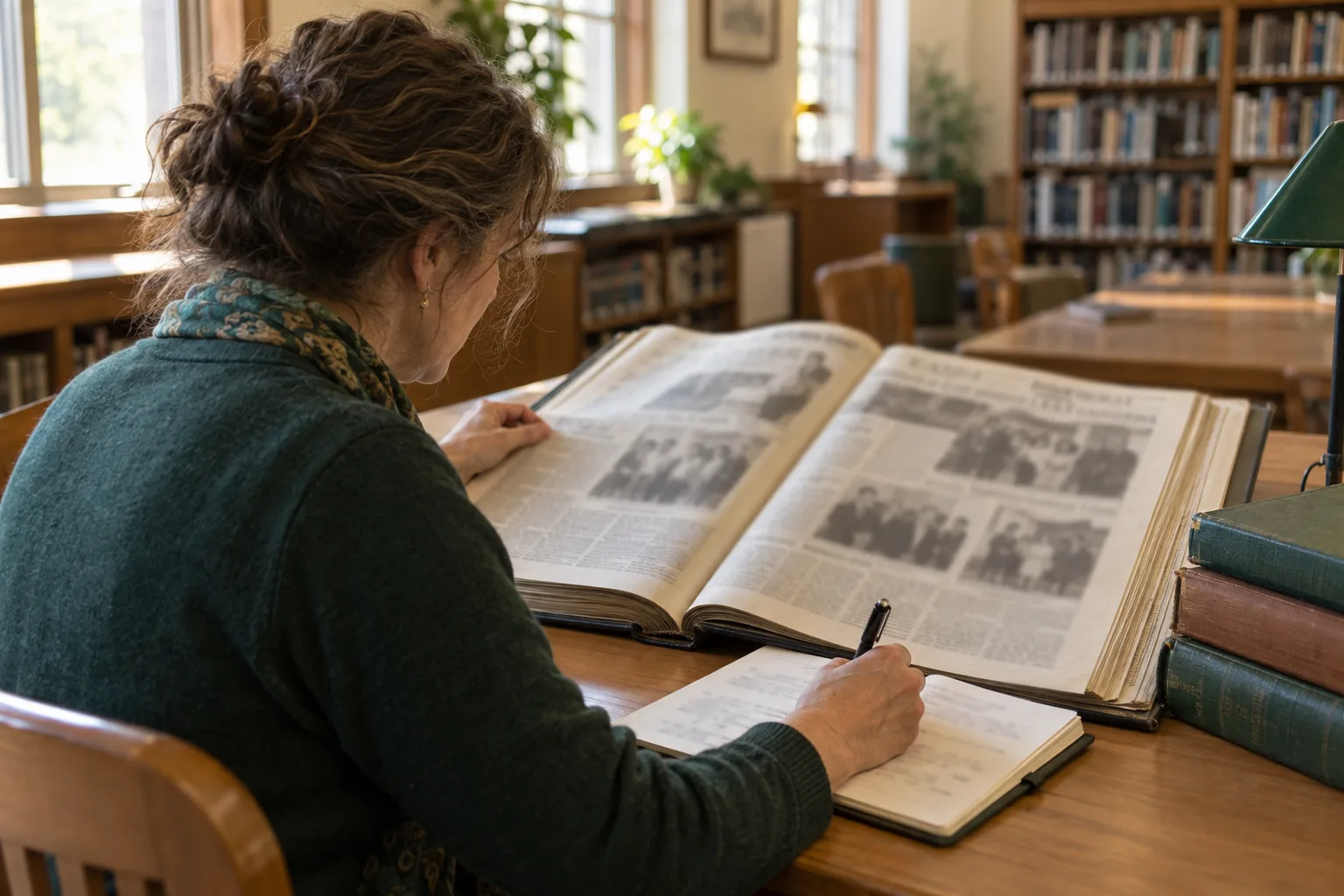
Copy the caption exactly as printed, including initials, punctuation and any uncertainty in the scan. Note whether it appears beneath the photograph, in the story, in a page index or only in a later archive description. A short caption can identify a person or event, but it may leave out the source of the identification and the date the picture was taken.
Separate three dates whenever possible: when the photograph was made, when the newspaper published it and when the archive described or digitised it. They may be different. A paper can publish an older photograph to illustrate a later story, and an archive may assign an approximate date from the print or its folder. Keep the wording that the source uses, such as “circa” or “date unknown,” rather than turning an estimate into an exact year.
Read the surrounding article and page. Check whether the image is a portrait, an event photograph, a publicity picture, a wire-service image or an illustration. Does the article say who identified the people? Does it describe a current event or recall an earlier one? Is the photograph reused in another issue with a changed caption? These details can alter what the image supports.
Treat image details as clues, not a shortcut to identity. Clothing, badges, signs, buildings and vehicles can suggest a date or place, but appearance alone rarely identifies someone securely. If a uniform or insignia matters, seek a specialist source or a record that names the person and organisation. Avoid assigning a rank, role or relationship from a visual resemblance alone.
Look for a newspaper photo morgue
Some newspapers kept picture files for editorial use. Libraries and archives may hold these files under names such as photograph morgue, picture morgue or newspaper photograph collection. The term refers to an accumulated picture archive, not necessarily a complete set of photographs printed in the newspaper.
The Library of Congress maintains a guide to newspaper photograph morgues in the United States and Canada. It lists public institutions that hold at least one newspaper photo morgue, with newspaper titles, date information and links to collection details. The guide advises researchers to contact the institution directly about current access and procedures. A listing is a lead to a repository, not a promise that a named person or particular photograph is in the collection.
Search the guide for the newspaper’s city, title and known date range. Open the linked finding aid or catalogue record and note how that institution organises its photographs. Some records are indexed by people; others use subjects, places, events or original folder labels. If the online description is brief, ask the repository whether an unprocessed or non-digitised collection might be relevant and what information staff need to locate it.
The New York World-Telegram & Sun collection at the Library of Congress provides a useful example of why finding aids need careful reading. Its searching and viewing guide explains that staff-created headings and descriptions were retained, that some entries indicate a folder with no photograph or only a clipping or printing plate, and that “SEE” or “SEE ALSO” references have not been verified. Those details apply to that finding aid. Other institutions may use different labels and procedures, so read each repository’s own guide.
Follow the people, places and events around the picture
A photo file may be hard to find by the ancestor’s name alone. Search the newspaper title, town, street, school, club, employer, public event or building. Try a known associate’s name as well as the person you are researching. A photographer or picture editor may have filed an image under the event or location rather than every person in it.
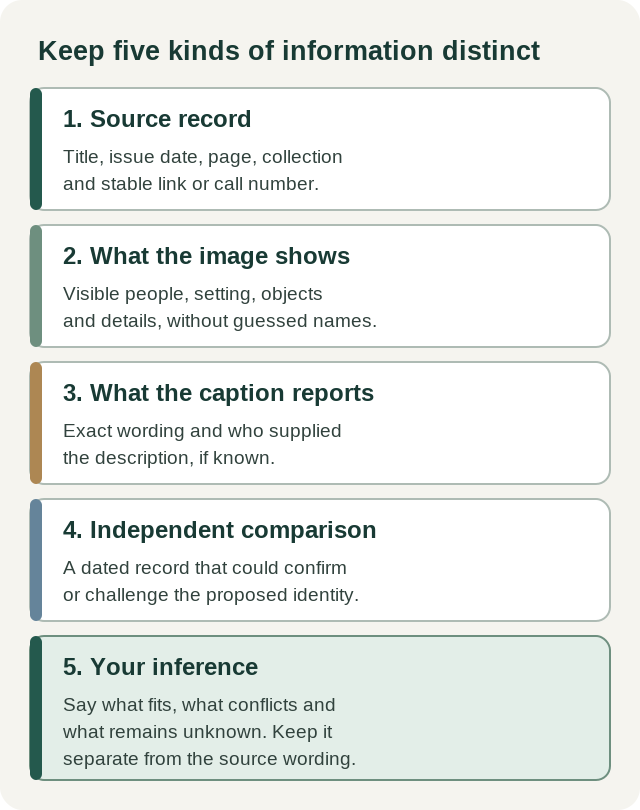
Use the newspaper article and the archive record together, but preserve their differences. A folder heading can point you to a photograph. The caption can name the event. The article can identify an organisation. None of those descriptions should silently overwrite the others in your notes.
If the photograph appears in a family file, look for the reverse side, envelope, album page or accompanying letter. Names, dates and handwriting can lead to a newspaper issue or repository. Record who wrote a note and when it was added if you know. A later inscription may preserve useful family knowledge, but it is still a separate source from the newspaper.
Test the identification against independent evidence
Choose checks that address the specific claim. If the caption names a person at a public event, look for an event programme, report, organisational record or another dated account. If the image may show a family business, compare the address and business name with directories, advertisements or property records. If it identifies a military unit, look for a service record or an official unit history that can confirm the relevant detail.
A second newspaper is useful when it adds independent information. A near-identical picture and caption reprinted from the same wire service may simply repeat the original identification. Note whether the second item has a different reporter, source or eyewitness detail, rather than counting copies as separate confirmation.
Compare the photograph with other securely identified images only as one part of the work. Consider the date, age range, location, known associates and source history. Similarity can support a hypothesis; it cannot repair a mismatch in chronology or establish a family relationship. If the identification depends on a family resemblance, say so and keep it provisional until records connect the person to the event or place.
The National Archives’ genealogy picture guide points researchers to photographs of relatives who served in the military or worked for federal agencies, as well as images of places and events. A related official collection may help test a newspaper lead, but a photograph of a town or unit is not automatically a photograph of your ancestor. Match names, dates and context rather than assuming that a relevant collection contains the person you seek.
Record what the source says and what you infer
Create one note for each image. Keep the source description, your transcription and your interpretation in separate fields. A useful record includes:
- Newspaper title, place, issue date and edition if shown.
- Page, article heading, caption and the wording immediately around the image.
- Photograph date as stated, including any estimate or uncertainty.
- Archive, collection, catalogue or finding-aid title, folder label and stable link.
- Names of the photographer, agency or editor when the source provides them.
- What the image visibly shows, described without guessing identities.
- Your interpretation, the records that support it and what remains uncertain.
- Access date and any restrictions on downloading or reuse.
Save a stable issue or catalogue link. If the repository permits a personal research copy, keep the image with its full-page context and do not crop away the masthead, caption or neighbouring article in your only saved copy. A detail crop can be useful for comparison, but label it as a crop and retain the uncropped source separately.
If you plan to publish or distribute a photograph, check the rights statement for that particular image and collection. The Library of Congress notes that not all material is public domain and that researchers are responsible for determining rights before publication or distribution. Access to a digital copy does not itself grant permission to republish it. Follow the repository’s terms and seek permission where required.
Our guide to verifying and preserving a newspaper discovery covers how to cite the issue, record the exact wording and keep uncertainty visible.
Try a one-photograph research exercise
Choose one newspaper photograph or photo-file entry that may relate to a person, place or event in your family research. Start with an item you can trace to a specific issue or collection record. If the only copy is an unattributed image on a social-media page, treat it as a lead and work backward before deciding what it shows.
Write down the exact caption or archive description, the title of the newspaper or collection, the date attached to the image and the date of the issue or record. Mark anything that is missing. Then search the names, place and event separately. Open the complete page or finding aid, not only the thumbnail or search snippet.
Choose one independent record that could test the main identification. Record what it confirms and what it does not. If the evidence remains incomplete, write a careful conclusion such as: “The 1932 issue labels the group as members of the Elm Street Club. The person at the left may be Nora Evans, but the article does not name the individuals and I have not found an independent record placing her at the event.”
That note is still useful. It preserves the lead without turning a possibility into a family fact.
Know when the photograph cannot answer the question
Some photographs have no caption, photographer or reliable date. A catalogue may repeat a label from the original folder without independent confirmation. The newspaper may not say who supplied the image. A group picture can include people who were never named in the paper. Even a clear portrait may show a person whose identity has been misremembered over time.
You may also find that the original print is not available online, that a photo-file entry refers only to a clipping or plate, or that the surviving issue does not include the expected image. Record the exact limitation and ask the repository about access rather than assuming the material is lost. The Library of Congress newspaper guide explains that historical issues may be available in different formats and that digitised coverage is selective.
A photograph can place a person within a story, community or setting, but it rarely establishes a full biography on its own. Keep the image, caption, archive description and your own conclusion distinct. When another record connects the person to the event, the photograph has a clearer place in the research. Until then, keep the identification open.
Sources and further reading
- Newspaper Photograph Morgues in the United States and Canada, Library of Congress
- Searching and Viewing the New York World-Telegram & Sun Newspaper Photograph Collection, Library of Congress
- Historical Newspapers, Library of Congress
- Pictures and Photos at NARA of Interest to Genealogists, National Archives
- Using the Prints and Photographs Reading Room, Library of Congress