
Newspaper research
How to identify and date an old newspaper clipping
The words and surviving edges of an undated clipping can lead you to a complete newspaper page. Compare that page before assigning a title or issue date.

On this page
- Record where the clipping came from before handling it
- Read the whole fragment, including the back
- Keep event dates separate from issue dates
- Search a distinctive phrase from the clipping
- Use place and date to shortlist newspapers
- Compare the clipping with the full page
- Check whether a matching report is a reprint
- A fictional clipping traced from words to an issue
- Ask a librarian about issues you cannot inspect online
- Write a source note that reflects what you found
- Try the method on one clipping this week
- Sources
To identify and date an old newspaper clipping, transcribe its distinctive wording, inspect the surviving print on both sides where safe, and look for a complete newspaper page that matches. Check the newspaper title and issue date, then compare the layout and surrounding text. A matching sentence is a lead: the same report may have appeared in several papers.
Even without a heading, the fragment may give you something specific to search. An advertisement on the back can be more useful than a common family name on the front. If you cannot find the full source, keep a note of the clues and searches, with the publication date marked unknown. You can preserve what the clipping tells you without guessing which issue it came from.
Record where the clipping came from before handling it
Write down who supplied the clipping and how it was kept. Was it loose inside a letter, tucked into a Bible, or pasted beside other cuttings? Photograph the scrapbook opening or envelope before moving anything. That context explains why you associate the clipping with your family, even if the person it mentions later turns out to be someone else.
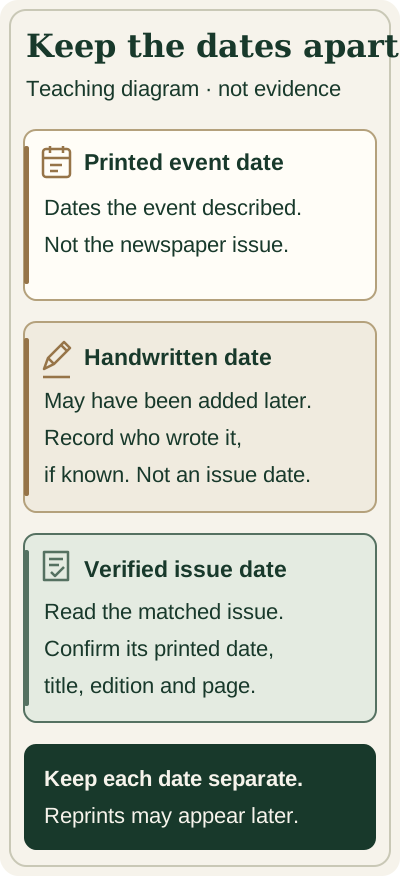
Record a handwritten label separately, including its wording and location. Name the writer only if you know who wrote it. A pencil note reading "Mother's wedding, 1912" tells you how someone understood the cutting; it does not establish when the newspaper published it.
The National Archives advice on preserving newspaper clippings recommends careful handling with clean hands, stopping if opening a fold causes damage, and avoiding glue or tape repairs. Use a camera or a scanner that fully supports the paper, without an automatic feeder. Keep loose newsprint separate from letters and photographs, and use a copy for display.
Leave a firmly pasted cutting attached. Work from the visible side rather than trying to uncover the back. Your photograph should show the whole fragment, including its edges, with enough detail to read the smallest surviving type. Save that untouched image alongside any enlarged or cropped working copies.
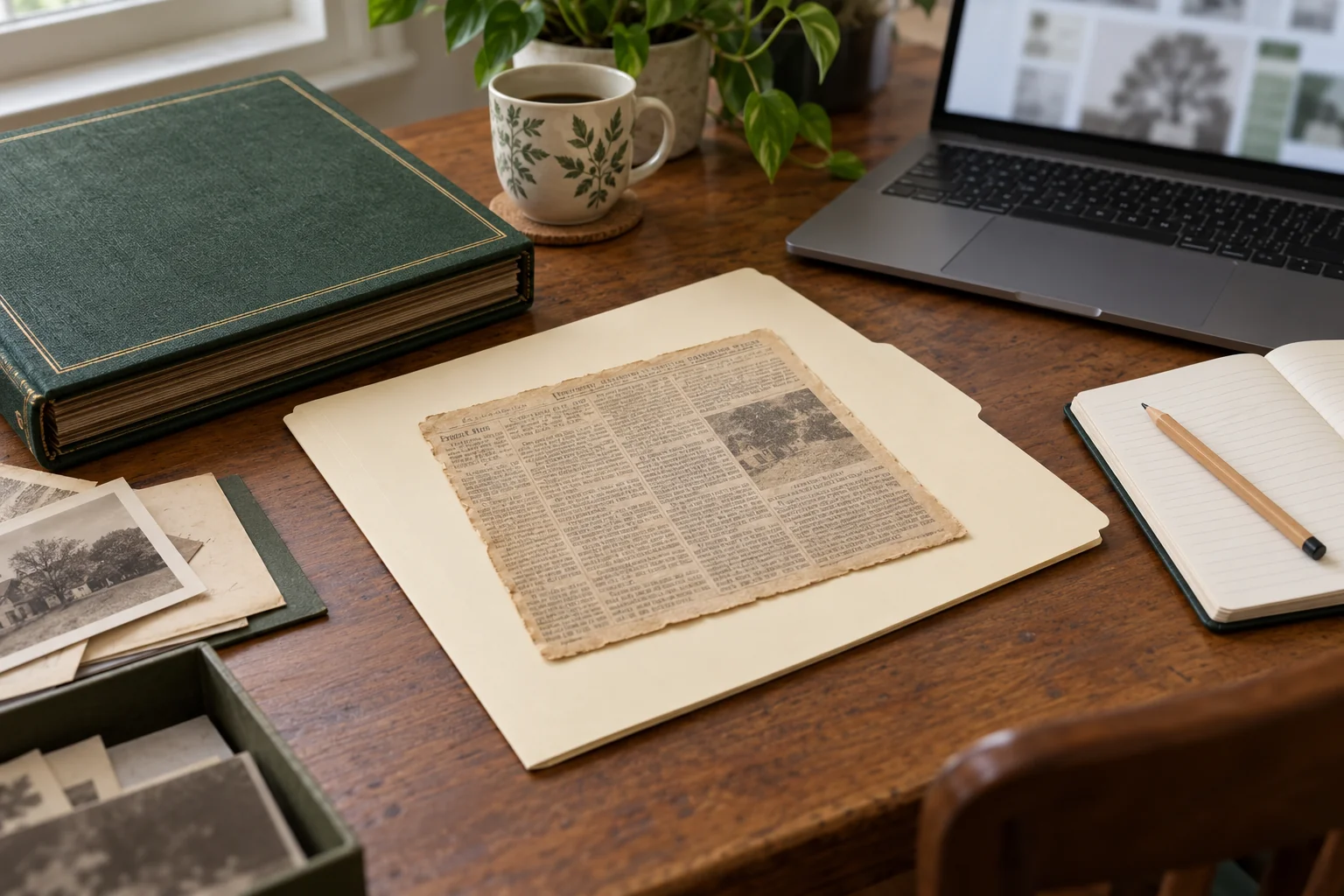
Read the whole fragment, including the back
Make a transcription before searching. Preserve initials and unusual spellings as printed, and mark unreadable letters with brackets, such as "[unclear]". Put your possible reading in a separate note. A misread place name can send you to the wrong newspaper, so it helps to know which words you are sure of.
Include the surviving headline and any text at the cut edges. A partial heading above the notice may name a village; a shop address below it may suggest the publishing town. Neither necessarily tells you where the family lived. A printed city and date at the start of a story may be a dateline, describing where and when it was filed. Keep that apart from the newspaper's publication place and issue date.
If a loose fragment can be turned safely, photograph and transcribe the reverse too. Label the files "front" and "reverse" so their relationship stays clear. Those two sides belong to the same sheet. A different cutting beside it in a scrapbook has no demonstrated physical connection, however similar its subject looks.
Describe the arrangement as well as the words. Note where a rule separates an advertisement, how many columns the headline spans, and where paragraphs break. These details will help you compare candidate page images. Searchable text can locate a report; the way it sits on the page can help identify the fragment you have.
Keep event dates separate from issue dates
Give your research note separate fields for the event date, any handwritten date and the publication date. Start the publication field with "unknown". If the article says a wedding took place on 18 June 1912, record that as the event date, along with the wording that supports it.
An upcoming sale date may suggest a search window, but it is not the date of the issue. Relative wording needs more context: "last Thursday" cannot give you a calendar date until you know when the words were published. Begin near a stated event date when that makes sense, then widen the window if you find nothing.
Read the tense and the reason for the report. A wedding announcement and a reminiscence written forty years after the wedding need different search windows. The event date in an anniversary article can otherwise send you to the wrong decade.
Yellowed paper and old-fashioned type do not establish an exact year. Treat a price or business name as a clue to investigate. If another record narrows the person's life or residence, note which record supplied that limit. This gives you a reason for your initial date range and something to reconsider if the search stalls.
Search a distinctive phrase from the clipping
Choose a short stretch of readable wording that someone else would be unlikely to use. A phrase about a presentation at a named hall is a more focused starting point than "a very pretty wedding". Copy it from your transcription and save the query with the date range you used.
For a US clipping, the Library of Congress tips for searching Chronicling America describe "Pages (Full Text)" searches, exact phrases and proximity searches. Place, title and date filters can narrow the results. OCR, the computer-generated searchable text, can misread the print, so a failed phrase search does not establish that the wording is absent.
Try an exact phrase first, using the archive's phrase option or quotation marks where supported. If it gives you nothing, shorten it to remove a doubtful word. You can also try distinctive words near one another if the archive has a proximity option. Change one part of the query at a time so you can tell which change helped.
Search another part of the fragment when the main report gets you nowhere. The hall name, a shop address or readable wording on the reverse gives you a different route into the page. A damaged family name need not hold up the whole search.
Open promising page images instead of relying on snippets, and save the page link with a brief description of the match. The guide to searching OCR and page images explains how to work around misread searchable text when you need more options.
Use place and date to shortlist newspapers
If wording searches stall, use the strongest place clue to make a small list of candidate titles. A street address tied to a business may point to a publishing town more directly than a report about someone visiting from another county. Keep both clues and explain why you are trying one place first.
The Library of Congress newspaper directory search guide describes title records and library holdings, with filters for city, county, years and publication frequency. It also advises checking title changes. The directory can help you find candidate publications and repositories; it does not search article full text or confirm your clipping's source.
For each plausible paper, note its publishing place and the dates you need to inspect. Separate its publication lifespan from the issues a repository actually holds or makes available online. A paper that existed in 1912 remains a candidate if the digital collection has a gap that year. Check the holdings information before deciding you have searched the relevant run.
For Britain, Ireland or elsewhere, take the same place clues to a library serving that area and ask about historic newspaper titles and surviving issues. The US directory will not cover those places. The guide to finding the right newspaper can help when several titles are plausible. Find out which issues you need before considering paid access.
Compare the clipping with the full page
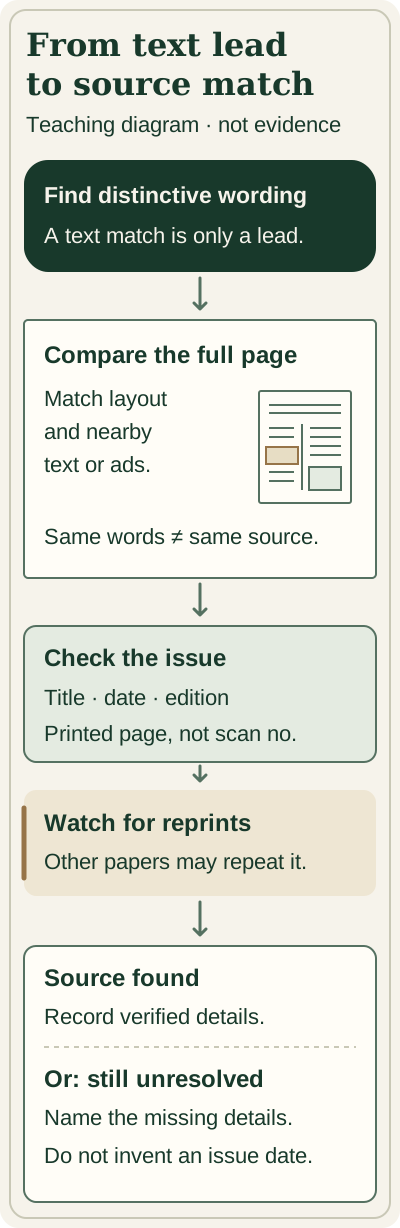
Put your photograph beside a promising page image. Read the beginning and end of the item, including any small correction or spelling error. Compare the headline's shape and the surviving line endings. Identical words in a transcript do not show whether the printer fitted them into the same column.
Then look outside the article. Does the neighbouring advertisement start at the same height? Can you find the partial sentence at the clipping's left edge in the next column? These surviving details can distinguish two pages carrying the same report.
If you photographed the reverse, look for the other side of that same sheet where the archive makes it available. Compare the surviving text in the corresponding area, allowing for the flipped orientation. Leave this check pending if you cannot establish which image is the physical reverse. The next scan in a viewer is not sufficient evidence by itself.
Check the title and date printed on the issue, including any edition label, and find the printed page number where it survives. If the archive label disagrees with the page, record the discrepancy instead of choosing silently. Note the visual details that agree, and any you could not check. For longer excerpts, the newspaper clipping comparison tool can help compare transcriptions; you still need to inspect the layout yourself.
Check whether a matching report is a reprint
When a report appears in two papers, keep a note for each version. Compare any attribution, local introduction or shortened ending. These differences may explain how the text travelled, without telling you which version your relative cut out.
The earliest version you find is only the earliest among those you inspected. It may not be the first publication or the source of your fragment. Preserve any attribution in the clipping, including wording such as "From our correspondent", without supplying a newspaper name that is not there.
Return to the physical comparison when two candidates share the wording. Different line breaks or neighbouring advertisements may rule one out. Record the specific mismatch so you do not return to that page later as a supposed solution.
If the clipping is trimmed to the text alone, you may have too little left to choose between matching pages. Keep those candidates in your research note. You can cite a version you actually inspected as a separate discovery while leaving the inherited clipping's source unresolved.
A fictional clipping traced from words to an issue
This example is entirely fictional. The wording and comparison results illustrate the method; they are not a real clipping, an archive search or a claim about collection holdings.
Suppose a loose cutting reports that Eleanor Marsh married on 18 June 1912. Someone has pencilled "1912" above it. One sentence mentions a presentation of "a silver kettle from the chapel sewing circle". Part of a boot-shop advertisement survives below the notice, and the back has a few lines about a lost pony.
The researcher begins with three date entries: wedding, 18 June 1912; pencil annotation, "1912, writer unknown"; publication, unknown. The phrase about the silver kettle becomes the first query, with an initial search window near the wedding date. The shop's partly visible address suggests a publishing town, recorded as a lead to check.
Imagine that two candidate pages are available. One prints the wedding report in a wider column, above a grocery advertisement. The other has the same line endings as the fragment, with the surviving boot-shop wording in the right position. The researcher establishes which image shows the reverse of that sheet and finds the matching lost-pony text there.
In this imagined case, the second candidate's issue has 22 June 1912 printed on the masthead, and the page containing the notice is numbered 5. The source note records the newspaper title as printed, its publishing place and the page link. It explains the matching line endings, advertisement and reverse text. The wedding remains dated 18 June; the clipping's publication is dated 22 June.
If only the wedding sentences matched, the result would be two possible sources. Here the additional page details allow the researcher to select one issue. Identifying that issue still would not establish Eleanor's relationship to the scrapbook owner. That requires separate family-history evidence.
Ask a librarian about issues you cannot inspect online
When a likely title has no accessible issue in your search window, contact a library serving the publishing place or a repository named in the holdings record. Include the clipping image, your transcription and the candidate dates. Explain whether you need help identifying the paper or locating an issue of a title you already know.
The Library of Congress guide to finding a newspaper explains that holdings may be in print, microfilm or digital form. Not every US newspaper has been digitised, and the Library does not hold every paper. It also notes that most of its electronic resources require onsite access, so check the access route before planning remote research.
A focused request might say: "I have an undated clipping mentioning a chapel presentation. A shop address on the reverse points to your town. Could you advise which local papers and issues I should check, and whether they survive?" Add the dates and titles you have already investigated so staff can see the gap.
Ask whether a visit or reproduction request is needed, and check any fee before ordering. Staff may help locate holdings without being able to search an entire run for you. The free and library newspaper access guide explains options for planning that work.
Write a source note that reflects what you found
For an identified clipping, record the title as printed, its publication place, the issue date and any known edition. Add the printed page number and a headline or description that locates the item. Keep the repository name, a link to the page you inspected and your access date. Briefly explain why you matched it to the fragment.
The Library of Congress guidance on citations and image links explains that "Cite This Item" supplies citation formats and that an issue link differs from a specific page-image link. Save the specific image link when available. Check printed numbering separately: the fifth scanned image need not be printed page 5. If the printed number is missing, say so and record the image position as an image position.
An unresolved note can read: "Undated newspaper clipping, title and publication date unidentified, retained in family scrapbook supplied by [name]. Mentions [event and stated date]. Front photographed [date]; reverse inaccessible because pasted down. Possible source: [candidate and reason]." Fill the brackets from your evidence and omit fields that do not apply.
Keep possible titles out of the confirmed citation fields. The newspaper citation generator can help format known details once you have them. Save unanswered questions beside the image so another reader can distinguish the newspaper's wording from your reconstruction of its source.
Try the method on one clipping this week
Choose one historical clipping with enough readable print to search. Give it a file label and record where it came from. Transcribe the print and separate the dates by what they describe. Photograph the reverse only if it is accessible without disturbing attached or fragile paper.
Try two queries independently, one from the main item and another from surrounding print, saving the settings and results. Compare any candidate with the whole page and note the features that agree or conflict. If you find none, shortlist a plausible newspaper and identify the holding you need to ask about.
End the session with a source note, even if the publication date remains unidentified. Give yourself a precise next task, such as "ask the town library whether June 1912 issues of this title survive". Keep it with the original photograph and search record so you can resume without handling the clipping again.
Sources
Library of Congress, tips for searching in Chronicling America
Library of Congress, directory of US newspapers search tips
Library of Congress, finding citations and linking to newspaper images