
Special editions
How to find an ancestor's biography in a special newspaper edition
Search library catalogues and digitised newspapers for local profiles, then separate useful family clues from promotional claims.

On this page
- Find the edition in catalogues and newspaper collections
- Search the edition for your ancestor's name and business
- Worked example: turn a business sketch into research leads
- What special editions contained
- Read the sketch as a promotional source
- Historical and old settlers' editions
- Compare sketches across editions and books
- Look for women and workers in other people's profiles
- Test the details against other records
- Turn the sketch into a timeline
- When you cannot find a special edition
- Record the sketch and its claims
- Start with one ancestor and one town
- Sources
Special and anniversary newspaper editions sometimes contain short biographies that ordinary name searches miss. Start with the town where your ancestor lived or worked.
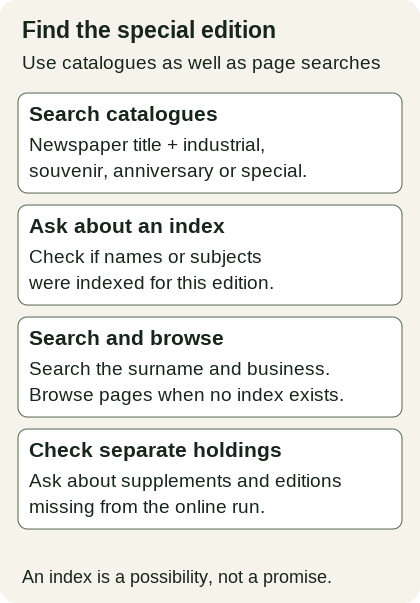
- Write down the newspaper titles and the years your ancestor lived there. If you do not know the titles, find the newspaper that covered the town.
- Search the local library or historical society catalogue for
[newspaper title] industrial edition, replacing the brackets. Also trysouvenir,anniversaryandspecial edition. - In the free Chronicling America collection, look for the same edition phrases in the relevant papers. If it lacks the title or years you need, find your state's free newspaper collection.
Ask whether a name or subject index exists. An index may help, but be prepared to browse the edition if none is available.
Find the edition in catalogues and newspaper collections
Library catalogues and indexes are often the best route. The Welland catalogue and Texas Tech list show editions described separately from a regular newspaper run; Texas Tech links to indexes for its named editions. Search the catalogues of the town's public library, the county historical society, the state historical society and the state library for the newspaper title with words such as "special edition", "souvenir", "industrial", "jubilee", "anniversary", "centennial" or "old settlers".
In digitised collections, search for those words with the town or county name. On Chronicling America, open Collection Items, expand Advanced Search and choose Pages (Full Text), as the Library of Congress explains in its tips for searching Chronicling America. Try souvenir edition, industrial edition or anniversary edition with This exact phrase, limited to the state and county papers, and browse any result's pages. A regular issue may also announce a forthcoming special edition, which gives you its date.
A special edition may have been issued as a separate section or supplement, or in a different format from the regular issue, and that could affect whether it was bound, filmed or digitised with the regular run. If you find a gap in a digitised run around the date of a known special edition, it may be worth asking the holding library whether the edition survives separately.
Search the edition for your ancestor's name and business
A sketch is a short biographical profile.
Within a digitised special edition, start with your ancestor's surname alone, then the business name, street or trade. In Chronicling America, try the surname with a distinctive trade word using These words within 10 words of each other. For the fictional example below, Holm harness is a useful pattern. Proximity controls word spacing, not spelling, so try name variants separately if the machine-read text is wrong. A sketch may be headed with the business name rather than the person's, so search both. Sketches of businesses may mention partners, clerks and family members working in the shop.
Browse the whole edition if you can. Sketches may be grouped by street, trade or neighbourhood, and your ancestor's may be next to a relative's or partner's. Portraits may be printed without names immediately beside them; check the captions and the page layout before attaching a face to a name. Our guide to finding ancestors in newspaper photographs explains how to read captions and test an identification.
Worked example: turn a business sketch into research leads
Everything in this example is invented: the person, the business, the town of Corliss, the newspaper, the edition, the sketch and all dates. No real person, business or newspaper is described, and none of these items exists in any archive.
Suppose your ancestor Frederick Holm ran a harness shop in the invented town of Corliss around 1900. You have him in census entries but know nothing of his life before he arrived.
The town library's catalogue lists an "Industrial and Souvenir Edition" of the invented Corliss Sentinel, dated 1 June 1899, with a typed index of names. Under "Holm, F." it gives page 14. The sketch reads, in part:
"F. HOLM, HARNESS AND SADDLERY. Mr. Frederick Holm, whose establishment on Main Street is one of the most complete of its kind in the county, was born in Schleswig in 1851 and came to America in 1870. After learning his trade in Chicago, he located in Corliss in 1882, and by close attention to business has built up a large and profitable trade. Mr. Holm is a member of the Odd Fellows and an enterprising citizen."
Here is what you can record. The Sentinel's special edition of 1 June 1899 printed a sketch saying that Frederick Holm, harness maker on Main Street, was born in Schleswig in 1851, came to America in 1870, learned his trade in Chicago, settled in Corliss in 1882 and belonged to the Odd Fellows.
What the sketch does not establish on its own. Every one of those details is the sketch's claim, probably supplied by Frederick or someone close to him, written to promote a business. "One of the most complete of its kind in the county" and "a large and profitable trade" are advertising language. The birthplace, year of birth and dates of migration and settlement are leads, each needing its own record. The sketch says nothing about a wife or children.
The useful result is a set of specific, testable claims: a birthplace, an emigration year, a stay in Chicago and a lodge. Each points to a record you can look for.
Use the fictional sketch to choose specific next checks:
- Claimed arrival in 1870: compare passenger lists and follow the naturalization-record trail.
- Claimed Odd Fellows membership: search lodge notices using Frederick's name and Corliss, then ask about surviving lodge records.
These are next searches, not records already located for Frederick.
What special editions contained
Local newspapers sometimes printed special editions to celebrate a town, a county or the paper itself: industrial or development editions promoting local business, souvenir editions, anniversary and jubilee issues, and editions honouring early settlers. Many of these were packed with short biographies of businessmen, professionals, farmers and pioneers, sometimes with portraits. If your ancestor ran a shop, practised a trade or had lived in a place for a long time, a special edition may hold the most detailed biography of them ever printed.
Library catalogues describe what survives. The Welland Public Library in Ontario describes a special industrial edition of the Welland Telegraph from around 1907 as a souvenir issue reviewing representative businesses and printing biographical sketches of leading business and professional men.
Some editions celebrated the past rather than commerce. Texas Tech University's Southwest Collection lists subject indexes to special editions, including a "Historical and Development Edition" of the Weatherford Democrat from 1939 and an "Old Settlers Edition" of the Vernon Times from 1927.
Read the sketch as a promotional source
Industrial and souvenir editions, like the Welland example, were promotional by design, and their sketches are unlikely to be critical. Rhonda Frevert's 2002 Common-place article on "mug books", the subscription county biographies of the same era, describes sketches that were uniformly flattering, notes that subjects had chances to shape what was printed, and warns that omissions are likely and factual errors not uncommon. It also explains that inclusion in those books depended largely on payment.
Newspaper special editions were a different product, and the sources read for this guide do not say how individual papers decided whom to include. But the same caution applies. A sketch tells you how the subject or the paper chose to present them. It is good evidence of what was claimed in a public, local source on a particular date, and it often contains details, such as a birthplace or a year of arrival, that no other source gives. Each detail still needs testing.
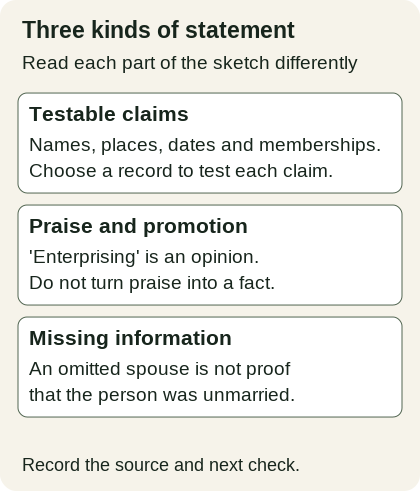
Separate three kinds of statement as you read:
- Specific factual claims, such as a birthplace, a year or a former employer, which you can test.
- Descriptions of character or success, such as "enterprising" or "large and profitable", which tell you about the tone of the edition rather than about your ancestor.
- Missing information: family members, failures, earlier marriages or moves that this sketch does not mention. An omission does not establish that something never happened.
Historical and old settlers' editions
Not every special edition was about business. The Texas Tech list includes an "Old Settlers Edition" and a "Historical and Development Edition", which suggests editions looking back at a county's early years. Editions like these may print reminiscences, lists of early residents, histories of churches and schools, and sketches of pioneer families, some written by the settlers themselves or their children. If the material you need appears in reports of an association reunion instead, see our guide to old settlers' and pioneer reunion reports for finding attendee and membership lists and assessing reported arrival years.
Read these as recollections. A pioneer's account printed fifty years after the events may be vivid and specific, and it may also compress or misremember dates. A family history written by a grandchild for an anniversary edition reflects family tradition at that time. Both are worth recording, with the writer's name if given, and both need testing.
Ask the holding library whether a name or subject index exists for the particular edition. The Texas Tech list shows that indexes exist for those named editions, not how common indexing is elsewhere. Many editions may still require page-by-page browsing.
Compare sketches across editions and books
The same person may be profiled more than once: in a special edition, in a county history, in a later anniversary issue and in an obituary. Collect every version and compare them line by line.
Matching wording is a warning sign rather than confirmation. A later sketch may have been copied from an earlier one, or both may have been written from the same family-supplied notes. Two sketches that repeat the same birth year in the same words count as one claim, printed twice. A sketch that adds a new detail, such as a first wife's name or a different year of arrival, gives you something new to test.
Differences matter too. If one sketch says your ancestor settled in town in 1882 and another says 1884, record both with their sources. Directories, tax lists and land records from those years may show which is closer, or that both reflect different moves.
Look for women and workers in other people's profiles
Frevert's article notes that the subscription biographies of the period mostly featured white men, with women appearing more often within a father's, husband's or son's sketch. Special editions are likely to have similar gaps. A wife may appear only as "Mrs. Holm" or not at all, and workers, servants and poorer residents may not appear by name.
If a sketch mentions a woman only through her husband, she is not identified by her own name. Our guide to finding female ancestors in old newspapers explains how to follow her through other records.
If your ancestor was a worker in a business that was profiled, the sketch may name the owner and perhaps the foreman or clerks. A profile of an employer can still help you understand where your ancestor worked and when the business existed. Our guide to tracing a family business through newspaper advertisements explains how to combine sketches with advertisements and business notices.
Test the details against other records
Take each factual claim in turn. A birthplace and year may be tested in a census, a naturalization record or a church register. A year of arrival in America may be tested in a passenger list or a naturalization record. A year of settling in the town may be tested in directories, tax lists and earlier newspapers. A lodge membership may be tested in the lodge's records or in lodge news.
If the sketch and another record disagree, record both. A sketch written decades after a migration may round dates or simplify a route. That does not make the other details worthless.
Turn the sketch into a timeline
A sketch usually tells a life as a sequence: born, emigrated, learned a trade, moved, settled, prospered. Break that sequence into dated lines, each attributed to the sketch, and add the records you already hold beside it.
Some lines will be dated exactly, such as a year of birth. Others will be relative, such as "after learning his trade in Chicago". Record relative statements as they are, without inventing dates. A gap between two dated lines, such as twelve years between emigration and settling in town, is a period the sketch skips. Look for records from those years rather than assuming what happened in the gap.
A sketch also dates itself. The edition's date tells you when its claims were published; a description of an operating business is a dated claim to check, not independent proof that it was trading that day. It does not tell you that every circumstance described, such as the shop's address, held throughout the person's time in the town.
When you cannot find a special edition
If no special edition is catalogued for your ancestor's town, check neighbouring towns and the county seat, and look for county histories and biographical books of the same period, which often contain similar sketches. Ask the local library whether any special editions are held in a vertical file or local history collection. Our guide to free and library newspaper access explains how to frame such a question.
Record what you checked: catalogues searched, titles, dates and search terms.
You can adapt this enquiry: "Do you hold a special, industrial, souvenir or anniversary edition of [newspaper title] for [town, state], around [years]? If so, is there a name or subject index, and how can I consult the edition or request a copy? Please let me know about any fees."
Record the sketch and its claims
For each sketch, record the newspaper title, the edition's title as printed, its date, the page, the heading of the sketch, and the text exactly as printed. Note any portrait and its caption. Then list each factual claim separately, with the record you plan to use to test it.
Keep interpretation separate: "Sentinel, Industrial and Souvenir Edition, 1 June 1899, p. 14: sketch of F. Holm. Claims born Schleswig 1851, to America 1870, trade learned Chicago, Corliss 1882, Odd Fellows. Promotional; untested. Next: naturalization record; Chicago directories 1870s." Our guide to verifying and preserving a newspaper discovery has a full checklist.
Start with one ancestor and one town
Choose one ancestor who ran a business, practised a profession or was a long-time resident of a town. Write down the town and the years they lived there.
Search the catalogues of the town library, county historical society and state historical society for the town's newspaper titles with "special edition", "souvenir", "industrial" or "anniversary". Then search Chronicling America or your state's newspaper site for the same phrases with the town name.
If you find an edition, search and browse it for your ancestor's name and business. Record each factual claim in the sketch as a separate line, and choose one claim to test next.
If you find nothing, look for a county history or biographical book covering the same years and place, and ask the local library whether it holds special editions that are not online.