
Pioneers and settlers
Find an ancestor in old settlers' reunion reports
Find old settlers' and pioneer reunion newspaper reports, then test their arrival years against independent evidence.

On this page
- Search for the association and the reunion
- A fictional reunion-list example
- What old settlers' associations recorded
- What newspapers printed about them
- Read the arrival year as a remembered claim
- Treat matching arrival details as clues
- Follow your ancestor across several reunions
- Members, attendees and eligibility
- Reminiscences, necrologies and officers
- County histories and association records
- When there is no list
- Record the list entry exactly
- Try an old settlers' search this week
- Sources
First, search Chronicling America for the exact phrase old settlers with your ancestor's county or nearest town. Read the reunion issue itself, not just the search result.
Old settlers' and pioneer associations sometimes held reunions that newspapers covered with lists of names or reported arrival years. These are useful clues, not proof that people knew or travelled together.
- Note its date, the list heading and whether it names attendees, members or reported arrival years.
- Search the association's name in later years for proceedings, membership registers and death notices.
If you do not know the county, start with a dated record that places your ancestor in a nearby town or state, then identify the county's newspapers.
Search for the association and the reunion
Associations went by several names: old settlers, pioneers, early settlers, territorial pioneers. Search for each.
On Chronicling America, open Collection Items, expand Advanced Search and choose Pages (Full Text), as the Library of Congress explains in its tips for searching Chronicling America. Limit by state and the county's papers; if you know only a town, use the papers serving it. Then try:
old settlerswith This exact phrase selected, then add the county or town name using All of these words.pioneer associationorpioneers associationwith These words within 5 words of each other.reunionwith the county name andsettlers, using These words within 10 words of each other.- Your surname with
old settlers, using within 10 words.
Once you find the first report, note the month the reunion was held and whether the paper printed a list. Then browse the issues after each year's reunion, rather than relying on a name search. Lists set in small columns may be read badly by OCR; our guide to searching when OCR gets names wrong explains how to read them from the page image.
A fictional reunion-list example
Everything in this example is invented: the people, Redfield County, the association, the newspaper, the list and all dates. Redfield County is not a real place, no real jurisdiction is implied, and none of these items exists in any archive.
Suppose your ancestor Thomas Ashby appears in Redfield County in a census of 1860, but family stories disagree about whether he arrived in 1849 or 1852. You want a record closer to his own account.
You search the invented Redfield Courier for old settlers with the county name across the 1880s and 1890s, and find that the Redfield County Old Settlers' Association held its first reunion in August 1886. The issue of 26 August 1886 prints a list headed "Old Settlers Present, With Year of Coming to the County", which includes: "Ashby, Thomas, 1851" and "Ashby, Mrs. Thomas, 1854".
Here is what you can record. The Courier of 26 August 1886 listed Thomas Ashby among old settlers present at the reunion, with 1851 as his year of coming to the county, and "Mrs. Thomas Ashby" with 1854.
Here is what you cannot record. The year 1851 is the arrival year given, probably by Thomas himself or a relative, thirty-five years later, and copied by the secretary or the paper. It may be accurate, or it may be remembered loosely. It disagrees with both family stories, which is useful information rather than a problem. "Mrs. Thomas Ashby" identifies a woman through her husband. Her own name is not given, and her later arrival year might mean she married Thomas after he came, or simply that she remembered differently. The list does not say.
The useful outcome is a third arrival year, closer to the source than family stories, and a clue that Thomas's wife may have arrived separately. Land records, early tax lists and the earliest county marriage record can test both. The list names no travel companions, and two Ashbys in one report do not show that they migrated together.
What old settlers' associations recorded
The associations varied, but their purpose was much the same. History Nebraska's finding aid for the Old Settlers' Association of Cass and Adjoining Counties, formed in 1895, quotes its aim to "bring the people together, cultivate acquaintance" and preserve memories of early settlement. Its rules required three years' residence in Nebraska and citizenship in Cass or an adjoining county. Its membership registers from 1895 to 1933 list name, residence, birth year, native state, year moved to Nebraska, year joined and sometimes date of death.
Other associations set stricter rules. History Nebraska's finding aid for the Nebraska Territorial Pioneers Association, organised in 1892, says membership was first limited to those who became residents before Nebraska's admission as a state, and was later opened to lineal descendants of territorial pioneers. Its surviving records include correspondence about applications, membership lists and lists of deceased members.
Some associations published their proceedings. The FamilySearch catalogue record for the Transactions of the annual reunion of the Oregon Pioneer Association shows an annual publication from the 1870s to the 1920s, on microfilm and digitised.
What newspapers printed about them
Newspapers covered the reunions as local events. The Linn County IAGenWeb site transcribes a list of attendees at the first meeting of the Old Settlers Association of Linn County, from The Gazette of Cedar Rapids, Iowa, on 14 August 1891, page 1. Each entry gives a surname, given name and year of arrival in Linn County. The transcription has some obvious errors, such as arrival years later than the meeting, which is a reminder to check the original page.
A reunion report might also include speeches, reminiscences, a roll of members who had died during the year or the officers elected. These are possibilities to look for, not a fixed format. Not every report printed a full list, so read each one.
If the material appears in a commemorative special edition rather than a reunion report, our guide to finding an ancestor's biography in a special newspaper edition covers that route.
Read the arrival year as a remembered claim
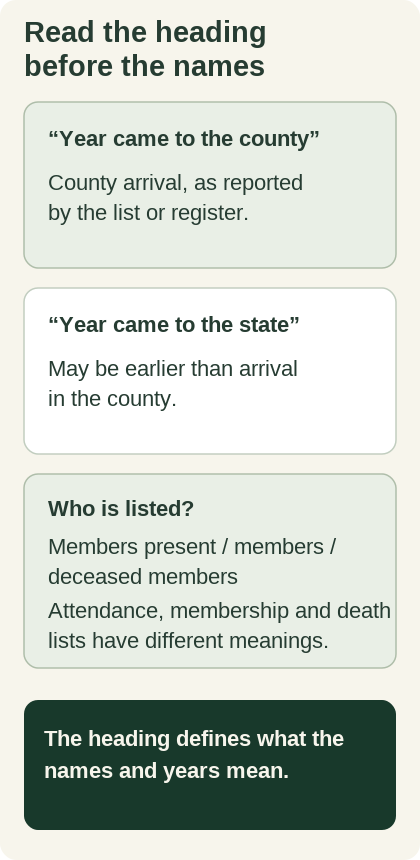
The arrival year in a reunion list is usually the settler's own recollection, given decades after the event. It is valuable because it comes from the person or someone close to them. It is also a memory, and it may round to a convenient year, confuse the arrival in the state with the arrival in the county, or reflect a later arrival after an earlier visit.
Read the heading carefully. The Cass County registers recorded the year a member moved to Nebraska, not to the county. A transcription on the Marion County, Missouri, MoGenWeb site of an old settlers' association membership list gives the year each member came to Missouri and notes that the year of coming to the county was not recorded. It also points out that some members never lived in the county. A list's wording decides what the year means.
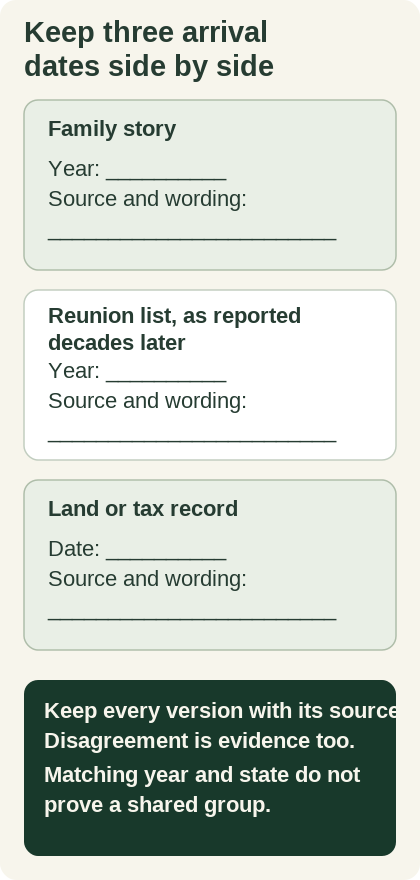
Compare the year with other records rather than choosing between them. If the reunion list says 1851, a land entry says 1852 and a family story says 1849, record all three with their sources. The disagreement may point to a first visit, a move within the state, or simply different memories.
Treat matching arrival details as clues
A reunion list can help you identify people who reported arriving in the same year as your ancestor. If it gives a native state, as the Cass County registers did, sort for people with the same reported year and state.
Matching arrival years and state are weak context, not evidence of association or shared travel. Search for independent travel records, or early land, church and marriage records that place them as neighbours, witnesses or relatives. These records may support a connection; do not infer a shared migration group unless independent records connect them. If you have only the matching year and state, keep their relationship unproven.
Treat shared surnames the same way. Two Ashbys in one list may be relatives, but the list does not say so.
Follow your ancestor across several reunions
If the association met for years, your ancestor may appear in several reports. Record each appearance separately. The arrival year given may change from one list to another, which tells you that memories or record-keeping varied. Keep each version with its date and source rather than correcting one to match another.
A member who appears every year and then disappears may have died, moved or stopped attending. Check the next report for a list of deceased members, and the death notices for that year. The Cass County registers sometimes added a date of death to a member's entry, so the association's own records may settle what the newspaper does not.
Members, attendees and eligibility
A list of people present at a reunion is not the same as a membership roll, and neither is a list of everyone who lived in the county. Eligibility rules shaped who could join. Some associations required a fixed number of years' residence. Some admitted only those who arrived before a certain date, and some later admitted descendants. The Nebraska territorial association's change of rules shows how the meaning of a membership list could shift over time.
So a name in a list tells you that the person attended or joined, as reported, on that date, and gives the arrival year reported for them. An absence tells you very little. Many early settlers had died, moved away or simply did not attend.
Women may appear under their husbands' names, as "Mrs. Thomas Ashby", or under their own. A married woman listed only through her husband is not identified by her own name until another record links them. Our guide to finding female ancestors in old newspapers explains how to follow a woman through married and maiden names.
Reminiscences, necrologies and officers
Reunion reports and published proceedings often included more than lists. Old settlers gave speeches recalling the early years, and these were sometimes printed. History Nebraska's territorial pioneers finding aid mentions a 1903 volume of reminiscences. Reports might also include a list of members who had died since the last reunion, which can help date a death, and the names of newly elected officers.
Treat reminiscences as memories told for an audience, sometimes decades after the events and sometimes polished for the occasion. They can describe a family's journey, early neighbours or hardships. Use them for leads and context, and test specific claims against land, tax and court records.
If a reminiscence mentions your ancestor, note who was speaking and how they knew the family. A settler recalling a neighbour's first cabin forty years later is a different witness from your ancestor describing their own journey. Record the speaker's name, the reported words and the date of the reunion together, and treat any dates or numbers in the story as the speaker's recollection. A printed speech may also have been summarised or tidied by the reporter, so the wording may not be the speaker's own.
A necrology, or list of deceased members, gives the association's record of a death, but not always a date. Use it to narrow the window for a death notice or obituary. Our guide to finding obituaries and death notices explains how to search once you have a narrower window.
County histories and association records
Many county histories printed lists of old settlers or pioneer association members. The Sac County IAGenWeb site transcribes a list compiled by the association's secretary on 1 June 1877, as printed in a county history published in 1914, giving each member's date of arrival and age when they signed the register. A list in a county history may come from the association's own register, from newspaper reports or from both. Note which, if the book says.
The associations' own records may survive in a state historical society, a county historical society or a local library. The two Nebraska finding aids show what can survive: registers, membership lists, correspondence and meeting records, some on microfilm. Search your state historical society's catalogue for "old settlers" or "pioneer association" with the county name.
When there is no list
Many reunions were reported without a list of names, and many counties had no association, or no surviving reports. If you find a report but no list, look for the officers' names and for a mention of your family in the account of the speeches or the oldest settlers present. If you find no report, check which papers served the county in the years after settlement, and whether the issues survive. Our guide to building a newspaper coverage map explains how.
Record what you searched: titles, years, terms and whether you browsed the issues after each reunion.
Record the list entry exactly
For each entry, record the newspaper title, issue date, page and column, the list's heading word for word, the name exactly as printed, the arrival year or date, any age, residence or birthplace given, and the names immediately around your ancestor's. Note whether the list is of attendees, members or deceased members.
Keep interpretation separate: "Courier, 26 August 1886, 'Old Settlers Present, With Year of Coming to the County': Ashby, Thomas, 1851; Ashby, Mrs. Thomas, 1854. Arrival year as reported, 35 years after the event. Next: land entry and earliest tax list; county marriage record." Our guide to verifying and preserving a newspaper discovery has a full checklist.
Try an old settlers' search this week
Choose one ancestor who settled in a Midwestern or Western county and whose arrival date is uncertain. Write down every arrival date you have, with its source.
Search Chronicling America or your state's newspaper site for old settlers with the county name across the decades after settlement, and note when the reunions were reported. Browse the issues after each reunion for lists, and record every entry with your surname.
Search your state historical society's catalogue for the association's records, and check whether a county history printed a list of old settlers.
If you find an arrival year, add it to your list of dates with its source and wording, and choose one record, such as a land entry or tax list, that could test it. If you find nothing, search for pioneer association and for neighbouring counties' reunions, since some associations covered more than one county.
Sources
- History Nebraska: Old Settlers' Association of Cass and Adjoining Counties, finding aid
- History Nebraska: Nebraska Territorial Pioneers Association, finding aid
- FamilySearch catalogue: Transactions of the annual reunion of the Oregon Pioneer Association
- Linn County IAGenWeb: Old Settlers Association of Linn County, attendees at the first meeting, The Gazette, 1891 (transcription)
- Marion County MoGenWeb: Old settlers' association membership list (transcription)
- Sac County IAGenWeb: Sac County Old Settlers Association list, 1877 (transcription)
- Library of Congress: Tips for searching in Chronicling America