
Lodges and societies
How to find an ancestor's lodge membership in old newspapers
A lodge name and number in a newspaper tribute can open a new trail. Find resolutions of respect and officer lists, then ask what the organisation’s own records preserve.

On this page
- What a resolution of respect looks like
- Other lodge items in the newspaper
- A fictional resolution from start to finish
- Search for the lodge wording and the order's name
- Read the dates and the claims
- Build a membership timeline from officer lists
- What membership in a lodge can tell you
- From the lodge name to the organisation's records
- When the lodge is not named
- Other societies that adopted resolutions
- Record each item and the lodge details
- Try a lodge search this week
- Sources
If your ancestor belonged to the Masons, the Odd Fellows or another fraternal society, their lodge may have left a trace in the local paper. The most personal is often a resolution of respect: a formal tribute adopted by the lodge after a member died and sent to the newspaper for publication. Papers also printed lists of newly installed officers, notices of meetings and memorial services, and reports of lodge events.
These items can confirm membership in a particular lodge on a particular date, give a death date or narrow one, and name the lodge by number. That lodge name is the key to the organisation's own records, which may hold far more than the newspaper.
Your first action is to open Chronicling America through the Library of Congress guide, then search the free collection for your ancestor's surname with the word "lodge" or "resolutions", limited to their county and the months after a known death. If you know or suspect a particular order, search the order's name and the town as well.
This guide explains what resolutions of respect and other lodge items contain, how to search for them, what they can and cannot tell you, and how to follow a lodge name to membership records.
What a resolution of respect looks like
A resolution of respect was a formal statement adopted by a lodge, a church society or a similar group after the death of a member. Transcriptions on county genealogy sites show a consistent pattern.
A resolution from Ferris Lodge No. 460 of the Masons, transcribed on the Ellis County TXGenWeb site from the Waxahachie Enterprise of 6 January 1882, opens with a "Whereas" noting the member's death, followed by "Resolved" paragraphs of tribute. A three-member committee asks for copies to go to the family and county newspapers. It gives no birth or death dates and names no relatives.
The Tate County MSGenWeb site's page of resolutions of respect includes Masonic examples from the 1850s and 1880s, printed in papers such as the Tate County Record. Most direct copies to the lodge records, family and newspaper. One Sunday-school resolution gives birth and death dates.
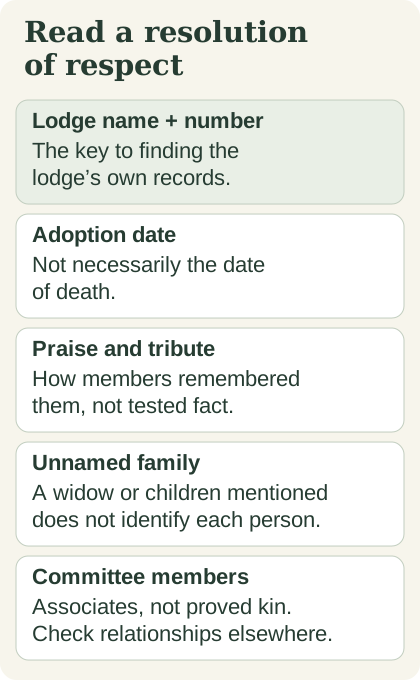
From these examples you can see what to expect. A resolution names the lodge, usually with its number, names the deceased member, records that the lodge adopted the resolution, and may name the committee members. Personal details vary, and many resolutions are mostly tribute.
Other lodge items in the newspaper
Gena Philibert-Ortega's 2024 GenealogyBank blog post, Genealogy Tips: Your Ancestor's Fraternal Group, describes Odd Fellows and Rebekah items in 1920s Texas papers: meeting notices, officer installations, regional gatherings and public events. Many of the names she found were officers, not ordinary members.
That is an important limit. If your ancestor held office, they may appear in an installation report. If they were an ordinary member, the resolution of respect may be the only newspaper item that names them in connection with the lodge.
A fictional resolution from start to finish
Everything in this example is invented: the person, the lodge, its number, the town, the newspaper, the committee, the wording and all dates. No real lodge or person is described, and none of these items exists in any archive. The fraternal order named is real, but nothing here describes its actual practice or records.
Suppose your ancestor Harlan Mercer died in the invented town of Ashby Mills around 1891. You have a gravestone with a date of death, 2 March 1891, but no obituary.
You search the invented Ashby Mills Banner for Mercer resolutions and Mercer lodge, using These words within 10 words of each other, for March to May 1891, and find this in the issue of 3 April 1891:
"RESOLUTIONS OF RESPECT. Hall of Laurel Lodge No. 212, I.O.O.F., March 24, 1891. Whereas, it has pleased the Supreme Ruler to remove from our midst our worthy brother Harlan Mercer; therefore be it Resolved, that in his death the lodge has lost a faithful member and the community an upright citizen; Resolved, that we tender our sympathy to his bereaved widow and children; Resolved, that a copy of these resolutions be sent to the family and to the Banner for publication. J. W. Cobb, E. T. Rand, S. Doyle, Committee."
Here is what you can record. The Banner of 3 April 1891 printed resolutions dated 24 March 1891 at the hall of Laurel Lodge No. 212, I.O.O.F., calling Harlan Mercer a "worthy brother" who had died, and expressing sympathy to his widow and children. Three committee members are named.
I.O.O.F. is short for the Independent Order of Odd Fellows. It identifies the wider organisation; the lodge name and number identify the local group in this fictional example.
Here is what you cannot record. The resolution gives no date of death, so your gravestone date remains the source for that. It does not name the widow or the children, or say how many children there were. It does not say when Harlan joined the lodge, or what offices he held. Its praise is the lodge's tribute, written for the occasion.
The useful result is the lodge's name and number. Those let you look for the lodge's own membership records, which might give Harlan's age, occupation, residence and date of joining.
Search for the lodge wording and the order's name
Lodge items appear in many places: local news, legal notices, classifieds, society columns and the paid notices near obituaries. Search for the wording they used, then narrow by name.
On Chronicling America, open Collection Items, expand Advanced Search and choose Pages (Full Text), as the Library of Congress explains in its tips for searching Chronicling America. Limit by state, the county's newspaper titles and a date range. Then try:
- Your surname with
resolutions, using These words within 10 words of each other. - Your surname with
lodgeorbrother, using within 10 words. resolutions of respectortribute of respect, using This exact phrase, then browse results by date.- The order's name or abbreviation with the town, such as
Odd FellowsorI.O.O.F., using All of these words. installedorinstallationwith the order's name and the town, for officer lists.
Abbreviations are hard for OCR. "I.O.O.F." or "F. & A. M." may be read in many ways, so search the order's full name as well, and browse pages where the paper printed lodge news. Philibert-Ortega suggests searching both the ancestor's name and the order's name, and, for women, both their own given name with their married surname and their husband's name, as in "Mrs. John Smith". Our guide to searching when OCR gets names wrong has more on working from page images.
Time your search around a death. The examples above show resolutions adopted days or weeks after a death and published afterwards, so search the issues for one to three months after the date.
Read the dates and the claims
Record the date of adoption when it is given and the newspaper issue date separately. Neither should be treated as the death date unless the text explicitly gives that information.
The resolution is a tribute adopted by colleagues. Phrases such as "a faithful member" or "an upright citizen" tell you how the lodge chose to remember him, not facts you can test. A reference to "his bereaved widow and children" suggests a family existed, but it does not name them or prove how many there were.
Our guide to finding obituaries and death notices explains how to distinguish the kinds of death coverage and notes that an organisation may publish a resolution among paid notices. A resolution may appear alongside a family's own notice and a news report, and each should be recorded as a separate item.
Build a membership timeline from officer lists
If your ancestor held office, installation reports can give you a run of dated sightings. Philibert-Ortega describes installation reports as items where the names are mostly the officers in charge, and the Newberry guide notes that city directories list lodges with their officers. Between them, a newspaper and a directory may show your ancestor as an officer in several different years.
Make a small table with one row for each sighting: the date, the source, the lodge name and number, the office as printed and the other officers listed. Offices often have titles specific to the order. Copy them exactly rather than translating them into a general word such as "officer", because the exact title can help a grand lodge or archivist find the right record.
Read the table for what it shows and what it does not. The first and last years in which you see your ancestor are not the years they joined and left. A gap in the run may mean that they held no office that year, that the paper did not print the list, or that you have not found the issue. A move to a lodge in another town may show up as a different lodge name in a later year, which is a lead for your residence timeline as well as your lodge research.
What membership in a lodge can tell you
A resolution or officer list establishes that the newspaper reported your ancestor as a member, or officer, of a named lodge at a date. That places them in a community and gives you a set of associates: fellow officers and committee members who may have been neighbours, business partners or relatives.
It does not establish relationships. Committee members who shared your ancestor's surname may have been relatives, but the resolution does not say so. Our guide to finding ancestors in social columns explains how to build a small network of mentions without treating repeated association as proof of kinship.
Many orders had related organisations for women. A woman may appear in the papers as an officer of an auxiliary, such as the Rebekahs that Philibert-Ortega mentions alongside the Odd Fellows. As with other notices, a woman named only as "Mrs." with her husband's name is identified through him, and you need another record for her own given name.
From the lodge name to the organisation's records
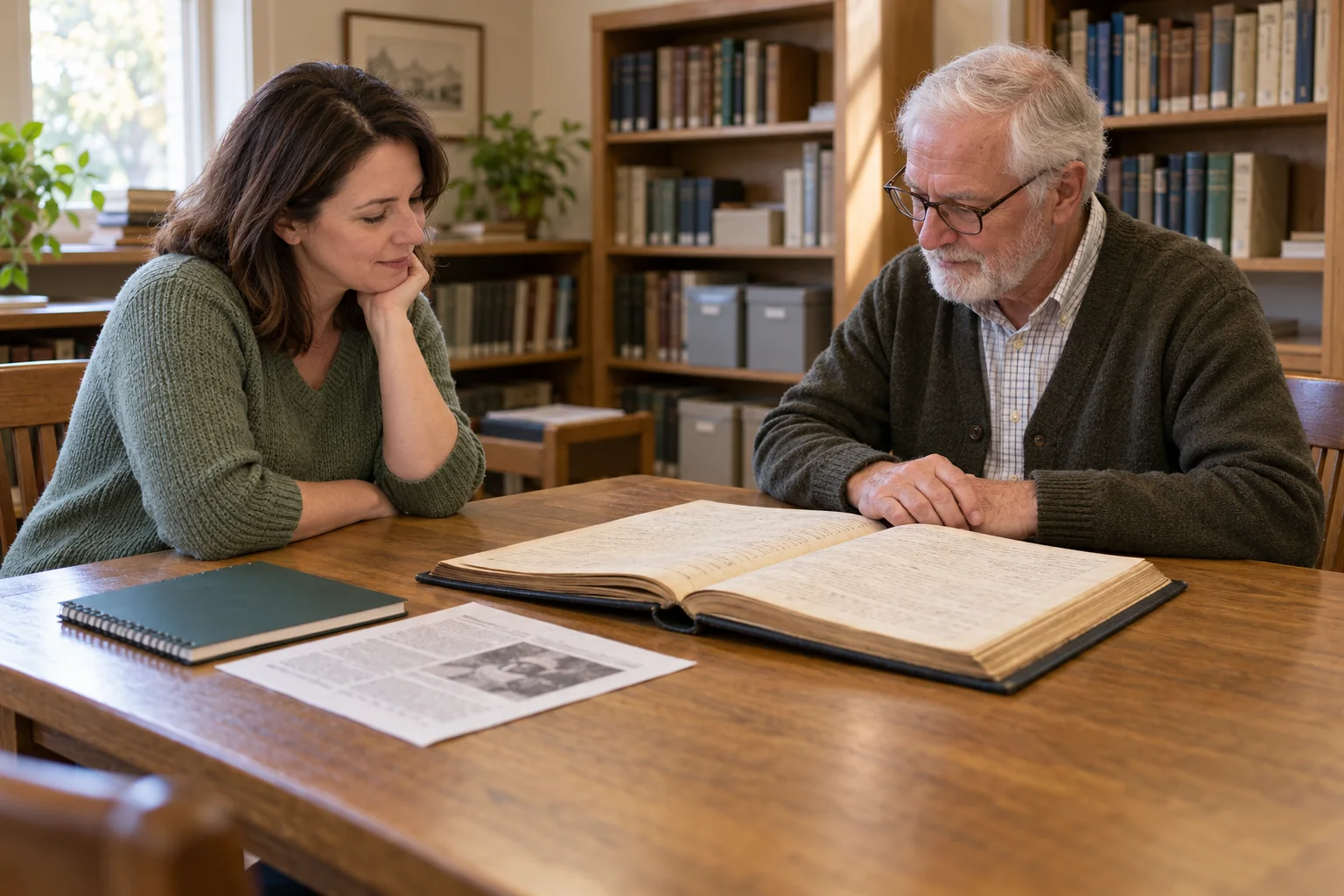
The organisation's own records can hold much more than the newspaper. A review on the Cook County, Illinois, ILGenWeb site of John S. Yates's 1998 book Freemasonry: A Guide for Genealogists describes membership cards that, where they survive, could record fifteen items of information about each member, and notes that the book lists addresses for Masonic grand lodge offices in each state, gives lodge charter dates and includes sample request letters.
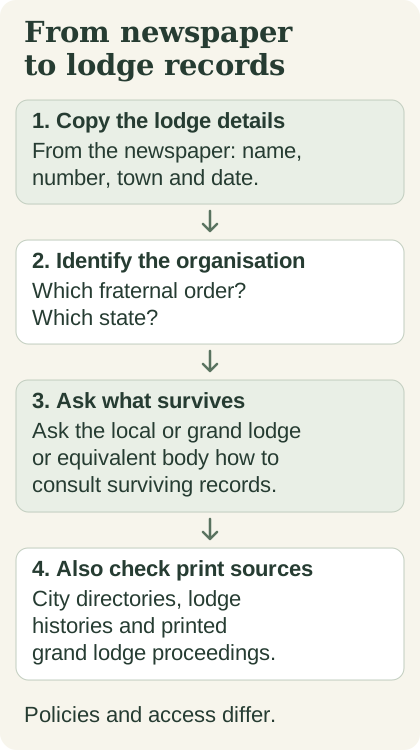
The Newberry Library's guide to fraternal organisations points to other published sources: city directories that list lodges with their addresses, officers and meeting times, published lodge histories that list members' names, and printed proceedings of grand lodges. Its examples include an 1883 Chicago directory of lodges and benevolent societies with member names and addresses.
A grand lodge is a governing body for local lodges within an order, often at state level in the US. Its name and responsibilities vary between organisations.
To request records, identify the order and the state, then contact the grand lodge or equivalent body for that state, or ask whether the local lodge still exists. Give the lodge's name and number from the newspaper, your ancestor's name and the approximate dates. Ask what records survive and how they can be consulted. Policies differ between organisations, and some records may have been lost or transferred.
A short records enquiry
You can adapt this message:
I am researching [ancestor's name], reported as a member of [lodge name and number] in [town and state] around [years]. Do you hold membership records for this lodge and period, and how can I consult them? If not, could you suggest who might hold them?
Replace the brackets with your own details and include the newspaper title, issue date and page so the recipient can check your reference.
When the lodge is not named
Sometimes a newspaper says only that "the lodge" attended a funeral, or that a member was buried "with the honours of the order". Use the date and town to find which lodges of that order existed there, through a city directory, a published lodge list or the grand lodge. Our guide to finding an ancestor's address in old newspapers explains how directories and newspapers can be compared.
If no lodge item appears, your ancestor may not have belonged to a lodge, the lodge may not have sent its resolution to that paper, the item may be in another paper in the county, or the issues may be missing. Check which papers served the town in the months after the death, and browse their pages.
Other societies that adopted resolutions
Lodges were not the only groups to adopt resolutions. The Tate County page includes one from a Sunday school. Other groups, such as church societies or veterans' organisations, may also have adopted and published tributes. If your ancestor belonged to any organisation, search its name with your surname and resolutions for the months after the death.
Record each item and the lodge details
For each item, record the newspaper title, issue date, page and column, the heading, the lodge or organisation's full name and number as printed, the date the resolution was adopted, every person named and their role, and any instructions about copies. Note whether the item gives a date of death or any relatives' names.
Keep interpretation separate: "Resolution of Laurel Lodge No. 212, I.O.O.F., dated 24 March 1891, printed 3 April 1891, for Harlan Mercer; mentions widow and children, unnamed. Next: grand lodge for the state, membership record for Harlan Mercer, Laurel Lodge No. 212." Our guide to verifying and preserving a newspaper discovery gives a full citation checklist.
Try a lodge search this week
Choose one ancestor who died in a known month and year, and look for any possible clue to membership, such as a mention in an obituary, a certificate or badge in family papers, or a fraternal emblem on a gravestone, which is worth testing but not proof on its own. Record the clue and its source.
On Chronicling America or the state's free newspaper site, limit to the county's papers for one to three months after the death. Search the surname with resolutions and with lodge, within 10 words. Then search resolutions of respect as an exact phrase for the same months and read every result.
If you know the order, search its name with the town for the years before the death to look for officer lists and installations.
If you find a resolution, note the lodge's name and number, and look up how to contact the grand lodge or equivalent for that order and state. If you find nothing, check a city directory for the town to see which lodges met there, then search each lodge's name in the paper.
Sources
- Ellis County TXGenWeb: Resolution of respect for J. T. Hussey, Waxahachie Enterprise, 1882 (transcription)
- Tate County MSGenWeb: Resolutions of respect (transcriptions)
- GenealogyBank blog (Gena Philibert-Ortega): Genealogy tips: your ancestor's fraternal group (2024)
- Newberry Library: Fraternal organizations research guide
- Cook County ILGenWeb: Review of John S. Yates, Freemasonry: A Guide for Genealogists
- Library of Congress: Tips for searching in Chronicling America
- Library of Congress: Chronicling America, a guide for researchers
- Independent Order of Odd Fellows: Official organisation website