
Divorce and separation
How to find an ancestor's divorce in old newspapers
Find historical divorce notices, court reports and legislative petitions in old newspapers, read what they actually establish, and use them to reach the court file.

On this page
- Where divorce appears in a newspaper
- Follow a fictional divorce notice to a reported decree
- Search for court wording and the surname
- Read the dates and claims separately
- Grounds, stigma and sensitive content
- When the notice concerns a common name
- From newspaper to court file
- When you find nothing
- How divorce items fit other legal notices
- Record the trail carefully
- Try a divorce search this week
- Sources
A divorce may help explain a gap in a couple's records. Look for a wife listed alone in a directory or a husband who remarried while his first wife was still alive, especially when no death record explains the change. Old newspapers can help in three ways. They printed legal notices telling an absent spouse that a divorce petition had been filed. They reported court business, including lists of divorces granted. And in some states and periods they reported legislative petitions, because divorce once required an act of the legislature.
Your first action is to search for the legal wording of a divorce case alongside the surname. In the free Chronicling America collection at the Library of Congress, limit the search to the county's newspapers and a span of years, and look for "divorce" within ten words of the family surname. Then read the legal notices and court news in the issues around any hit.
This guide explains what each kind of newspaper item can tell you, how to search for them, how to read their dates and claims, and how to follow them to the court record. It concerns historical research. Recent divorce records may involve living people and are often restricted, so this guide does not cover them.
Where divorce appears in a newspaper
Divorce cases reached newspapers for different reasons, and each type of item says something different.
A legal notice was published because the court required it. A transcription by the TNGenWeb Historical News Indexing Project of a notice from the Cleveland Banner, Tennessee, in 1872 shows how a service notice could read. The notice states that William B. Stearns was a non-resident of Tennessee, so ordinary process could not be served, and orders publication requiring him to appear and answer his wife's petition or face a hearing without him. The transcription dates the first publication to 19 April 1872, records a four-week press fee, and identifies the issue transcribed as 3 May 1872.
A court report was published because the editor thought it news. A local paper might summarize a court session by listing cases heard and decided, and divorce decrees can appear among them. Check whether your paper did this before relying on it.
A legislative report was published because the legislature had acted. In Virginia, the Library of Virginia's Out of the Box blog explains in a post on legislative petitions for divorce that from 1776 to 1826 petitioning the General Assembly was the only way to obtain a divorce, that county and city courts began granting divorces in 1827, and that the legislature continued to receive petitions until 1852.
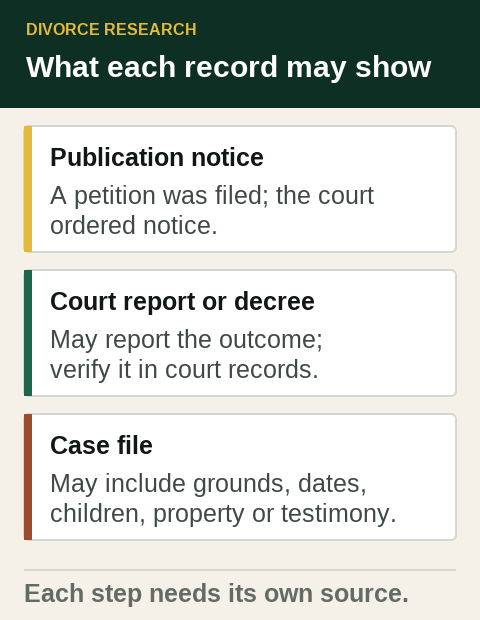
Knowing which type you have tells you what it can support. A notice records that a petition was filed and what it alleged about the defendant's residence. A court report may record a decree. A legislative report may record a bill passed or rejected.
Follow a fictional divorce notice to a reported decree
Everything in this example is invented: the people, Calder County, the newspaper, the court, the dates and the wording. Calder County is not a real jurisdiction, and these items do not exist in any archive.
Suppose your records show Nora and Edwin Halvey married in 1879. In an 1880 census entry they share a household. By 1890 a city directory lists "Halvey, Nora, dressmaker" alone, and you have no death record for Edwin.
You search the invented Calder Weekly Clarion from 1882 to 1890 for Halvey divorce within 10 words and find this on page 4 of the issue of 11 October 1884:
"NON-RESIDENT NOTICE. Nora Halvey vs. Edwin Halvey. In the Circuit Court of Calder County. In this cause it appearing that the defendant Edwin Halvey is a non-resident of this State, it is ordered that publication be made for four successive weeks requiring him to appear at the November term and answer the bill for divorce, or the same will be taken for confessed."
From this you can record:
- A bill for divorce was filed by Nora Halvey against Edwin Halvey in the Calder County Circuit Court before October 1884.
- The court accepted that Edwin was a non-resident of the state at that time and ordered publication.
- He was required to appear at the November 1884 term.
You cannot yet record that a divorce was granted, when, or on what grounds. The notice does not give grounds. It does not prove that Edwin had left voluntarily or show where he lived. It records the court treating him as a non-resident for the purpose of service.
You then browse the Clarion's court report for the November term and find "Halvey vs. Halvey, divorce granted" in the issue of 29 November 1884. That item, if it concerns the same case, records a decree. It still gives no grounds and no detail about children or property. For those, you need the court's case file.
Search for court wording and the surname
Divorce items are scattered across legal pages and court columns, in small type. Combine the surname with the words the court or the editor would have used.
On Chronicling America, open Collection Items, expand Advanced Search and choose Pages (Full Text). The Library of Congress describes these options in its tips for searching Chronicling America. Limit by state, then by the county's newspaper titles and a date range. Try:
- Your surname and
divorcewith These words within 10 words of each other selected. bill for divorcewith This exact phrase selected, then browse results by date.petition for divorcewith This exact phrase selected.libel for divorcewith This exact phrase selected. In some states the person seeking divorce was called the libellant.non-residentwith your surname, within 10 words, to catch publication notices that do not use the word divorce in the heading.
Search both spouses' surnames when the wife may have resumed an earlier name. If a case name is "Halvey vs. Halvey", OCR might read it in several ways, so also try the surname alone with vs within 5 words.
If searching returns nothing, browse the court report for each term in your window. Notices like the ones above name the court term, so once you know when that court sat and when the paper printed its court news, you can go straight to those issues. Our guide to searching when OCR gets names wrong explains how to read dense pages when search fails.
Read the dates and claims separately
A divorce notice may carry several dates: the date the petition was filed or the court made its order, the date of first publication, each later publication date, and the court term at which the defendant must appear. A decree, if you find one, has its own date. Record each with its meaning.
The transcription of the 3 May 1872 issue identifies 19 April as the first publication date and notes a four-week press fee. The petition and court order had already occurred by then, so do not mistake the issue date for the case's starting point.
The claims in a notice come from the person seeking the divorce, filtered through the court. A statement that the defendant was a non-resident tells you what the court accepted for service, not where the defendant actually lived. A statement in a court report that a divorce was granted is the editor's summary. It may abbreviate names, confuse parties or omit cases.
Grounds, stigma and sensitive content
Divorce was hard to obtain in many places and periods, and couples had to state a reason. Rhonda R. McClure's divorce records handout for the New England Historic Genealogical Society notes that no-fault divorce was not available in earlier years, that grounds such as abandonment, adultery or cruelty might be alleged, and that case files may describe unpleasant topics. She also notes that families may not have talked about a divorce, so researchers often have to read between the lines.
Newspapers sometimes printed the grounds, and occasionally reported contested cases in detail. Treat these reports as accounts of allegations made in court, not as findings about what happened in the marriage. A decree that states grounds records the legal basis used in that proceeding. It does not prove every allegation was true, especially if the other spouse did not appear.
Think about how you record and share these details. They concern real people's private lives and may involve descendants still living. You can note that a divorce was granted, and on what stated grounds, without repeating every allegation in a family history.
When the notice concerns a common name
Divorce notices name both spouses, which helps with identity. Even so, two couples with the same names can exist in one county. Check that the husband's and wife's given names, the county and the timing all fit your family. If the notice names a court term or a case number, those will lead you to the file, which may give ages, the marriage date and children's names.
Do not use a divorce notice alone to decide which of two men with the same name was your ancestor. Our guide to finding an ancestor with a common name explains how to keep candidates separate until a distinguishing record settles the question.
If a woman's later records show her under a different surname, the divorce file or a later marriage record may explain the change. A newspaper item calling her "Mrs. Halvey" after the decree does not tell you whether she had remarried, resumed a former name or kept her married name.
From newspaper to court file
Once you have the names, the court and a term or date, find the case file. McClure's handout explains that divorce cases were handled by civil courts, usually at county level, and that the court varies by state. It lists possible courts including chancery, circuit, common pleas, district, probate and superior courts. It also notes that older completed cases may have moved to a state archive, that some county records are stored offsite, and that some court records were microfilmed and appear in the FamilySearch catalog under the county's court records.
The handout distinguishes bound volumes kept by the clerk, such as docket books, minutes, orders and judgments, from case files holding the petition, orders and depositions. The case file usually has more detail. If the file is missing, a docket book or minute book may still record the decree.
When you write to a court clerk or archive, give them what the newspaper gave you. A short request might read: "I am looking for the case file and any decree in Nora Halvey vs. Edwin Halvey, a divorce case in the Circuit Court of Calder County, with a publication notice in October 1884 requiring the defendant to appear at the November 1884 term. Do you hold the file, and how can it be consulted or copied?" That gives the clerk the parties, the court and a term to check in the docket, which is far easier to answer than a request to search for any divorce in a family.
For Virginia before 1852, also search the Library of Virginia's digitized legislative petitions, which the Out of the Box post says can be searched by locality, topic or the main petitioner's name. The post reports that in the years when the legislature was the only option, about one in five petitioners obtained a divorce or legal separation. A petition found there tells you someone asked. A separate act or record tells you whether it was granted.
When you find nothing
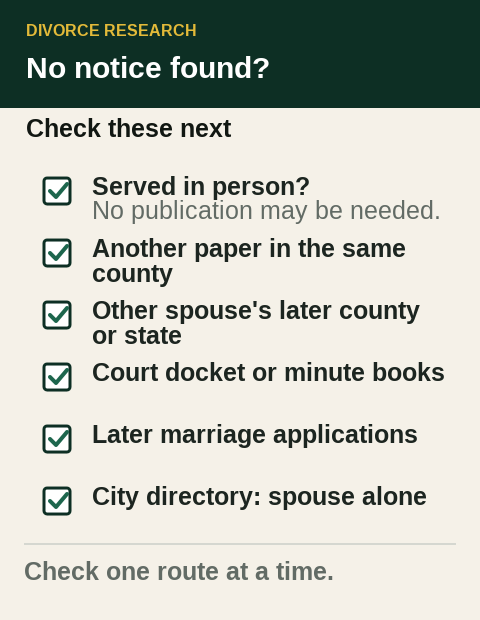
There are several explanations for an empty search. The couple may have separated without divorcing. The divorce may have been granted in another county or state, perhaps where one spouse moved. The notice may have been published in a different paper in the same county. The defendant may have been served in person, in which case no publication notice was needed. Or the issues may be missing or not digitized.
McClure suggests other records that may reveal a divorce: marriage applications that ask about previous marriages, death records, censuses and city directories. A woman listed alone in a directory, or later described as a widow when her husband was still alive, may be a clue worth testing. Our guide to finding an ancestor's address in old newspapers explains how to compare dated directory and newspaper entries without assuming that a change of address or household marks a particular event.
If the newspaper you need is not online, our guide to free and library newspaper access explains how to request particular issues on microfilm. Record the titles, dates and searches you tried so the negative result is precise.
How divorce items fit other legal notices
Divorce notices sit among the same legal columns as estate, land and other court notices. Our guide to military, legal and migration news notes that a divorce notice does not explain the relationship and that legal notices should be read as announcements rather than outcomes. The same habit applies here. A publication notice announces a case; a decree ends it; the file explains it.
If another record names a place where one spouse later lived, local columns or the new town's paper may offer the next lead. If the notice itself names a destination, search there too. "Non-resident" alone does not tell you where the spouse went.
Record the trail carefully
For each item, record the newspaper title, issue date, page and column, the heading, the case name as printed, the court, every date in the item with its meaning, and whether you saw it in several issues. Transcribe the notice exactly.
Keep interpretation separate. For example: "Notice of 11 October 1884 shows a bill for divorce filed by Nora Halvey against Edwin Halvey, Calder County Circuit Court, Edwin found non-resident. Decree reported 29 November 1884. Grounds not stated. Next: request the case file and docket entry."
When you obtain the case file, note what it adds or contradicts: the date and place of marriage, children's names, property, residence claims and the grounds.
Try a divorce search this week
Choose one couple in your tree whose records diverge without a death to explain it. Note the county where they last lived together and a span of about ten years after that point.
On Chronicling America, limited to that county's papers and your span, search the surname and divorce within 10 words, then bill for divorce and petition for divorce as exact phrases. If the paper printed court reports, find when they appeared and browse each term's report for the surname.
For any item you find, record the court and term, then look up who holds that county's historical divorce or equity records today, checking the state archives' catalog and the FamilySearch catalog under the county's court records.
If you find nothing, search the other spouse's later county of residence for the same span, and look at a later marriage application for either spouse to see whether it mentions a previous marriage ending in divorce. Record each place and span you have checked.
Sources
- TNGenWeb Historical News Indexing Project: Stearns petition for divorce, Cleveland Banner, 1872 (transcription)
- Library of Virginia, Out of the Box: Breaking Up Is Hard to Do: Legislative Petitions for Divorce
- New England Historic Genealogical Society (Rhonda R. McClure): Divorce records handout, PDF
- Library of Congress: Tips for searching in Chronicling America