
Inventors
How to use old U.S. newspapers to find an ancestor's patent
Use old newspaper patent lists and advertisements to trace an ancestor's invention. Find the patent record and check what it establishes about the person.

On this page
- What newspapers printed about patents
- A fictional search from start to finish
- Search newspapers for patent items
- Find the U.S. patent itself
- What a patent can tell you
- Use the patent's dates to place other events
- Assignments, partners and heirs
- The patent file at the National Archives
- Separate the inventor from namesakes
- When the story does not match the record
- Record the newspaper item and the patent trail
- Try a patent search this week
- Sources
If a family story says an ancestor "invented something" or "had a patent", a local U.S. newspaper may have reported it. Some papers printed lists of patents granted to local inventors; others covered inventors, advertised patented devices or reported disputes over inventions. A notice can provide an inventor name, place, invention or approximate date to help you find a U.S. patent record. It remains a newspaper's report, not proof that a matching inventor is your ancestor.
Start with a U.S. name search in Google Patents. Then search a free newspaper collection such as Chronicling America for your ancestor's surname with "patent" and their town. If the patent search fails because an old name was misread, a newspaper item may offer another date, spelling or invention term to try.
This guide focuses on U.S. patent records. It shows how to find newspaper leads, use them to search for a patent, and follow a promising record into archival files without treating any one match as settled family history.
What newspapers printed about patents
The Legal Genealogist, in a 2018 post on patents and genealogy, advises not to neglect local newspapers, noting that some papers praised local inventors, some ran columns drawn from patent announcements, and some carried inventors' advertisements for their devices or for rights to sell them. Its example of a local plumber whose claim to an invention was disputed by another plumber shows that patents could also become local news for less happy reasons.
Lists of patents could be detailed. A page of transcriptions on the Brooklyn Genealogy Information site, compiling patent lists from Brooklyn newspapers between 1860 and 1905, shows weekly or daily lists, mostly from the *Brooklyn Daily Eagle* and other local papers. Each entry usually gives the inventor's name, their city or town, and the invention, and some note an assignment or a reissue. The transcribed lists do not give patent numbers.
Such a list records that the paper reported a named person, place and invention together. Those details give you more ways to search for a patent, but the examples do not establish how often the search succeeds.
A fictional search from start to finish
Everything in this example is invented: the person, the town, the newspaper, the invention, the patent number and all dates. No real patent, inventor or newspaper item is described, and none of these items exists in any archive or database.
Suppose a family story says your great-great-grandfather Josiah Kemble, a tinsmith in the invented town of Lowbridge, "patented a lantern". A search of Google Patents for Josiah Kemble returns nothing.
You search the invented *Lowbridge Herald* for Kemble patent with These words within 10 words of each other, for 1870 to 1890, and find this in a weekly column headed "Patents to Local Inventors" on 19 September 1882:
"Josiah Kemble, Lowbridge, lantern; Thomas Gale, Hartwell, churn."
Here is what you can record. The *Herald* of 19 September 1882 listed Josiah Kemble of Lowbridge as receiving a patent for a lantern, in a column of patents granted to local inventors.
Here is what you cannot yet record. The list does not give the patent number or the exact issue date, so you do not know which week the patent was granted. It does not say whether Josiah was the only inventor, or whether he had assigned rights to someone else. It does not prove that this Josiah Kemble is your tinsmith, though the town and the family story agree.
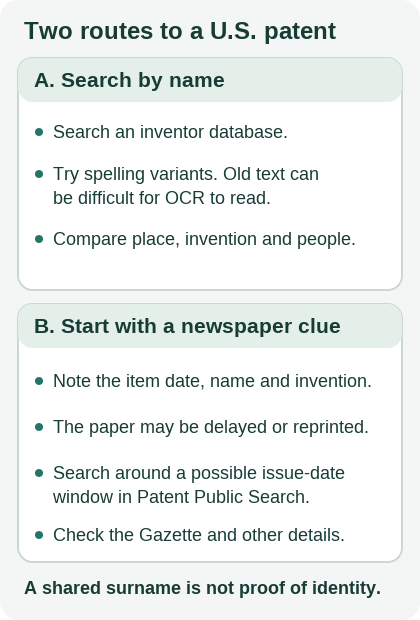
Now you search by date instead of name. The list gives no issue date. In this fictional example, you begin with the weeks before 19 September, while keeping open the possibility that the column was delayed or reprinted. Iowa State University Library describes searching the USPTO's Patent Public Search by issue date and checking the Official Gazette for inventor names and numbers. In the invented results, a patent for a lantern to "Josiah Kimble" of Lowbridge appears in that window. The town and invention fit, but a misspelled surname alone does not prove this is the tinsmith.
Search newspapers for patent items
On Chronicling America, open Collection Items, expand Advanced Search and choose Pages (Full Text), as the Library of Congress explains in its tips for searching Chronicling America. Limit by state and the papers serving your ancestor's town. Then try:
- Your surname with
patent, using These words within 10 words of each other. patents grantedorpatents issued, using This exact phrase, to find where the paper printed lists, then browse those lists across the years you need.- The invention, if the family story names one, with your town, using All of these words.
- Your surname with
patenteeorinventor, within 10 words.
Advertisements are worth a separate search. The Legal Genealogist post mentions inventors advertising their devices or franchises. Search your surname with patented or rights within 10 words, since such advertisements may offer the right to make or sell a device in an area. Our guide to tracing a family business through newspaper advertisements explains how to read advertisements as evidence rather than as statements of fact.
Lists of patents set in small type are hard for OCR. If a search finds one list in a paper, browse the same page in other weeks. Our guide to searching when OCR gets names wrong explains how to work from the page image.
Find the U.S. patent itself
Patent databases now make many historical patents searchable, but their name searches depend on OCR too. The Iowa State University Library's guide to patents for genealogy recommends name-searchable databases such as Google Patents and The Lens, using the inventor or assignee field and filtering by country and date for common names. It warns that text before 1976 was captured by OCR, so misread names can make name searches fail. In that case it suggests searching by issue date or patent number instead.
It describes how to search the USPTO's Patent Public Search by issue date, using a code for an exact date or year, and narrowing the range where possible. The USPTO's current Patent Public Search page states that a USPTO.gov sign-in requirement begins November 7, 2026. Check that page for access instructions before starting, as they can change. The Official Gazette of Patents lists issued patents, including inventor names, numbers and issue dates. Iowa State's guide describes historic Gazette access through HathiTrust; verify the years and issues available there.
A newspaper item gives possible search terms: a name, town, invention and a newspaper publication date. Treat any date window as a starting hypothesis, not a proven grant date. Search the Gazette or Patent Public Search around a plausible range, widen it if needed, and compare the inventor, place and invention before accepting a candidate.
What a patent can tell you
The patent document can add details that a newspaper list leaves out. Iowa State's guide notes that patents can show a stated inventor location, co-inventors, attorneys and an assignee, which was often an employer. The Legal Genealogist describes patents naming inventors, witnesses, lawyers and other signatories, filing and issue dates, and, in a specific 1919 example, the inventor's citizenship.
Each detail can suggest another record to check. A co-inventor or assignee may have a business connection to investigate; witnesses and attorneys may be named elsewhere. The 1919 example in The Legal Genealogist shows how a stated citizenship could help frame a naturalization search, but do not assume every patent names citizenship. For address clues, see how to interpret an ancestor's address in old newspapers.
Read the patent's description as what the inventor claimed to have invented, written for the patent office. It does not prove the invention was used, made or sold.
Use the patent's dates to place other events
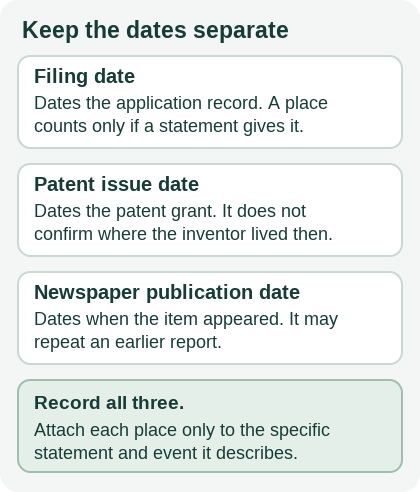
A patent may give a filing date and an issue date; the newspaper item has its own publication date. Record each separately and attach it only to the document, statement or event it actually dates. The dates can be months or years apart.
If a patent records a residence beside the application information, record the wording and the event or statement it describes. Do not use the later issue date as a fresh observation that the inventor still lived there. A newspaper may also repeat earlier patent information rather than report a new residence. Different places can suggest a move to investigate, but use records that expressly state a location and its date to build a timeline. Even those entries do not prove continuous residence between them.
The Legal Genealogist's example shows another use. A 1919 patent stated the inventor's citizenship, which helped narrow when he would have had to naturalize. If a patent describes your ancestor as a citizen or subject of another country, compare it with the naturalization records and census answers you have.
A patent can provide a research lead into an ancestor's work. It describes the invention claimed in the patent, not proof that the inventor made or sold it or held a particular occupation. Compare the claim with dated advertisements, directories and other work records before drawing a conclusion.
Assignments, partners and heirs
Patent rights could be assigned or inherited. The Iowa State guide notes that a named assignee was often an employer; The Legal Genealogist discusses inherited patents. In July 2022, NARA listed Patent Assignment Digests for planned relocation to Kansas City, with August 1, 2022 as an estimated availability date. That notice is historical, not proof of the series' current location, so confirm availability with NARA before requesting it. The current NARA patent-records page describes case-file series held at Kansas City; do not assume every patent series is there.
For family history, an assignment can be as useful as the patent. A patent assigned in part to a brother-in-law, a partner or a local merchant shows a recorded financial connection, not necessarily kinship. A newspaper list that names an assignee alongside an inventor, as some Brooklyn entries did, gives you a lead to investigate. It does not tell you why the rights were assigned, how much was paid or whether the parties were related. Look for the assignment record, business records and later newspaper items before drawing conclusions.
The patent file at the National Archives
Some patent case-file series are held at the National Archives at Kansas City, alongside design, plant and reissue case-file series. Its current patent-records page explains that records can be viewed by appointment or requested as reproductions. NARA asks for as much as you have of the patent number, inventor or parties, patent title and issue or case date. Use the linked catalog entries and contact NARA to check whether the specific file survives and how it can be accessed. When you write, you might adapt: I am researching [inventor], and a newspaper item [citation] reports [invention] on [date]. The related patent may be [number or title]. Do you hold a case file connected to this patent, and what are the current reproduction or research-room options and fees? Check NARA's current contact instructions before sending.
Patent records have gaps, and a series description does not mean that every individual file survives. For nineteenth-century cases, ask the National Archives about the specific patent number and related record series before assuming a file exists.
Separate the inventor from namesakes
A name in a patent list or database is not automatically your ancestor. The same name may belong to another person in another town, and a misspelling may hide the right person. Compare the exact place statement, the date and event it refers to, and any co-inventors or witnesses with records you already trust. A matching place alone does not establish identity.
If the name is common, keep candidates separate until a detail ties one of them to your family. Our guide to finding an ancestor with a common name explains how.
When the story does not match the record
Family stories about inventions are often partly true. An ancestor may have held a patent for an improvement rather than the whole device, shared a patent with someone else, assigned it away, or bought the rights to sell someone else's invention. A newspaper advertisement for "the Kemble lantern" may describe a product made under licence, not an invention by a Kemble.
Ask relatives whether any family papers survive, such as a certificate of letters patent, a deed of assignment, a printed advertisement or a drawing. Any one of them may carry a patent number or date that makes the search far easier.
Record what each source says. If you find a patent for a different invention, or a patent held by a partner rather than your ancestor, that is still useful evidence about their work. If you find nothing, the story may refer to an application that was never granted. The Iowa State guide notes that the patent office did not publish applications before 2001, so earlier unsuccessful applications are most likely not findable.
Record the newspaper item and the patent trail
For each newspaper item, record the title, issue date, page and column, the heading, and the entry exactly as printed: name, town, invention and any assignee. For each patent, record its number, filing and issue dates, inventors, the wording and context of every place statement, assignee, witnesses, attorney and where you found it.
Keep interpretation separate: "Herald, 19 September 1882, lists Josiah Kemble, Lowbridge, lantern. Patent found under 'Josiah Kimble', Lowbridge, for a lantern, issued shortly before. Spelling differs; town and invention match. Next: request the case file using the patent number." Our guide to verifying and preserving a newspaper discovery has a full checklist for citations.
Try a patent search this week
Choose one ancestor with a family story of a U.S. patent, or an occupation such as machinist, tinsmith or engineer that gives you a search lead. Write down the documented town and the dates your sources actually describe.
Search Google Patents by name using the inventor field, filtered to the United States and their working years. Then search Chronicling America, or the state's free newspaper site, for the surname with patent within 10 words, limited to their town's papers.
If you find a newspaper item but no patent, use its date and the invention to search the Official Gazette on HathiTrust or the USPTO's Patent Public Search by issue date for the weeks before the item.
If you find a possible patent, note its number, the exact wording and context of any place statement, co-inventors, assignee and witnesses. Compare them with independent records before deciding whether the match belongs to your family. Then ask the National Archives whether a related case file is available. If you find nothing, search for advertisements of a patented device under the surname, in case your ancestor made or sold someone else's invention.
Sources
- The Legal Genealogist: Light bulbs, patents and genealogy (2018)
- Brooklyn Genealogy Information: Patent lists from Brooklyn newspapers, 1860 to 1905 (transcriptions)
- Iowa State University Library: Patents, genealogy research guide
- National Archives: U.S. Patent and Trademark Office records at Kansas City
- National Archives: Patent records transfer notice, July 2022
- USPTO: Patent Public Search
- USPTO: Official Gazette of Patents
- Library of Congress: Tips for searching in Chronicling America