
Irish newspapers
How to find an Irish ancestor in historical Irish newspapers
Find clues in Irish newspaper notices, court reports and emigrant references. Search names and townlands, check library access, and follow leads in original records.

On this page
- Why Irish newspapers matter for family history
- Who is likely to appear, and who is not
- The main collections and where to read them
- Working through a fictional death notice
- Reading family notices
- Search with Irish names and places
- Advertisements and early personal notices
- Court and crime reports
- Linking an Irish notice to an emigrant
- When the paper you need is not online
- Record each notice carefully
- Try an Irish newspaper search this week
- Sources
Start with the most specific place you have and a 20-year span. Check which titles covered it and whether those years are digitised in the Irish Newspaper Archive or the British Newspaper Archive, then ask your library about access before paying for pages.
Why Irish newspapers matter for family history
Genealogist Nicola Morris, in a 2026 tutorial for Who Do You Think You Are? magazine on tracing ancestors in Irish newspapers, notes that newspapers began in Ireland in the late seventeenth century but become useful for family history from about the 1750s. The 1922 fire at the Public Record Office in Dublin destroyed records, including some early court records. Survival depends on the court, record series and period; the National Archives of Ireland's legal research guide describes records that remain and advises looking for copies or transcripts when originals were destroyed.
Newspaper reports can add a narrative or clue and may help you locate a case or related documentation. Do not assume that a report is the only surviving account without checking the relevant court, date and repository.
Morris also describes who was more likely to appear in Irish papers, and who was often missing.
Who is likely to appear, and who is not
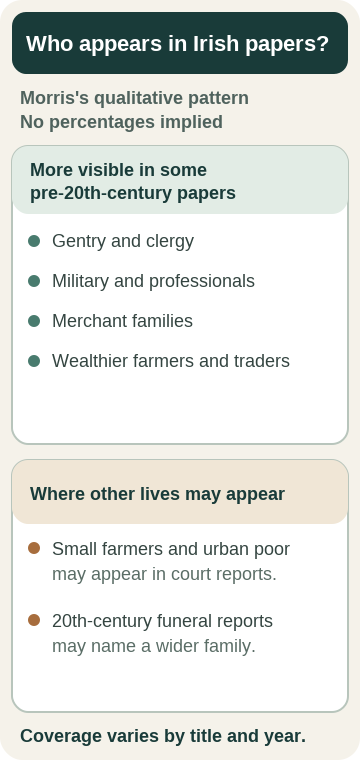
Morris describes the people who mainly appear in Irish newspapers before the twentieth century as gentry, the military, the professional classes, clergy, merchant families, wealthy farmers and some traders. Small tenant farmers and the urban poor are largely absent, she writes, except where they were involved in crime.
If your family were labourers or smallholders in the nineteenth century, adjust your expectations. A death notice is less likely, but a court report might still mention them. In the twentieth century, Morris notes, funeral reports can name mourners, married daughters, grandchildren and cousins, which can bring wider family into view.
This is a bias in the source, not a reason to give up. Search for the family's townland and parish as well as the surname, and look at the kinds of reports where poorer families did appear.
The main collections and where to read them
Online collections do not have identical coverage. Some titles appear in both the Irish Newspaper Archive and the British Newspaper Archive; others appear in only one, and not every Irish paper has been digitised. Search by exact title and year as well as place, then check issue coverage before treating a failed search as evidence that a paper or family mention does not exist.
The National Library of Ireland says it holds the largest collection of Irish newspapers in the country, with titles dating from the late seventeenth century to the present. Many historical issues are available on microfilm. The NLI describes its digitised Newsplan Ireland report as a research tool, not a complete bibliography, so use it to identify possible holdings and then confirm the exact title, year and access with the holding library.
Free and library routes are worth checking first:
- The National Library of Ireland's newspaper e-resources include the Irish Newspaper Archive, the British Newspaper Archive and the Irish Times archive as onsite subscription resources. Check the Library's current reader and access requirements.
- The British Library offers free access to British Newspaper Archive pages in its Reading Rooms. Its current access instructions require a Reader Pass, BNA registration and a connection to the Library's Wi-Fi. The BNA research guide says you can search the index without signing up.
- Ask a public or university library near you whether it offers access to either archive, and what its conditions are. Availability varies by institution.
Working through a fictional death notice
Everything in this example is invented: the people, the townland of Drumfarnagh, the newspaper, the wording and the dates. Any resemblance to a real townland or family is coincidental, no particular county or real jurisdiction is implied, and the notice does not exist in any archive.
Suppose an American record says your ancestor Michael Kerrane was born in Ireland around 1840 and that his mother was Mary. A family letter mentions "Drumfarnagh". You search an Irish collection for Kerrane with the date range 1860 to 1880 and find this in the invented Western Clarion of 14 March 1868:
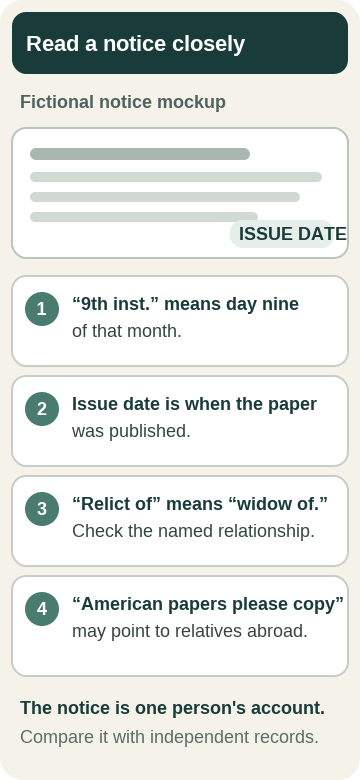
"DEATHS. On the 9th inst., at her residence, Drumfarnagh, Mrs. Mary Kerrane, relict of the late Patrick Kerrane, aged 74 years. American papers please copy."
Read it piece by piece. "On the 9th inst." means the ninth of the current month, so the death was on 9 March 1868, five days before the issue date. "Relict" means widow, so Mary's husband Patrick had died before her. Her age, 74, implies a birth around 1794, but an age in a notice was supplied by whoever placed it and may be approximate. "American papers please copy" asks papers in America to reprint the notice. Morris points out that such requests can suggest relatives who had emigrated.
What the notice supports: a Mary Kerrane, widow of Patrick, aged about 74, died at Drumfarnagh on 9 March 1868, and whoever placed the notice wanted it seen in America.
What it does not support: that she was Michael's mother, or which relatives were in America. A woman of 74 in 1868 could be the mother of a man born around 1840, but the notice names no children. The next step is to search the American papers in Michael's area for a reprint of the notice in the weeks after March 1868, and to check the parish registers for a Michael born to Patrick and Mary Kerrane.
Reading family notices
Morris's tutorial gives a useful guide to what each kind of notice usually contains:
- Birth notices are the least informative. Early ones typically give only the place and the father's name.
- Marriage notices may name the bride's father or parents, the groom's occupation, and the minister and church.
- Death notices are the most informative and may give the name, age and place of death, and sometimes an occupation, spouse, children, siblings or parents.
- Obituaries give fuller life stories. Funeral reports, mostly from the twentieth century, can name mourners, married daughters, grandchildren, cousins and the burial place.
Two cautions apply to all of them. The notice was written by someone for a purpose, often a relative, and its details are their account. And the date of the newspaper is not the date of the event: births, marriages and deaths were usually reported days or weeks later, and Morris advises checking local papers for the two weeks after a known death, remembering that many were weekly or twice weekly.
If a marriage notice names "Mrs. P. Kerrane" or a funeral report lists "Mrs. Kerrane" among mourners, that courtesy form identifies her through her husband. It does not tell you her own given name or maiden surname. Look for her own name in another record before you attach the notice to a particular woman.
Search with Irish names and places
Irish names vary in print. The tutorial notes that names may be shortened or reduced to initials, for example "Pat Murphy" or "Mr. P. Murphy". Prefixes such as O' and Mac may be present or absent, and a surname may be printed in more than one spelling. A National Library of Ireland blog post by a family historian, describing the Library's 2012 family history workshops, notes that because many ancestors could not read or write, clerks recorded the same surname in different ways, so even siblings can appear under different spellings.
Places need the same care. Morris explains that addresses may use official townland spellings or local spellings, and suggests checking an index of townlands. A townland is a small land division, often smaller than a parish, and it is frequently the most specific place you will find. Search the townland name alone with a date range, as well as the surname, because the townland may be spelled consistently where the surname is not.
The tutorial also notes that search engines driven by OCR can miss text affected by creases, tears, smudged ink or tight binding, and recommends trying different terms, spellings and filters before turning to a manual search. Our guide to searching when OCR gets names wrong explains how to build a short list of variants and when to browse instead.

Advertisements and early personal notices
Do not skip the advertising columns, especially in eighteenth- and early nineteenth-century papers. Morris describes early advertisements as noticeboard items for local readers, giving examples such as changes in the ownership of a business and notices about soldiers who had absconded. She also notes that personal notices, such as announcements of separations between spouses, began to disappear from about the 1830s as advertising became more commercial.
For a family historian, that means the earlier papers can hold short, personal items that later papers would not print. A shopkeeper announcing that he had taken over a business from a named predecessor, a widow continuing her late husband's trade, or a farmer advertising a lease can all name people and places that appear nowhere else.
Read these as statements by the advertiser. A notice that a husband would not pay his wife's debts, for example, records his public position at that moment. It is not a record of what happened between them, and it may have been placed in anger. Search the surrounding issues for any reply or later notice.
Court and crime reports
The National Archives of Ireland's legal research guide covers court records from many levels and periods. It explains that newspapers can help locate a case or related documentation, and that copies of some records destroyed in 1922 may survive in private, solicitor or business collections, or in transcripts made before the loss. A court report may name defendants, witnesses, victims, constables or magistrates, with places, ages and occupations. Check the correct court and date before treating a newspaper report as the only evidence.
Read them as reports, not verdicts. A charge is not a conviction, and a newspaper might print a name that was later shown to be wrong. Where reports survive, follow a case across issues from the first account to any trial or sentence, and record each step separately. Morris notes that these reports can be particularly useful for relatives who were transported to Australia, where other records may pick up the story.
Our guide to military, legal and migration news explains the general habit of separating what a report says from what you infer, which matters especially here.
Linking an Irish notice to an emigrant
For families who left Ireland, the Irish papers can supply what American or Australian records lack: a townland, a parent's name, a family's standing in the parish. Linking the two sides is where mistakes happen, because the same given names recur and many families shared a surname in one parish.
Look for details that tie them together: a townland or parish that matches an American record, a parent's name, an occupation, dates that fit, and, where you are lucky, a notice that mentions a relative overseas. A "please copy" request can point you to the overseas papers where a reprint might name the emigrant.
If the surname is common in the parish, keep separate working records for each candidate family until a distinguishing record settles the question. Our guide to finding an ancestor with a common name explains how.
A townland in a notice is a dated place clue. It shows where someone was described as living on one date, not that the family lived there throughout. Our guide to finding an ancestor's address in old newspapers explains how to arrange such clues in order.
When the paper you need is not online
If a paper is not digitised for the years you need, it may survive in print or on microfilm. Use the National Library of Ireland's newspaper collection and Newsplan information as research aids, then confirm a specific title and issue with the holding library. Search the NLI and British Library catalogues and check their current reading-room arrangements before travelling.
Our guide to free and library newspaper access is written for US collections, but its advice on asking a library a precise question, with the title, place and dates, applies just as well to an Irish repository.
Record which titles and years you searched online, and which you could not reach. A gap in online coverage is not proof that the paper or issue never existed.
Record each notice carefully
For each item, record the newspaper title, place of publication, issue date, page and column, the collection you used and your access date. Transcribe the notice exactly, including abbreviations like "inst." and "relict", and any "please copy" line.
Then note the dates separately: the event date if stated or calculable, and the issue date. Keep your interpretation apart, for example: "Mary Kerrane, widow of Patrick, died Drumfarnagh 9 March 1868 aged 74. Possible mother of Michael. Next: parish baptisms for Michael, about 1840; American papers for a reprint, March to May 1868."
Try an Irish newspaper search this week
Choose one Irish-born ancestor and write down the most specific place you have for them, with its source: county, parish or townland.
Ask your library whether it offers access to either archive. If you are in Ireland, check the National Library of Ireland's onsite e-resources. The British Newspaper Archive's index can be searched without signing up; viewing full pages may require a subscription or Reading Room access, so check the current terms.
Search the surname with the county and a twenty-year span, then search the parish or townland name alone over the same span. Note every hit that mentions the right place, and read the full notices for the strongest two or three.
If you find a death notice with a "please copy" line, search the American papers in your emigrant's area for the following two months. If you find nothing in Ireland, check whether your area's papers are digitised for your years, note the gaps, and look up which library holds them in print or on microfilm.
Sources
- Who Do You Think You Are? Magazine (Nicola Morris): How to trace your ancestors in Irish newspapers (2026)
- National Library of Ireland: Newspapers and Newsplan Ireland
- National Library of Ireland: E-resources
- National Library of Ireland blog: family history workshops (2012)
- National Archives of Ireland: Legal research and court records
- British Library: British Newspaper Archive research guide
- British Library: Current British Newspaper Archive Reading Room access