
Civic lists
Find ancestors in jury lists and local election results
Search jury lists and local election results for a dated township clue, then check who the entry describes and whether the person was drawn, served or elected.

On this page
- Search for the list heading
- A fictional jury list from start to finish
- What these lists look like
- What a listed name can and cannot tell you
- Who appears, and who does not
- Drawn is not the same as served
- Read the place attached to each name
- Using lists to separate people with the same name
- Follow local officeholders into original records
- Check whether repeated surnames describe relatives
- When the list is missing or your ancestor is absent
- Record each entry with its context
- Try a civic list search this week
- Sources
Newspaper jury lists and local election results pair names with dated place clues. Use them to investigate a township connection or separate namesakes, not as automatic identification.
Start with one ancestor, a documented county and a short span of years. If the free Chronicling America collection has a suitable paper, limit the search to that title and try petit jurors (trial jurors) as an exact phrase. Read the list heading and each printed place before deciding who a name describes. If the paper is not available there, check the free and library routes.
Search for the list heading
Lists of names in narrow columns are hard for OCR. Find the lists by their headings, then read them.
On Chronicling America, open Collection Items, expand Advanced Search and choose Pages (Full Text). The Library of Congress explains the options in its tips for searching Chronicling America. Limit to the state and county paper and a span of years. Try:
petit jurorswith This exact phrase selected.grand jurorswith This exact phrase selected.jurors drawnwith These words within 5 words of each other selected.town officersortownship officerswith This exact phrase selected.electedwith your township's name, using These words within 10 words of each other.justice of the peacewith This exact phrase, plus a date filter around spring or autumn elections if you know when local elections were held.
When you have found one jury list, note how far before the court term it appeared. Then work out the court's terms, from the list headings or from the court calendar printed in the paper, and browse the issues just before each term.
Our guide to searching when OCR gets names wrong explains how to read lists from page images when the text layer is poor.
A fictional jury list from start to finish
Everything in this example is invented: the people, Tarrow County, Wexmoor and Lanning townships, the newspaper, the court and the dates. Tarrow County is not a real jurisdiction, and these lists do not exist in any archive.
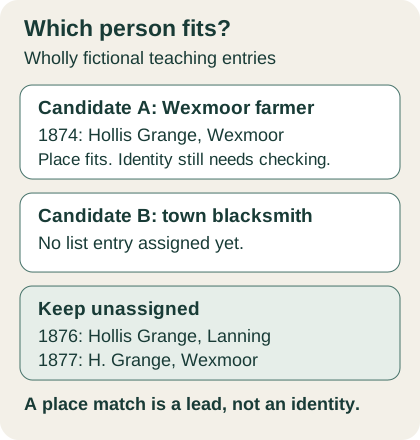
Suppose two men named Hollis Grange appear in the 1870 census of Tarrow County, one a farmer aged 52 in Wexmoor Township, the other a blacksmith aged 29 in the county town. You descend from one of them but are not sure which. Your ancestor's daughter married in 1878, and her marriage record says her father was "of Wexmoor".
In the invented Tarrow County Reporter you find that before each circuit court term the paper printed "Jurors Drawn for the March Term" and similar lists. Browsing the lists from 1872 to 1880, you find:
- In the issue of 21 February 1874, under "Petit Jurors": "Hollis Grange, Wexmoor."
- In the issue of 18 February 1877, under "Grand Jurors": "H. Grange, Wexmoor."
- In the issue of 12 April 1876, election results for Lanning Township: "Constable, Hollis Grange."
Here is what you can record. A Hollis Grange of Wexmoor was drawn as a petit juror for the March 1874 term. An H. Grange of Wexmoor was drawn as a grand juror for the March 1877 term. A Hollis Grange was elected constable in Lanning Township in April 1876.
Here is what remains open. The Wexmoor entries fit the older farmer's census township and the "of Wexmoor" marriage record, so they are worth attaching to him provisionally. The Lanning constable might be the younger man if he had moved there, or a third person. "H. Grange" in 1877 is an initial only. None of these entries gives an age or occupation.
The useful outcome is a sorted set of leads. The Wexmoor jury entries give you dated leads associated with that township; they do not yet establish that the listed people were the farmer or that he attended court. The Lanning constable needs a separate check, such as an 1880 census entry or a deed placing one of the men in Lanning.
What these lists look like
Jury lists were usually printed before a court term, naming the people drawn to serve. A page on the Ontario County NYGenWeb site transcribes jury lists from the Geneva Gazette and Geneva Courier between 1847 and 1851. The headings vary, from "Grand and Petit Jurors" to "Jurors for the Circuit Court", and each names the court and the drawing or session date. Each entry gives a name followed by a town, and most lists separate grand jurors from petit jurors.
A grand jury decided whether there was enough evidence to bring charges. A petit jury, sometimes called a trial jury, heard cases. The distinction matters less for family history than the place attached to each name, but record which list your ancestor was on.
The same pattern continued well into the twentieth century. The Clayton County IAGenWeb site transcribes jury lists printed in the Clayton County Register in Iowa from 1940 to 1949, usually several petit jury lists a year and some grand jury lists, each name followed by a town or rural community.
Election results came in more varied forms. Read the town heading, office and any vote totals together. The Cumberland County Archives description of municipal election returns includes supervisors, constables, school directors and other local offices, and notes that some returns name all candidates and their votes. Use the original returns to check a newspaper's abbreviated result; a candidate's name alone does not mean they won.
What a listed name can and cannot tell you
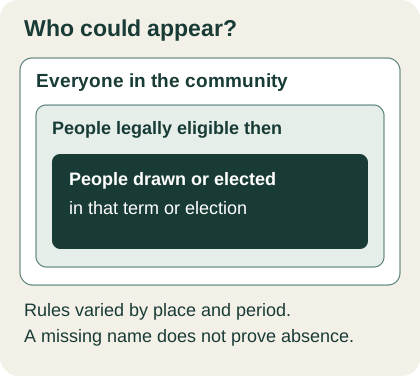
A name on a jury list tells you that officials drew that person from the pool of eligible people for a particular court term, and attached them to a particular town or township. A name in election results may identify an elected officer or a candidate. Read the result and vote columns before describing the person as elected.
Both are good evidence of a connection to a place on a date. Neither proves continuous residence, and neither proves identity on its own if the name is common.
They also carry an implication about status, because only people who met the legal qualifications could serve or hold office. Be careful with this. The Legal Genealogist, in a post on women and juries, quotes the 1880 Supreme Court statement that states could confine jury selection to males, freeholders and citizens, among other limits. The qualifications differed between states and changed over time. Before you write "owned land" or "was a citizen" because someone served on a jury, find out what the law in that place and year actually required.
Who appears, and who does not
Eligibility rules shaped these lists, and they excluded many people. For most of American history, women could not serve on juries. The Legal Genealogist post describes how eligibility expanded at different times in different states. The Equal Justice Initiative, in a sidebar on gender-based jury exclusion, notes that the Supreme Court's 1961 decision in Hoyt v. Florida recorded three states still barring women entirely, and that in 1975 Taylor v. Louisiana held that excluding women violated the requirement for a jury drawn from a fair cross-section of the community.
Other groups were excluded too, by law or in practice, depending on the place and period. So an absence from a jury list tells you very little about a person. A woman, a person excluded by race, a recent immigrant who was not yet a citizen or a man without the required property might have lived in the township for decades without ever appearing.
Election results have a similar bias. Who could vote or hold a particular office depended on local law and the period. Many of the older lists you encounter will name mainly men. These lists are valuable for the people they include, but they are not a census.
Drawn is not the same as served
A jury list records who was drawn or summoned, not who sat. People were excused, failed to appear or were never called because a term had few cases. The Clayton County transcriptions include lists from October and November 1949 printed as notices stating that the jurors would not be summoned until the court ordered it. A name on such a list shows the person was in the jury pool. It does not show they attended court.
If attendance matters, for example because you want to know whether your ancestor was in town on a particular week, look for the paper's report of the court term. A court report may name the jurors empanelled for a case. Our guide to military, legal and migration news explains how to read legal and court items as announcements, which applies here as well. Court minute books may also record who was sworn.
Read the place attached to each name
The town or township after a name is the main reason these lists are useful. It identifies the place officials associated with that person when the list was drawn, usually where they lived. Read the heading or any note to see whether the paper explains it, and copy the place exactly as printed, because township names, post office names and village names can differ.
A jury list attaches a person to a township at the time of drawing. An election result attaches them to the township where the office was held. If the same name appears with two different places, do not assume a move straight away. Check whether the places were neighbouring townships with a shared post office, whether a boundary changed, or whether there were two people.
Our guide to finding an ancestor's address in old newspapers explains how to arrange dated place clues in order without assuming continuous residence between them.
Using lists to separate people with the same name
Civic lists are particularly good at this because each entry pairs a name with a place on a known date. If two people share a name but are independently documented in different townships, a printed township can help distinguish them. It still needs checking against dates and the possibility of another namesake.
Build a small table: date, list type, name as printed, place, and the candidate you think it belongs to. Leave the candidate column blank where the evidence does not decide it. Initials, a missing place or two candidates in the same township should stay unassigned until another record settles them.
Our guide to finding an ancestor with a common name explains how to keep separate working records for namesakes, which suits this kind of list well.
Follow local officeholders into original records
Election to a minor local office can tell you more than a jury list. Offices such as road supervisor, constable, overseer of the poor, school director or justice of the peace were usually held by local residents. Holding one for several years suggests a settled place in the community, and the office may lead to other records.
The Cumberland County Archives in Pennsylvania, for example, describe a series of municipal election returns from 1792 to 1949 that usually name the municipality, the person elected, the office, the term and the date and place of the election or town meeting, with related bonds, oaths and resignations. Original records like these can confirm and add to what a newspaper printed, including results the paper did not receive in time.
A newspaper's election report may abbreviate names and omit offices. If an office matters to your research, look for the original returns or the town or township minutes, which may be held by the township, the county or a state archive.
Check whether repeated surnames describe relatives
Jury lists and officer lists often show the same surname several times in one township. That can point to a family group, but it can also reflect neighbours with a common local surname. A father and son with the same name may both appear, sometimes distinguished as "Sr." and "Jr.", which in older usage could sometimes distinguish an older and a younger man who were not father and son.
Treat shared surnames in a township as a prompt to look for relationships in other records, not as evidence of them. A list that shows Hollis Grange and Thomas Grange both of Wexmoor associates two printed names with that township. It does not say how they were related.
When the list is missing or your ancestor is absent
If you cannot find jury lists, the paper may not have printed them, may have printed them only for some terms, or the issues may be missing online. Browse several issues before each court term to see whether lists appeared at all.
If lists exist and your ancestor is absent, remember the eligibility rules. Many people were never eligible, and among those who were, only a few were drawn in any term. Absence across many terms is weak evidence of anything.
If the issues you need are not online, the free and library access guide linked above explains how to request particular dates on microfilm. The court or county clerk may also hold jury records, and township clerks may hold election records.
Record each entry with its context
For each entry, record the newspaper title, issue date, page and column, the list heading, the court or election, the term or election date, the list type (grand jury, petit jury, office), the name exactly as printed and the place attached to it.
Keep interpretation separate. For example: "Hollis Grange, Wexmoor, petit juror, March 1874 term. Fits the older Hollis (Wexmoor farmer in 1870). Not yet distinguished by age or occupation. Next: 1880 census of Wexmoor and Lanning."
For a copyable research log, start with these fields:
- Newspaper title and publication town:
- Issue date, page and column:
- List heading and type:
- Court term or election date:
- Name exactly as printed:
- Printed town or township:
- Candidate identity and supporting record:
- Unresolved questions and next record:
Our guide to verifying and preserving newspaper evidence explains how to keep the full page, citation and your interpretation together.
When you count appearances, count lists, not printings. If the paper printed a jury list twice, it is one drawing.
Try a civic list search this week
Choose one ancestor, usually a man before the mid-twentieth century, whom you want to place in a township during a period without other records.
On Chronicling America, limited to the county paper and a span of ten years, search petit jurors and grand jurors as exact phrases. Note when lists appeared relative to court terms, then browse each list for your surname.
Next, search town officers or township officers as exact phrases, and your township name with elected within 10 words. Browse the spring and autumn issues where election results appear.
Record every entry for the surname, with its date and place, in a simple table. Mark which entries you can attach to your ancestor and which remain open.
If you find nothing, check whether the paper printed these lists at all in your period, and whether your ancestor would have been eligible under the rules of the time. Then note the county or township office that might hold original jury or election records for the next step.
Sources
- Ontario County NYGenWeb: Jury lists from the Geneva Gazette and Geneva Courier, 1847 to 1851 (transcriptions)
- Clayton County IAGenWeb: Jury lists, Clayton County Register, 1940 to 1949 (transcriptions)
- The Legal Genealogist: No girls allowed
- Equal Justice Initiative: Gender-based jury exclusion
- Cumberland County Archives (Pennsylvania): Municipal election returns, 1792 to 1949
- Library of Congress: Tips for searching in Chronicling America