
Brothers and sisters
How to find an ancestor's siblings in old newspapers
A visiting sister or a brother named in a funeral report can widen your family history. Follow the printed relationship, identify the person behind the name and keep unanswered questions visible.

On this page
- Start with one ancestor and a sibling question
- A fictional visit notice identifies a sister and leaves a brother unresolved
- Search a free collection with the right settings
- Search relatives and relationship words separately
- Look for family visits as well as death notices
- Follow a married name back to an identified person
- Read the full item before interpreting sister or brother
- Check parentage without treating a household as proof
- Keep the search open for siblings who are missing
- When a search is empty, check the issue coverage
- Save each candidate with a conclusion you can revisit
- Try one sibling search this week
- Sources
To find an ancestor's siblings in old newspapers, begin with a record you already have. Write down the ancestor's name, a dated residence and any known parents. Search the name alongside words such as sister, brother and visiting, then investigate the relatives you find in their own right. Open the newspaper page before deciding what the relationship means.
For US research, a free first stop is Chronicling America. Open the Library of Congress newspaper guide and follow its Chronicling America link under Digital Collections. Check your real place, newspaper title and available issues first; the search settings and copy-ready examples are below.
A notice may name a sibling absent from the records you have checked, describe someone by a married name or leave the relationship ambiguous. Identify the person and compare other records before adding a brother or sister to your family tree.
Start with one ancestor and a sibling question
Choose a question you can test: "Who was the sister who visited my ancestor?" or "Which brothers and sisters can I identify from this family's newspaper mentions?" Work on historical, deceased people only.
Keep a small family note beside the search box. Include the ancestor's known name forms, places with dates and the source of any parent names. List possible siblings separately from established relatives. An unsourced name in a family tree belongs in the possible list until you can inspect its evidence.
If you do not know the parents, start with a reported sibling relationship. You can investigate who the newspaper meant without first reconstructing the whole family. Record the missing parentage as a question rather than filling it from a nearby household.
A fictional visit notice identifies a sister and leaves a brother unresolved
Everything in this example is invented: every person, place, address, newspaper, date, quotation and record. The example has no real jurisdiction. Its registrations contain details chosen to teach the method, not fields or records you can expect for every actual place and year.
Your starting records identify Harriet Fenwick, an unmarried schoolteacher living at 24 Orchard Lane in Alderbrook. Her fictional birth registration records her birth on April 12, 1870, naming father Martin Fenwick and mother Agnes Fenwick, formerly Cole. A fictional 1911 school employment ledger gives Harriet's same birth date and Orchard Lane address, connecting the birth record to the adult you are researching.
The fictional Alderbrook Weekly of July 18, 1912, prints:
"Miss Harriet Fenwick, of 24 Orchard Lane, received a visit from her sister, Mrs. Owen Bell of Reedhaven."
The address identifies the host as your Harriet within the teaching case. The visitor is a candidate named only as Mrs. Owen Bell, with Reedhaven as her reported home. The notice explicitly calls her Harriet's sister, but gives neither her own first name nor her birth surname.
An invented 1912 Reedhaven directory names Ada Bell as the wife of Owen Bell, a printer. A fictional marriage registration dated May 14, 1896, names Owen Bell, a Reedhaven printer, and Ada Fenwick, age 23. It records Ada's parents as Martin Fenwick and Agnes Fenwick, formerly Cole, and her premarital address as 24 Orchard Lane.
Ada's separate fictional birth registration records her birth on March 9, 1873, with those same parent names. Her age at marriage agrees with that birth date. The spouse's name, occupation and town connect the marriage entry with the directory; Ada's age, parents and premarital address connect her earlier identity with Harriet's family. No rival couple or conflicting detail appears in the teaching materials.
To check the parents' identities, compare more than their names. Both sisters' invented birth entries give the parents' residence as 6 Mill Court, Alderbrook, and Martin's occupation as a bookseller. The parents' own fictional marriage registration identifies Martin Fenwick, bookseller, and Agnes Cole as the couple living at that address. Those details connect each birth entry to the same father and mother in this case.
The evidence supports identifying Ada as the visitor and as Harriet's full sister on the recorded parentage. The two birth entries identify the children individually; the other records connect their adult names and the parent couple. This is a supported conclusion within the fictional evidence, not biological certainty established by a newspaper or certificates.
A different fictional notice, dated August 8, 1912, says:
"George Fenwick is visiting his sister, Miss H. Fenwick, in Alderbrook."
The visitor is George Fenwick; the host is an incompletely named Miss H. Fenwick. Neither has an address or parents in this notice. A fictional census entry for a George Fenwick of a suitable age is worth investigating, but does not identify this visitor or establish shared parents. Keep the notice as an unresolved possible brother lead until you can identify both people.
Search a free collection with the right settings
Follow the Library of Congress instructions for searching Chronicling America: open Collection Items, expand Advanced Search and select Pages (Full Text). Choose a location and date range supported by your own records, then select a keyword mode.
These copy-ready examples use the fictional family to show how queries are constructed. Copy only the words after the colon into the keyword field:
- This exact phrase:
Harriet Fenwick - These words within 5 words of each other:
Harriet Fenwick - All of these words:
Fenwick sister
The invented towns and notices are not archive targets. For your research, replace the names and use a date window around a documented event or residence. If a narrow window yields nothing, widen it while keeping track of the dates already searched.
The selected mode controls the search. Exact phrase requires adjacent words; proximity allows intervening words, including an initial. All of these words requires the terms on the same page, so Fenwick and sister could belong to unrelated notices. These distinctions come from the Library's search instructions. Do not assume quotation marks override the form's mode, or that another archive works identically.
Search relatives and relationship words separately
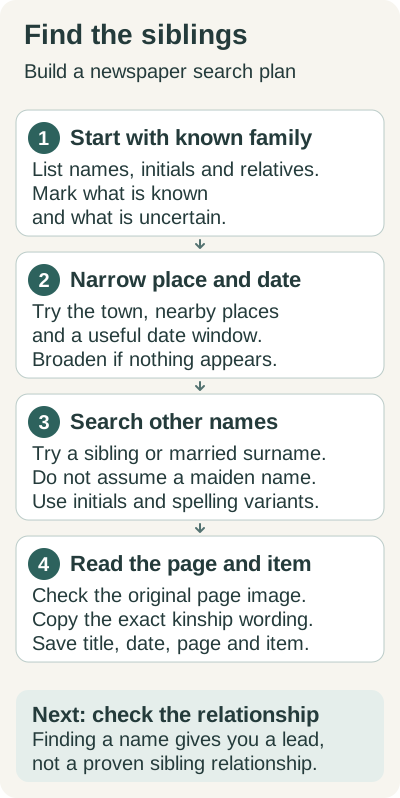
Start with the ancestor's name alone so you can see how the paper prints it. Then try the surname with brother or sister. Search each relationship word separately before combining a long list that could exclude notices with different wording.
Other useful experiments include a surname with visiting, funeral or reunion. Read a sample issue to see the paper's own vocabulary. Record a successful phrase so you can reuse it for the same title.
Search a known parent's name too. An item about a parent may name adult children under several surnames. Once a notice gives you a possible sibling's name, search that person alone, including the town they reportedly came from. Their own life events may identify your ancestor more clearly than another search for the ancestor does.
Keep observed spellings separate from speculative search variants. The National Archives' census research advice recommends investigating siblings and other relatives, allowing for initials and name variations, and distinguishing namesakes through other details. Apply that family-group approach when choosing newspaper queries.
If a common name produces several plausible people, our guide to separating common-name newspaper candidates helps you keep their records apart while you investigate.
Look for family visits as well as death notices
Local news can supply a relationship in an ordinary sentence about a visit. The Library of Congress guide to women in newspapers points to personal mentions, rural correspondents, social calls and travel, alongside obituaries and marriage announcements. It also recommends following affiliations and checking discoveries against other records.
Browse columns under town names or headings such as Local and Personal. A visitor's home town may lead you to another newspaper. A report about a gathering might name several relatives, though a guest list alone does not tell you how they were related. Our social-column research guide explains how to locate and use these everyday mentions.
Death coverage remains useful. Read a parent's notice and the notices of already identified siblings, as well as your ancestor's. Our guide to finding obituaries and death notices helps when you need a publication window or different notice types.
A survivor list tells you whom that item names at that time. It is not a complete list of everyone born into the family. A sibling could have died earlier or simply been omitted. Keep the exact wording, including any distinction between surviving relatives and those who predeceased the person.
Follow a married name back to an identified person
When a notice uses a spouse-based courtesy name, seek a record that connects it with the woman's own name. Then establish any earlier surname from evidence that makes the change explicit. A marriage entry may help, depending on what that jurisdiction recorded and what you can access.
Read the original entry when available; an index may omit identifying details. Compare the named spouse and dated residence with the newspaper candidate. Check which place an entry describes: a birthplace, marriage location and later home need not be the same. Locate the record in the jurisdiction of the event, and investigate conflicting information before merging identities.
Build searches from documented names and leave speculative ones marked as queries. Try her own name, a known earlier surname, initials and a spouse-based courtesy form where appropriate. Our guide to finding women in old newspapers covers those naming patterns without assuming every woman married or changed her surname.
For more than one marriage, keep a dated name history. A notice may continue using an earlier form. Do not assign a new surname to a candidate simply because someone of a suitable age married locally.
Read the full item before interpreting sister or brother
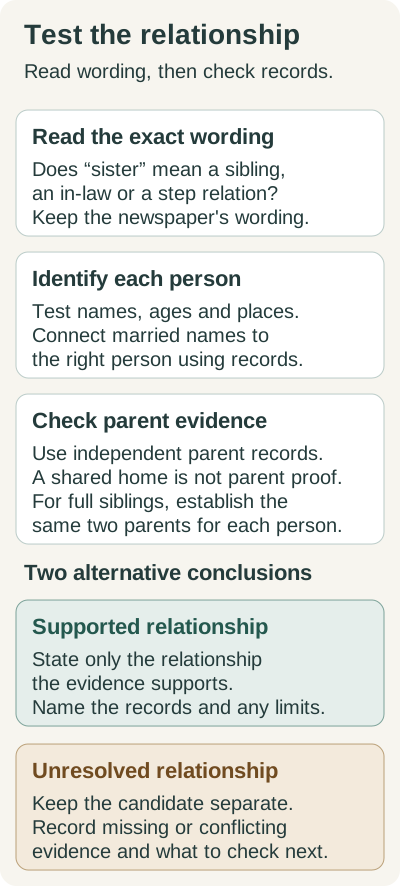
Locate the words on the page image. Read the complete sentence and any continuation, checking whose sister or brother the writer means. A snippet can lose the possessive word or join text from separate columns.
Preserve distinctions such as sister-in-law, half brother and stepsister. If the paper prints one of those relationships, record it as written. Calling everyone a sibling in your notes can erase the information you need to understand the family.
Where the wording says only sister, report that first. Consider whether an in-law, step relationship or another usage could fit the people and context. You do not have to propose every conceivable interpretation; investigate alternatives raised by actual evidence. An unclear word in the scan belongs in your uncertainty note until you can read it.
A later correction may change a name or relationship. Another title may carry the same wording as a reprint. Keep both copies if useful, but do not count the repeated statement as independent confirmation. Compare the reports' wording and any attribution before deciding what the second item adds.
Check parentage without treating a household as proof
Once you have identified the newspaper candidate, ask what evidence connects that person to the ancestor. For a full-sibling conclusion, investigate both parents of each person. Records naming a shared father alone leave the mothers unresolved; they do not distinguish full siblings from paternal half siblings. Likewise, a shared mother leaves the fathers to be investigated.
Seek records that could answer the missing question, such as birth registrations, baptismal entries or other records explicitly identifying parents. Their content and availability vary. Compare details that distinguish the parents from namesakes, as well as the children's identities. Note who supplied the information, how close the record was to the event and whether it agrees with the rest of the evidence. Several records repeating one account may not be independent.
A census household helps locate people, but read each relationship in its proper frame. The National Archives' description of the 1900 census and its index explains that relationships are recorded to the household head. An index card can lead you to the original schedule.
Two people recorded as the head's children are not thereby shown to share the same mother. Nor does a shared home establish biological parentage. Compare the schedule with records about each individual and retain conflicting surnames or parent details. The National Archives also cautions that census accuracy depends on the informant's knowledge.
Keep the search open for siblings who are missing
A family group can look complete because you have found everyone in one household. Before closing the question, consider who might have left home earlier, died young or appeared under another name. Search the parents' notices and newspaper mentions from earlier periods if those questions fit the evidence.
The National Archives' census-clue guide explains that the 1900 and 1910 censuses record how many children a woman had borne and how many were living. A difference between that reported count and the children you have identified can prompt further research.
Those counts do not supply the missing children's names. They also do not assign all her children to the marriage current at the census date. Treat an unexpected count as a question to investigate, allowing for informant error or an unclear entry.
You may identify the particular sister in a visit notice while still lacking a complete sibling list. Record those as separate outcomes so a solved identity does not silently become a claim about the whole family.
When a search is empty, check the issue coverage
Before widening the name search, check whether the needed issues are available. A title record can describe a newspaper's run without establishing that every issue is digitised, searchable or held by the repository you are using.
The Library of Congress newspaper guide points researchers to the Directory of U.S. Newspapers for holdings and to physical or microfilm collections when digital material is missing. Our free and library newspaper access guide helps turn a title and date gap into a specific library request.
If the issue is available, browse the relevant local column. The Library's Chronicling America search guidance explains how OCR errors can affect keyword results and why proximity searches can help. A blank exact-name result is not evidence that no sibling existed.
Record whether you searched available pages without a match, could not read the critical wording, or could not obtain the issue. Each problem calls for a different next action.
Save each candidate with a conclusion you can revisit
Give every possible sibling a separate note. Include the name as printed, the newspaper title, publication place, issue date, page or scan location, and an exact short quotation. Add the repository, page link and date you inspected it. Our guide to verifying and preserving newspaper evidence explains how to keep the source and your interpretation distinct.
Below that citation, record the identity and parent records you compared, any disagreement and your current conclusion. Use ordinary descriptions such as identified sister on recorded parentage, reported sibling with parentage unresolved, or unassigned namesake. Explain why the label fits and which question remains open.
Keep a conclusion's scope visible when transferring it to a tree or sharing it. A supported relationship for one person does not resolve another candidate or complete the family. Save the evidence behind the conclusion so you can revise it if a new record changes the picture.
Try one sibling search this week
Choose one deceased ancestor and a dated place from a record you can reopen. Write one sibling question and check a relevant newspaper's issue coverage through Chronicling America or a library route.
Search the ancestor's first name and surname using a proximity mode if available. Then try the surname with sister or brother, one word at a time, or search a known relative's name. Keep the query mode and filters in your notes. Open any promising page and copy the exact relationship wording.
Choose one candidate to investigate outside the newspaper. Write down what would identify the person and what would establish the relationship. Finish your note with the newspaper citation, the records compared, your current conclusion and one specific next record to seek. If nothing useful appears, record the title, issues, queries and access gap instead. Either outcome gives you a search you can resume without treating missing evidence as a family fact.