
UK newspapers
How to find a British ancestor in historical UK newspapers
Find an ancestor in British newspapers. Start with free routes in Wales, Scotland and England, then test an overseas departure clue against American records.

On this page
- The main collections and how they relate
- Free and low-cost ways to read the pages
- A fictional departure notice, tested against other records
- Choose the British place from American evidence first
- Search with British place names and conventions
- Look beyond the county
- Titles change, merge and survive unevenly
- Identity checks across the Atlantic
- What British papers can add to an American tree
- Recording British newspaper finds
- Try a British newspaper search this week
- Sources
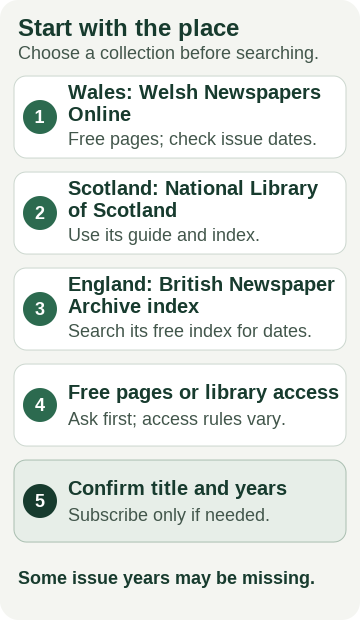
For England, Scotland and Wales, start with the family's home country, not Irish newspaper collections. Search Welsh Newspapers Online for Wales, use the National Library of Scotland's newspaper guide for Scotland, or search the British Newspaper Archive's free index for an English town and year.
The main collections and how they relate
For families who later lived in North America, a local paper from the family's home town may report marriages, deaths, court appearances, sales or an overseas departure.
The British Library's research guide to the British Newspaper Archive, updated on 14 October 2026, describes the archive as the main resource for digitised UK local and regional newspapers. It reports over 100 million pages from more than 2,000 titles, covering every UK region and including Irish and some Commonwealth titles. Home reading is by subscription, but the guide says you do not need to sign up just to search. This article focuses on Great Britain, not Irish newspaper research.
For Scotland, the National Library of Scotland says it collects a copy of every newspaper published there and provides a newspaper guide for family history, including a route to its Guide to Scottish Newspaper Indexes. It also describes different access conditions for its newspaper databases: some are available remotely to members with a Scottish address, while others require on-site access. Check the current terms and holdings for the title you need.
Welsh Newspapers Online is separate. The National Library of Wales describes it as a free resource with more than 1.1 million pages from nearly 120 publications. Coverage is generally up to 1910, with additional material for some titles from the First World War period. The Library notes that the collection reflects its physical holdings, so not every issue is present.
No collection includes every paper or every issue. Treat a title list as a starting point, then check the year and issue you need before concluding that a paper is unavailable.
Free and low-cost ways to read the pages
Searching the British Newspaper Archive's index costs nothing, but reading full pages usually needs access. Several routes cost nothing or very little.
Free-to-view pages: search the British Newspaper Archive's current site and choose its Free To View access filter to check titles and dates. The British Library's 2021 announcement describes the initial release, not today's full selection. The 2021 announcement says a free account was needed for that initial selection. Current access terms may differ, so check them before relying on this route.
Public libraries: the British Library reports that the British Newspaper Archive is available at many public libraries for free. Ask your local library whether it offers access, whether use is limited to the branch and whether you need your own account. Arrangements vary, so confirm before travelling. The British Library's current overview of the archive describes this route.
British Library reading rooms: the British Library guide says the archive can be used free on reading-room computers or on your own device connected to its reading-room Wi-Fi. Check the current Reader Pass and opening requirements before travelling. You can also ask local family-history societies whether they offer newspaper access.
If none of these is practical from North America, a short subscription after you have confirmed coverage through free searching is a more efficient use of money than subscribing first.
A fictional departure notice, tested against other records
Everything in this example is invented: the people, the market town of Kirkbrough, the county, the newspaper, the notices and the dates. Kirkbrough is not a real place and no real jurisdiction is implied. None of these items exists in any archive.
Suppose an American census entry shows Thomas Ellery, born in England around 1846, arriving in 1871 and working as a saddler. His naturalization papers (also invented) give his birthplace as "Kirkbrough, England". You want his family in England.
You search the British Newspaper Archive's free index for Ellery with the place filter set to Kirkbrough's county and a date range of 1840 to 1880. The results show an invented weekly, the Kirkbrough Mercury, with several hits for Ellery, including:
- A family notice in 1845: "MARRIAGES. At the parish church, William Ellery, saddler, to Sarah Pell, both of this town."
- A news item in 1871: "Mr. Thomas Ellery, son of Mr. W. Ellery, saddler, of Market Street, left on Monday for Liverpool, intending to sail for New York."
Before paying to read anything, you note that the 1871 snippet fits your Thomas: the same surname and trade in the family, an 1871 departure and New York as a destination. You then read the full pages through a free route or a short subscription.
Here is what the 1871 item supports: a Thomas Ellery, described as the son of W. Ellery, saddler of Market Street, Kirkbrough, was reported to have left for Liverpool intending to sail to New York.
Here is what it does not support: that he sailed, that he arrived when your census says, or that he is your saddler. The 1845 marriage of a William Ellery, saddler, makes a plausible father, but the newspaper does not tie that William to the W. Ellery of 1871. Use the passenger lists for 1871, the English census of 1861 and the parish baptism register to test each link.
Choose the British place from American evidence first
A British newspaper search works best when you know which town to search. Many American records give only "England" or "Scotland", which is far too broad for a county paper. Before searching across the Atlantic, collect every birthplace or origin statement you have from records created in America, and note who supplied each one.
Look in the places where a specific town tends to appear: naturalization papers, church records, obituaries and local items in the American paper, letters, and the records of a fraternal society. An American obituary may say "born in Kirkbrough, England" even when every census says only "England". If the family read a community-language paper after settling, it may have printed home-town news or an origin; our guide to immigrant-language newspapers explains how to search one.
Rank the places by how close the source was to the person. A place given by the emigrant on their own naturalization papers usually carries more weight than one given by a grandchild for a death certificate decades later. Where sources disagree, search each candidate place in turn rather than choosing one.
Then check the British collection's title list for each candidate place. A town with a digitised local paper for the right decades is a better first search than a larger place with no coverage. If you find a street, farm or parish in a British notice, treat it the way you would an American address: as a dated place clue, not proof of continuous residence. Our guide to finding an ancestor's address in old newspapers explains that approach.
Search with British place names and conventions
Start broad and narrow. Search the surname alone with your county and a date range, then add the town. British local papers were often named after towns or counties, and a county weekly might carry news from many villages. A family in a village may appear in the nearest market town's paper or the county paper.
Use the archive's article types where offered. The British Library guide mentions family notices, obituaries, news articles, adverts and letters among the types to focus on, and filters for date, location and publication type in Advanced Search.
The British Library guide groups births, marriages, deaths, weddings and funerals together as family notices, which is a useful article type to filter on. In the notices themselves, an address may be a street in a town, a farm name or a parish, and an occupation may be printed with the name. Copy both exactly, because they are often what separates one family from another.
Search the place as well as the person. A notice may refer to "Mr. W. Ellery" or "the late Mrs. Ellery", and OCR may misread the surname. Searching the street or farm name with a date range can find items the surname search missed. Our guide to searching when OCR gets names wrong explains this approach, which works the same way in British collections.
Each archive handles quotation marks and search operators in its own way. Check the help pages for whichever collection you use rather than assuming it works like Chronicling America.
Look beyond the county
The home-town paper is not the only title worth checking. A nearby port or regional paper may carry a departure notice, and a later event in America may be reprinted or mentioned in news from home. Treat each as a lead and read the page before adding it to the family narrative.
For an emigrant, try searching the home town paper for the surname with words such as "America", "New York", "Canada" or the name of the state or city where the family settled. Our guide to military, legal and migration news explains how departure and arrival reports can be linked across places.
Titles change, merge and survive unevenly
The title in a family story may not match the name used in the year you need. Check catalogue and collection title lists for predecessor titles, successor titles and related editions. Record the title and years you actually searched; a broad date range does not prove every issue survives.
If the year is not digitised, check library catalogues for a print or microfilm copy and confirm the exact issue and current reading-room access rules before travelling.

Identity checks across the Atlantic
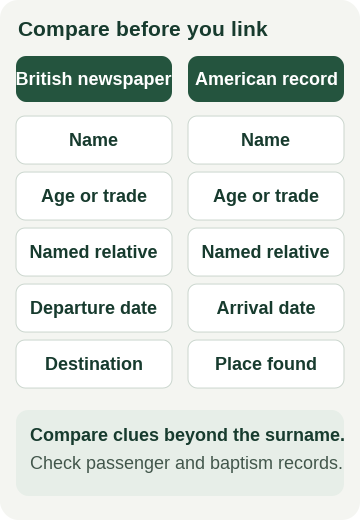
Linking a British notice with an American ancestor is where errors creep in. A surname may be common in a county, and the same given names recur in families. Look for details that tie the people together: an occupation, a street or farm, a named parent or spouse, an age, and dates that fit both sides.
A departure notice is a strong lead when it gives a destination and a date close to an arrival record. It still needs a passenger list or other record to confirm the crossing, and a birth or baptism record to confirm parentage. A newspaper describing someone as "son of" a named man is reporting what was known locally, which is valuable, but it is not a birth record.
If the surname is common, keep separate working records for each candidate family. Our guide to finding an ancestor with a common name shows how.
What British papers can add to an American tree
British local papers may give you the parish or street a family came from, the names of parents and siblings, the family trade, and local events involving the family that left little trace elsewhere. They may also record the family left behind: a parent's death notice that mentions "a son in America", or a sibling's marriage.
Those later items are useful even when they do not mention your emigrant, because they help you build the family group in the home town. Then compare that group with the American records, looking for the same names among witnesses, godparents, business partners or neighbours.
Recording British newspaper finds
Record the newspaper title as printed, the place of publication, issue date, page and column, and the collection you used, with its URL and your access date. In the British Newspaper Archive, note whether you read the page through a free-to-view title, a library or reading room, or a subscription, since that affects whether you can revisit it.
The British Library's 2021 post explains that its free-to-view titles were chosen because they were out of copyright under a "safe date" of 140 years after publication. Rights for later pages differ, so check the terms before reproducing an image.
Keep your interpretation separate from the transcription, especially for transatlantic links: "Item reports a Thomas Ellery, son of W. Ellery, saddler, leaving for New York in 1871. Fits my Thomas by trade, date and destination. Next: 1871 passenger arrivals and the 1861 English census."
Try a British newspaper search this week
Choose one ancestor born in England, Scotland or Wales, and write down the most specific birthplace you have from American records, with the source.
If the place is in Wales, search Welsh Newspapers Online for the surname and town. If it is in Scotland, use the National Library of Scotland's newspaper guide to identify indexes and likely holdings, then check which database or archive provides access. If it is in England, search the British Newspaper Archive's free index for the surname with the county filter and a twenty-year span ending with the year of emigration.
From the results, list the titles that served the place, the years with hits, and the snippet text for any hit that mentions the right occupation, street or destination. Do not pay to view anything yet.
Then check current free-to-view titles, your local library's family-history resources and any county family-history society to see which route can show you the full pages. Read the strongest two or three items in full and record them.
If you find nothing, search the place name with words like "America" or "emigrated" across the same span, and check the archive's title list to see whether your town's paper is digitised for the years you need. Record which titles and years you have covered.
Sources
- British Library: British Newspaper Archive research guide
- National Library of Scotland: Newspapers for family history
- British Newspaper Archive: search and current Free To View access
- British Library: Free to view online newspapers (2021)
- British Library: The British Newspaper Archive reaches 100 million pages
- British Library: Reader Pass
- National Library of Wales: Welsh Newspapers Online