
Land claims
How to find your ancestor's homestead final proof notice in old newspapers
Find old newspaper homestead final-proof notices, read the claimant and land description, and use the notice to locate a land-entry case file.

On this page
- Search for the notice wording, not the name
- Why the newspaper carried a final-proof notice
- What the notice usually tells you
- A fictional notice: what the clues establish
- Read the land description
- Witness names are leads, not relationships
- Dates in the notice and what they mean
- Check the patent index by name and land description
- Requesting the land entry case file
- When the claim was never completed
- When you cannot find a notice
- Record the notice and the trail it opens
- Start with a county and ten-year window
- Sources
Start with a free newspaper collection for the county where your ancestor farmed. Search for "final proof" or "notice for publication" within a ten-year window when the claim may have been completed.
"Public-land states" are the 30 states where federal public-domain land claims were available. The National Archives' land-records guide lists them and advises researchers in the other 20 states to start with state archives or a historical society. If your ancestor claimed federal land in one of these states, a nearby newspaper may carry a final-proof notice. It announced the claimant's intention to complete the claim and may identify the claimant and land, give the planned proof date and place, and name intended witnesses.
Search for the notice wording, not the name
Land office notices were set in small type, often several to a column, and the claimant's name might be printed in capitals or with an unfamiliar spelling. OCR, the software that turns page images into searchable text, often struggles with them. Find the notices first, then read them.
If the county's papers are available in Chronicling America, open Collection Items, expand Advanced Search and choose Pages (Full Text). Several states also have their own free digitised newspaper sites. The Library of Congress describes the Chronicling America options in its tips for searching Chronicling America. Limit by state, choose the county's newspaper titles, and set your ten-year window. Then try:
final proofwith This exact phrase selected.notice for publicationwith This exact phrase selected.intention to make final proofwith These words within 10 words of each other selected, which allows for small differences in wording.- Your surname with
proofusing These words within 10 words of each other. - If you already know the land description, the section, township and range numbers alongside
proof, using These words within 10 words of each other. Numbers can sometimes be read correctly when a name is not, though number searches also bring back unrelated notices.
The Library recommends the proximity options over exact phrases for names, partly because OCR errors and inserted initials can break an exact match. Our guide to searching when OCR gets names wrong explains how to work from page images when the search fails.
Once you find one notice, note the page where the paper printed land office notices and how often. Then browse that page in every issue across your window. Before deciding which papers to search, it helps to list every title that served the county and which of their issues survive, as our guide to building a newspaper coverage map explains.
Why the newspaper carried a final-proof notice
A homestead or similar claim did not become private property the moment a settler moved onto it. The claimant had to show the land office that they had met the law's conditions, which included living on the land and improving it. History Nebraska's summary of U.S. government land laws in Nebraska from 1854 to 1904 explains that a homesteader filed a notice of intention to make final proof, which was published once a week for thirty days in a legal newspaper nearest the land, and that two witnesses completed similar forms testifying to the facts of the claim. It describes the same kind of published notice for preemption claims.
For a family historian, that public step left a dated, printed record naming the claimant, the land and the intended witnesses.
Rules changed over time and differed between kinds of entry, so treat the thirty-day pattern as typical rather than universal. A transcription on the Becker County, Minnesota, RootsWeb site of a final proof notice from the Detroit Record in 1879 shows a notice that ran once a week for five consecutive weeks, followed by the publisher's sworn statement that it had been printed.
What the notice usually tells you
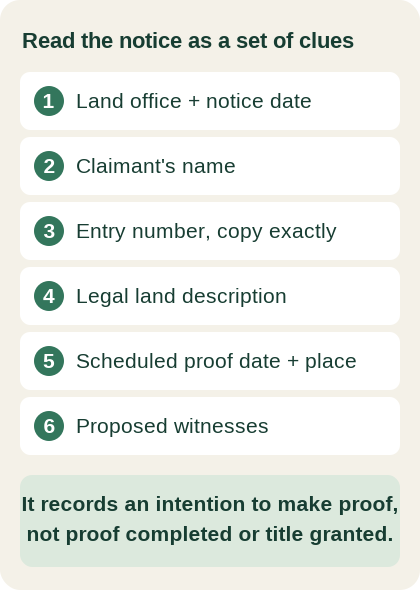
The 1879 Minnesota example contains most of the details you are likely to meet. It is issued from the land office at Crookston and dated 7 October 1879. It says that a named settler has filed notice of intention to make final proof on his claim, identifies the claim by an entry number, gives the land as parts of a section in a numbered township and range, and names two witnesses, both described as of Becker County. It is signed by a land office official.
From a notice like this you can usually record:
- The claimant's name as the land office wrote it.
- The land office handling the claim.
- An entry or filing number, often abbreviated.
- A legal description of the land by section, township and range.
- The date and place where proof would be made, or how long after the notice.
- The names, and sometimes the residences, of the witnesses.
- The name of the land office official who issued the notice.
That is a remarkable amount for a short item. It is also limited. The notice announces that the claimant intended to make final proof. It does not show that the claimant appeared, that the proof was accepted, or that a patent, the government's grant of title, was ever issued. It is not by itself proof that the claimant lived on the described land.
A fictional notice: what the clues establish
Everything in this example is invented: the people, Sable County, the Redwater land office, the newspaper, the land description and all dates. No real jurisdiction is implied, and none of these items exists in any archive.
Suppose a family story says Peder Halvorsen "took up a homestead" in Sable County in the 1880s. You have him in a census entry in the county with his wife Ingrid and three children, but no land record.
You search the invented “Sable County Pioneer” for final proof with the date range 1884 to 1892, and find that the paper printed a block of land office notices on page 4 almost every week. Browsing that page, you find this in the issue of 12 May 1888:
"NOTICE FOR PUBLICATION. Land Office at Redwater, May 3, 1888. Notice is hereby given that the following-named settler has filed notice of his intention to make final proof in support of his claim, and that said proof will be made before the clerk of the district court at Sable Centre on June 16, 1888, viz: Peder Halvorsen, for the NE 1/4 of Sec. 22, Tp. 14 N., R. 9 W. He names the following witnesses to prove his continuous residence upon and cultivation of said land: Ole Brekke, Nils Tande, Johan Sletten and Anders Brekke, all of Sable Centre."
Here is what you can safely record. A notice dated 3 May 1888 at the Redwater land office, printed in the Pioneer issue of 12 May 1888, said that a Peder Halvorsen intended to make final proof on a described quarter section before the district court clerk at Sable Centre on 16 June 1888, and named four witnesses.
Here is what you cannot yet record. You do not know that the proof was made on that date, that it was accepted, or that a patent was issued. You do not know when Peder first entered the land, although the claim must have begun some time earlier. And the four witnesses are not shown to be relatives. Two share the surname Brekke, which may suggest a family, but the notice says only that they lived at Sable Centre.
The useful outcome is that you now have a land office, a legal description and a date window. Those details are exactly what you need to find a patent record and request the case file.
Read the land description
The legal description is the most useful line in the notice because it connects the notice to a specific tract and lets you search the land records. In the public land states, land was surveyed into townships, ranges and sections. A notice such as "NE 1/4 of Sec. 22, Tp. 14 N., R. 9 W." means the north-east quarter of section 22, in the township numbered 14 north and the range numbered 9 west of a principal meridian. Abbreviations vary, as the 1879 example's "n hf se qr" shows, so copy the description exactly as printed.
Do not turn the description into a modern address or assume it matches a farm name your family used later. The description is what land offices, the Bureau of Land Management's GLO Records and the National Archives use.
Newspaper notices about delinquent taxes concern a different process. See our guide to tax lists and sheriff's sale notices for that separate research question.
If the same claimant appears in more than one notice, compare the descriptions. Two notices for different land may reflect two kinds of claim, a second claim after the first, or two different people with the same name.
Witness names are leads, not relationships
The witnesses named in a final proof notice were people the claimant intended to call to support the claim. History Nebraska's summary says witnesses testified to the facts offered in the claim. Treat each name as a research lead, not proof of a family or neighbour relationship. If the notice gives a residence, record it exactly and compare it with independent records.
Use them carefully. A witness who shares your ancestor's surname may be a relative, but the notice does not say so. A witness from a distant town may have been a business contact. Search each witness's name in the same paper. You may find their own final proof notice, with your ancestor as a proposed witness, which adds another possible local connection to investigate. Our guide to finding an ancestor with a common name explains how to keep similar names apart while you do this.
The notice names the witnesses the claimant intended to call. Check the case file to see whose testimony was actually filed.
Dates in the notice and what they mean
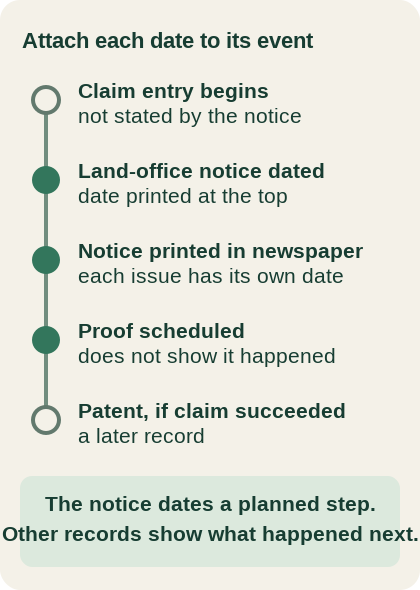
A final proof notice can carry several dates. The date at the head of the notice is when the land office issued it. The newspaper's issue date is when you found it printed, and the same notice may run for several weeks. The proof date is when the claimant was to appear. If the proof was postponed, a new notice might follow.
None of these is the date the claim began, and none is the date of the patent. Record each date with its meaning. A good timeline line would read: "Notice of intention dated 3 May 1888; printed 12 May 1888 onwards; proof set for 16 June 1888." That leaves room for the entry date and patent date, which come from other records.
Our guide to finding an ancestor's address in old newspapers explains why a dated place in a newspaper should not be read as continuous residence. The same applies here. The notice states that the claimant intended to prove residence on the described land; it does not show where they lived before or after, or that the testimony was given.
Check the patent index by name and land description
The Bureau of Land Management's General Land Office (GLO) Records provides online access to federal land-conveyance records for the public land states. BLM says the collection is extensive but does not contain every federal title record. The National Archives' land-records guide directs researchers to GLO for patents and explains that the search contains only patented land files. Cancelled or relinquished case files will not appear in a patent search.
Search GLO using the name and state when you have them, then compare any result's legal land description with the notice. BLM says township and range can be entered through Map Find Address by choosing Legal Land Description. The map search does not currently work for Ohio records, so BLM directs Ohio researchers to Advanced Search. After choosing a state, click Update; click Update again after choosing a county. BLM says an account is not needed for general searching; Login.gov is needed only to save searches. A missing result is not proof that no claim existed: it may have been cancelled or relinquished, omitted from this extensive collection, or indexed under a name or description you did not try. The case file, not the notice, can show what happened after the planned proof date.
Requesting the land entry case file
The case file is where the fuller story is. The National Archives' land-records guide says files may document a person's age, place of birth, citizenship, military service, literacy and economic status, and may include information about family members. The National Park Service's page on homestead records, from Homestead National Historical Park, adds that files describe improvements such as houses built, wells dug and crops planted, and may include naturalization details or a date of death.
To request a file, follow the National Archives' access guide. It separates military bounty land warrants, pre-1908 general land entry files and post-1908 land entry files, and the information needed to identify a record differs by category. Your notice may supply the claimant's name, land office, entry type or land description. Check the instructions for the right category before placing an order; do not assume every file uses the same certificate number.
The National Archives notes that selected homestead records have been digitised through Ancestry, Fold3 and FamilySearch. Check each collection's scope and current availability; a matching certificate does not necessarily include the full case file. If you do not find your ancestor online, check the Archives' instructions for the relevant state and record category before ordering copies.
When the claim was never completed
Not every final proof notice ended in a patent. A proof could be contested, rejected or abandoned. If you find a notice but no patent, keep both facts. The notice shows that a claimant had announced an intention to make final proof on the described claim. It does not establish that your ancestor was living there, appeared for proof, met the requirements or received title. Use the case file and other records to find out what happened next.
The National Archives' land-records guide says cancelled or relinquished case files are not in the patent index and directs researchers to the National Archives facility that holds the state's records. It lists name indexes for cancelled, rejected and relinquished files from certain land offices. A newspaper may also report a contest, so search the claimant's name with words such as contest or contestant in the months after the proof date.
When you cannot find a notice
There are several possible reasons. The paper that carried land office notices may not be digitised for your years. Notices were placed in a paper near the land, which might be in a neighbouring county or town. Your ancestor's claim may have been of a kind that did not require this notice, or may have been bought outright. Or OCR may have failed.
Try the township and range numbers instead of the name, and browse the land office notices page directly. Search the names of known neighbours, who may have named your ancestor as their witness. If the issues are missing online, our guide to free and library newspaper access explains how to ask a library for specific dates on microfilm.
You can also work from a patent record back to the newspaper, but do not use a fixed two-month window before the patent date. The scheduled proof date and newspaper notice belong to an earlier stage; a patent date alone may not identify when the notice appeared. Look for entry, notice and proof dates in the case file or related land records, then use those dates to choose a manageable newspaper window.
Record the notice and the trail it opens
For each notice, record the newspaper title, place, issue date, page and column, the heading, the land office, the notice date, the proof date and place, the claimant's name exactly as printed, the entry number and abbreviations, the full land description and every witness name with residence. Note each issue in which the notice appeared, and mark them as repeats of one notice.
Keep interpretation separate. For example: "Notice for Peder Halvorsen, NE 1/4 Sec. 22, Tp. 14 N., R. 9 W., Redwater land office, proof set 16 June 1888. Witnesses include two Brekkes; relationship unknown. Next: patent index by land description; request case file." Our guide to verifying and preserving a newspaper discovery gives a full checklist for the citation.
Start with a county and ten-year window
Choose one ancestor who farmed in a public land state and who you think obtained land from the government. Write down the county and a ten-year window when the claim might have been completed.
Check which newspapers served that county in those years and whether they are digitised. On Chronicling America or the state's own free site, limit to those titles and your window. Search final proof and notice for publication as exact phrases, then your surname with proof within 10 words.
When you find the first notice of any kind, note the page and browse that page in each issue of your window. Record every notice for your surname, and every notice that names your ancestor as a witness.
If you find a notice, search the Bureau of Land Management's GLO Records by name and state, compare the land description, and then follow the National Archives' access guide to request the right case file.
If you find nothing, search GLO by name and legal description, then consult the National Archives' guidance for unpatented or cancelled entries. If a case file gives you the entry or proof date, use it to set a newspaper window. The land description also gives you township and range terms to try when a name search fails.
Sources
- History Nebraska: U.S. government land laws in Nebraska, 1854 to 1904 (PDF)
- Becker County, Minnesota, RootsWeb: Final proof notice and publisher's affidavit, Detroit Record, 1879 (transcription)
- Bureau of Land Management: General Land Office Records
- National Archives: Land Entry Case Files and Related Records
- National Archives: Accessing Land Entry Records
- National Park Service, Homestead National Historical Park: Homestead records