
Census gaps
How to use old newspapers to bridge the missing 1890 census
Use newspaper mentions to follow an ancestor through the missing 1890 census years, treating each as a dated clue, not proof of continuous residence.

On this page
- What happened to the 1890 census
- Where newspapers fit among the substitutes
- A fictional search from start to finish
- Search from both ends of the gap
- Read every mention as a dated sighting
- Births, marriages and deaths in the gap
- Moves, visits and business changes
- Children who appear and disappear
- Use the veterans' schedules with the newspapers
- Combine the newspaper timeline with other substitutes
- When the gap stays empty
- Record the timeline
- Try a census-gap search this week
- Sources
For most American families, the federal census jumps from 1880 to 1900. The 1890 population schedules were almost entirely lost, so twenty years can pass between two census snapshots. In that time children were born and died, families moved, and people married and remarried. Newspapers from the 1880s and 1890s can fill some of that gap with dated mentions: a birth notice, a visit, a business advertisement, a court case, a move to another town.
Your first action is to write down where your family was in 1880 and in 1900, according to the census, and then search the newspapers of the 1880 place for the years after 1880 and the 1900 place for the years before 1900. The Library of Congress's free Chronicling America collection is a good first stop. Its search tips can help you get started, alongside any free state newspaper site. Each item you find becomes a dated point on a timeline across the gap.
This guide explains what survives of the 1890 census, how newspapers fit among the other substitutes, how to search for a family across two decades, and how to read each newspaper mention as a dated sighting rather than proof of where someone lived for years.
What happened to the 1890 census
The National Archives' page on the 1890 census explains that a fire at the Commerce Department building in Washington on 10 January 1921 destroyed most of it. Fragments of the general population schedules survive for ten states and the District of Columbia, covering a little over 6,160 people, on microfilm with a surname index. Special schedules of Union Civil War veterans and their widows survive for many states, and a territorial census of Oklahoma from 1890 also survives.
Kellee Blake's 1996 article in the National Archives' *Prologue* magazine, First in the Path of the Firemen, tells the fuller story: the 1921 fire and water damaged the schedules, and in 1933 Congress authorised the destruction of what remained, with other accounts dating the final destruction to 1934 or 1935. Blake urges researchers to check the surviving fragments before assuming a family is lost, and lists other substitutes, including election, tax, criminal, vital and local records, some state and territorial censuses taken near 1890, and voter registers for some counties.
So start by checking whether your family is in the surviving fragments or the veterans' schedules. If not, the newspapers become one of several substitutes.
Where newspapers fit among the substitutes
A 2026 post by Nancy Maxwell on the Grapevine Library's genealogy blog, Substitutes for the (Mostly) Lost 1890 Federal Census, lists state and territorial censuses taken between 1884 and 1896, city directories, tax and assessment records, and voter registration lists. It gives newspapers a section of their own, noting that articles, announcements and business advertisements from around 1890 can provide evidence of where people were, and advising researchers to check the nearest town's paper if a place had none.
The Free Library of Philadelphia's guide to censuses and census substitutes adds a reminder that city directories are often needed alongside censuses in cities, and describes using directories to find the ward needed to search a surviving 1890 veterans' schedule.
Newspapers are particularly useful because they record events rather than snapshots: births, marriages, deaths, moves, business openings and closings, illnesses, visits. A census tells you who was in a household on one day. A newspaper may tell you when something changed.
A fictional search from start to finish
Everything in this example is invented: the family, both towns, both newspapers, the items and all dates. No real family, town or newspaper is described, and none of these items exists in any archive.
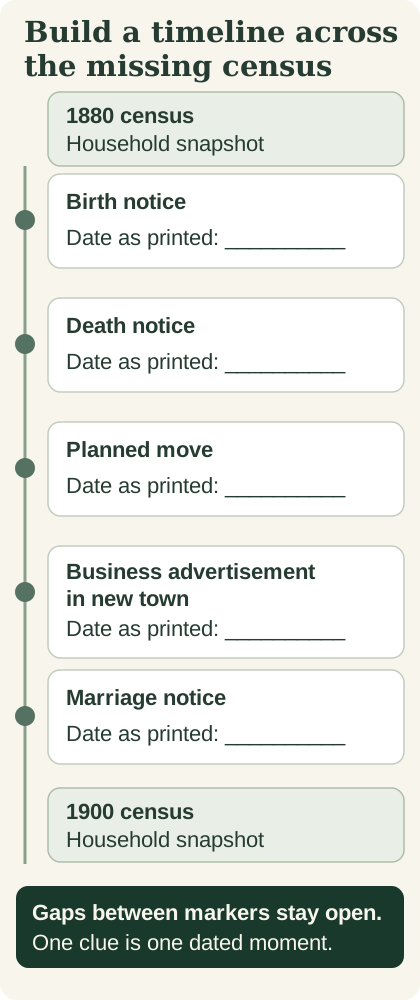
Suppose the 1880 census shows Samuel and Lucy Garland in the invented town of Fenwick with two children, and the 1900 census shows Samuel in the invented town of Brayton, eighty miles away, with a wife named Martha and three children whose names you have not seen before. You want to know what happened in between.
Searching the invented *Fenwick Gazette* for Garland from 1880 to 1890, you find a local item from 9 June 1883: "Born, to Mr. and Mrs. Samuel Garland, a son." On 13 February 1886: "Mrs. Samuel Garland died at her home on Elm Street Tuesday, after a long illness, leaving her husband and four children." And on 20 September 1887: "S. Garland has sold his blacksmith shop to J. Pell and will remove to Brayton."
Searching the invented *Brayton Courier* from 1886 to 1900, you find an advertisement first appearing on 6 January 1888: "S. GARLAND, Blacksmith and Horseshoer, Water Street." And on 3 May 1889, among marriage notices: "Garland and Hale: Samuel Garland and Miss Martha Hale, both of this city."
Here is what you can record. Each item is a dated report: a son born to a Mrs. Samuel Garland in Fenwick by June 1883; a Mrs. Samuel Garland's death "Tuesday" before 14 February 1886, leaving a husband and four children; an S. Garland's planned removal to Brayton in September 1887; an S. Garland blacksmith's advertisement in Brayton from January 1888; and a marriage of Samuel Garland and Martha Hale in Brayton by May 1889.
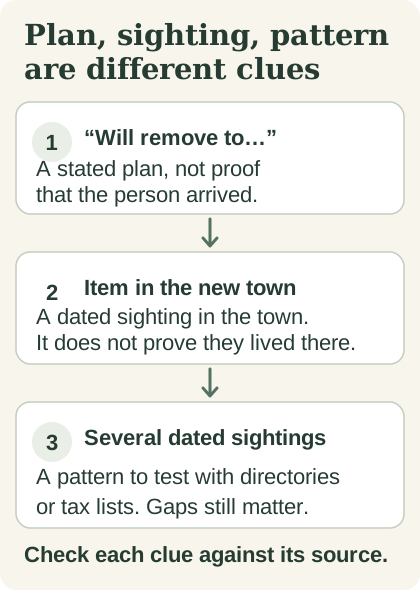
Here is what you cannot record. The items do not name Lucy, so you cannot be sure the Mrs. Samuel Garland who died was her, though that is worth testing. "Leaving four children" does not name them. "Will remove to Brayton" is a stated plan, not a record of arrival, and the Brayton advertisement shows an S. Garland in business there from 1888, not that he lived on Water Street throughout. You also cannot tell from these items whether the 1900 household's children were born to Martha, Lucy or both.
The useful result is a sequence of dated events that explains the jump between the two censuses and tells you which records to look for next: a death record for Mrs. Garland in 1886, a marriage record for Samuel and Martha in 1889, and births of the children in the 1880s.
Search from both ends of the gap
Work forwards from the 1880 place and backwards from the 1900 place. A family that moved will often appear in both papers, sometimes with the move itself reported at one or both ends.
On Chronicling America, open Collection Items, expand Advanced Search and choose Pages (Full Text), as the Library of Congress explains in its tips for searching Chronicling America. For each place, limit by state and the town's papers. Then try:
- The surname alone across the years you need, sorting results by date.
- The surname with a given name or initial, using These words within 5 words of each other.
- The surname with an occupation or business, using within 10 words.
- The surname with words for events, such as
born,married,diedorremoved, using within 10 words.
Read each result in full and note the date. When the surname is common, use the occupation, street or a relative's name to narrow results. Our guide to finding an ancestor with a common name explains how to keep similar people apart while you search.
If the 1880 or 1900 place had no paper, try the nearest town's paper or the county paper, as Maxwell suggests.
Read every mention as a dated sighting
Each newspaper item tells you about one moment. A birth notice tells you that a birth was reported by the issue date. An advertisement tells you that the business was advertised in that issue. A local item about a visit tells you that someone was visiting on a particular date, not that they lived there.
Place your sightings on a timeline in date order, each with its exact wording and source. Leave the gaps between sightings visible. A sighting in Fenwick in 1883 and another in 1886 does not show that the family lived there continuously in between, although it may suggest it. Our guide to finding an ancestor's address in old newspapers explains how to keep dated place clues separate from assumptions about continuous residence.
A stated plan, such as "will remove to Brayton", is a different kind of evidence from an arrival. Look for a mention in the new place before treating the move as complete.
Births, marriages and deaths in the gap
Life events in the 1880s are exactly what the missing census would have shown indirectly. Newspapers may report them directly. Search for birth announcements, marriage notices and death notices for the surname in both places across the gap. Our guides to marriage, birth and family announcements and to obituaries and death notices explain how these notices were worded and how to search them.
Be careful with family size and names. A death notice "leaving four children" gives a count, not names, and the count may include children from an earlier marriage or exclude those who had left home. A birth announcement "to Mr. and Mrs. Samuel Garland" identifies the mother only through her husband. If the father remarried in the gap, you need another record to know which wife was the mother of which child.
Moves, visits and business changes
Local columns recorded comings and goings. A family selling up, a shop changing hands, a farewell party or a visit back to the old town can all mark a move. Business advertisements can show when a trade began or ended in a place.
Look for the move at both ends. The old town's paper may report a departure. The new town's paper may report an arrival, a new business or a family attending church for the first time. Later, the old town's paper may report a visit from former residents, which can confirm where they went.
Children who appear and disappear
The twenty-year gap hides children who were born after 1880 and died before 1900. They appear in neither census, and a family may have forgotten them. Newspapers are one of the few places they may be recorded. Look for birth announcements, notices of children's deaths and funerals, and local items mentioning a sick child, for every year of the gap.
Compare counts with names. If a death notice in 1886 says a mother left four children, and the 1880 census shows two, then two may have been born between 1880 and 1886, or the count may include stepchildren. A birth notice from 1883 gives you one of them. Search each year for the rest before assuming.
The National Archives' description of the 1900 census schedules says that for a wife in the household they record the "number of children born of that marriage, and number of children living", which can show that children are missing from the record. If those numbers do not match the children you have found, the newspapers of the 1880s and 1890s are a good place to look for the others. Record each child you find with the exact wording of the notice, and do not assume a parent's name from the household alone.
Use the veterans' schedules with the newspapers
If a man in the family served in the Union forces, or a woman was a Union veteran's widow, the surviving 1890 special schedules may list them. The National Archives' page describes entries giving the veteran's unit, dates of enlistment and discharge, length of service, post office address and any disability. A post office address in 1890 gives you a precise place and year to search in the newspapers.
The Free Library of Philadelphia's guide shows that, in a large city, you may need the ward and enumeration district to find someone in these schedules, and that city directories can supply them. A newspaper item that gives a street address in 1890 can serve the same purpose.
Combine the newspaper timeline with other substitutes
Once you have a newspaper timeline, use it to target other records. A death notice gives you a date to search civil or church death records. A marriage notice points to a marriage register. An advertisement points to a city directory for the same year. A move gives you a year to check tax and assessment lists in the new county.
Maxwell's list of state and territorial censuses taken between 1884 and 1896 is worth checking for your states. If your family appears in a state census of 1885 or 1895, compare that household with your newspaper sightings. The two kinds of record can confirm or challenge each other.
When the gap stays empty
If you find nothing, check whether the newspapers for both places survive for the 1880s and 1890s, and whether they are digitised. Our guide to building a newspaper coverage map shows how to record which titles and years exist. Search the county seat's paper and neighbouring towns, since small items about rural families may appear in a county paper's columns of local correspondence.
Try other surname spellings and initials, since OCR and printers both introduced variations. Our guide to searching when OCR gets names wrong explains how to work around misread names.
Record which titles, years and terms you searched, so you can see exactly where the gap remains.

Record the timeline
For each sighting, record the newspaper title, place, issue date, page and column, the item type, the wording exactly as printed and any dates mentioned in the text. Put the sightings in date order, with census entries at either end and other substitutes in between.
Keep interpretation separate: "Fenwick Gazette, 13 February 1886: Mrs. Samuel Garland died 'Tuesday' (calculated 9 February 1886), leaving husband and four children. Probably Lucy, not confirmed. Next: death record for Fenwick, February 1886." Our guide to verifying and preserving a newspaper discovery has a full checklist.
Try a census-gap search this week
Choose one family that appears in the 1880 and 1900 censuses but changed in between: a new place, a new spouse, new children or missing children. Write down the place and household from each census.
Check first whether the family appears in the surviving 1890 fragments or the veterans' schedules, using the National Archives' index.
Then search the 1880 place's paper for the surname from 1880 to 1890, and the 1900 place's paper from 1890 to 1900, sorting by date. Record every sighting in date order.
Choose the most important event you found, such as a death, a marriage or a move, and look for the civil, church or directory record that can confirm it. If you find nothing, check for a state census taken between 1884 and 1896 in either state, and search the county seat's paper for the same years.
Sources
- National Archives: 1890 census
- National Archives, Prologue (Kellee Blake): First in the path of the firemen, the fate of the 1890 population census (1996)
- Grapevine Library (Nancy Maxwell): Substitutes for the (mostly) lost 1890 federal census (2026)
- National Archives: 1900 federal population census, part 1 (microfilm catalogue description)
- Free Library of Philadelphia: Censuses and census substitutes, including tax records
- Library of Congress: Tips for searching in Chronicling America