
Land and property
How to find an ancestor in old newspaper real estate transfer lists
Find an ancestor in old newspaper property-transfer lists, read dates and stated amounts carefully, then use an entry to locate the recorded deed.

On this page
- What a transfer list may show
- A fictional transfer from start to finish
- Search for the column, then for the name
- Read the dates carefully
- Read the stated amount carefully
- Read the names carefully
- Ownership is not residence
- From the newspaper to the deed
- Follow a property or a family across years
- Other property news in the same paper
- When nothing turns up
- Record each entry exactly
- Try a transfer list search this week
- Sources
Start by checking whether your ancestor's local newspaper printed a transfer list. Search a free collection such as Chronicling America for "real estate transfers" or "deeds recorded", filtered by state, county and date; add the newspaper title if you know it.
Some American newspapers printed recurring transfer columns, but their headings and contents varied. Open a few results to learn your paper's format. An entry may name the parties, describe a parcel or report an amount. Treat it as a lead to the county deed, not the deed itself.
What a transfer list may show
The Hamilton County, Ohio, OHGenWeb transcription of the Cincinnati Enquirer issue of 1 May 1921 is one example, not a standard format. It groups entries under neighbourhood names and records the parties, parcel description, a stated consideration and a separate tax figure. Multiple entries state "$1". A note on that page relates the tax figure to the property's value, but the transcription does not establish the note's legal basis or how to interpret it for other places or papers.
Other papers used other headings. A University of Hawaiʻi repository record catalogs a 1902 item titled "Real Estate Transactions" from the Honolulu Pacific Commercial Advertiser, with subject tags for named parties and places. That is catalog metadata, not a transcription of the newspaper page.
For a rural parcel, an entry may use a legal description such as section, township and range, metes and bounds, or a nearby landmark rather than a street address. Copy the description exactly as printed, and check the column heading before deciding what kind of transaction it reports.
A fictional transfer from start to finish
Everything in this example is invented: the people, Brennock County, the land, the newspaper, the entries and all dates. Brennock County is not a real place, no real jurisdiction is implied, and none of these items exists in any archive.
Suppose your ancestor Albert Voss appears as a farmer in Brennock County in a census of 1910, and you want to know when and how he got his land.
You search the invented Brennock County Register, a weekly published on Wednesdays, for Voss with transfers within 10 words for 1895 to 1910. In the issue of Wednesday 21 October 1903, under "Real Estate Transfers. The following deeds were filed for record during the week", you find:
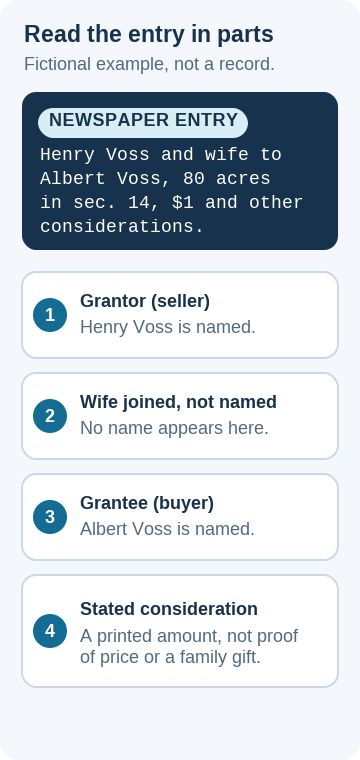
"Henry Voss and wife to Albert Voss, 80 acres in sec. 14, $1 and other considerations."
Here is what you can record. The Register of 21 October 1903 listed a deed from Henry Voss and wife to Albert Voss for 80 acres in section 14, filed for record during the week before that issue, with a stated consideration of "$1 and other considerations".
Here is what you cannot record. The list gives the week the deed was filed, not the date it was signed, which may have been earlier. It does not say how Henry and Albert were related, and "and wife" does not name Henry's wife. A stated consideration of $1 does not prove a family relationship or a gift. The Cincinnati transcription above also shows $1 in multiple entries, but it does not explain why those deeds state that amount. The list does not show that Albert lived on the land.
When you find the deed in the county's books, it shows that it was signed on 3 April 1903 and recorded on Saturday 17 October 1903. The deed names Henry's wife as Margaret, who signed it. It still does not say whether Albert was their son.
The useful outcome is a filing date that took you to the deed, a wife's name from the deed itself, and a hypothesis about a father and son that probate or other records can test.
Search for the column, then for the name
If a column is densely set, OCR may misread names. Search for its heading first to learn where and how often that paper printed it, then search and browse for your names.
The Library of Congress's published tips for searching Chronicling America describe selecting Collection Items and Pages (Full Text). Interface labels may change, so follow the linked help if a control has moved; narrow by state, county, city or newspaper title and date where available. Then try:
real estate transfers,realty transfers,deeds recordedortransfers of real estatewith This exact phrase.- Your surname with
transfersordeed, using These words within 10 words of each other. - Your surname with a section number, a township or a subdivision name, using within 10 words, if you know where the land was.
Elizabeth Hodges, a librarian at the Allen County Public Library's Genealogy Center, suggests in a handout on researching the history of a house looking at the real estate transfers section of the newspaper of the period and noting its exact wording, so you can use the same words when you search.
Our guide to searching when OCR gets names wrong explains how to read dense lists from the page image.
Read the dates carefully
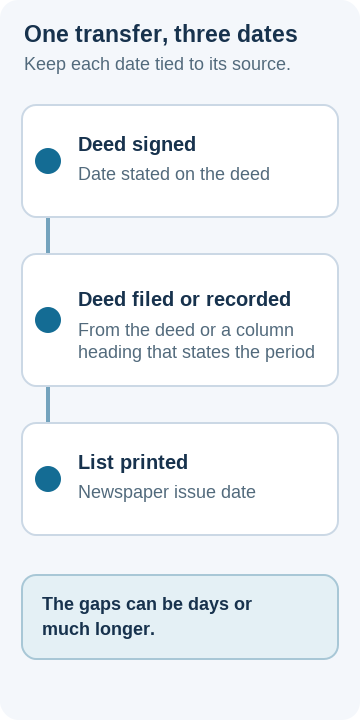
A transfer list involves at least three dates: the date the deed was signed, the date it was filed or recorded at the courthouse, and the date the newspaper printed the list. They may be days apart or much further apart.
Diana Elder's FamilyLocket article on deeds gives an example of a land record filed three days after the transfer. Hodges notes that deeds were not always recorded right away. If you cannot find a buyer in the deed index, she suggests checking the newspaper's transfer announcement, which can narrow down the recording date and give you the seller's name.
So record the issue date and any heading that explains what the list covers, such as "filed for record during the week". Do not record the issue date as the date of sale.
Read the stated amount carefully
A transfer entry may state a consideration, the amount reported for the deed. Treat it as the printed figure, not automatically as the amount paid. The 1921 Enquirer transcription contains multiple $1 entries and a separate tax figure. Its note relates that tax to the property's value, but the transcription does not state the note's legal basis or explain why particular deeds report $1. Check the deed and the jurisdiction-specific basis before interpreting either figure; do not use this one paper's note as a general property-valuation method.
A nominal price does not by itself tell you why a transfer was made. The sources read for this guide do not explain why particular deeds stated nominal sums, and reasons could vary, so do not assume a gift or a family arrangement. Treat a $1 consideration as a question, not an answer.
Read the names carefully
A list may print "Henry Voss and wife", "H. Voss et ux." or "Henry Voss et al." rather than every name. "And wife" and "et ux." tell you that a wife joined the deed but not who she was. "Et al." means others are involved, who may be heirs, co-owners or partners. A courtesy form such as "Mrs. H. Voss" does not identify which woman is meant.
Angela Packer McGhie's FamilySearch handout, Introduction to Using Land Records in Genealogical Research, explains that in some states a wife was required to release her dower right, a one-third interest, when her husband sold land, and that land records can state family relationships, such as husband and wife or "my son". The deed itself is where you are most likely to find names the newspaper left out.
A shared surname between seller and buyer suggests a family connection but does not prove it. Our guide to finding an ancestor's siblings in old newspapers explains why relationships need more than a surname, and full siblings need both parents identified.
Ownership is not residence
In a column whose heading says that deeds were filed or recorded, an entry may report a deed between two parties. It does not show who lived on the land or in the house. A buyer might be an investor, a relative buying for someone else, or a farmer adding a field to a farm elsewhere. A seller might never have lived there.
Hodges makes the point from the other side: not everyone who lived in a house necessarily owned it. Our guide to finding an ancestor's address in old newspapers explains how to keep ownership, occupancy and dated place clues apart.
From the newspaper to the deed
An entry can give you names and a date range to search in deed indexes. McGhie explains that land transactions were usually handled at the county level, by an office such as the county recorder or register of deeds, and that most counties created indexes to grantors, the sellers, and grantees, the buyers. Elder describes these as direct and indirect indexes and recommends checking both.
Joe Michalak's guide to researching the history of a Santa Cruz house, from Santa Cruz Public Libraries, describes working back from a current owner through the grantor and grantee indexes, with each grantor becoming the grantee of an earlier deed, and keeping a record of each name, book and page and date. A newspaper entry can give you a starting point anywhere in that chain.
Elder also notes that deed books contain more than land sales, including mortgages, leases and bills of sale. If a list included a mortgage or lease, the deed books may hold it too.
Follow a property or a family across years
One entry is a single dated event. A run of entries can tell a longer story. Search for each later year in which your ancestor might have bought or sold, and search for the buyer's name as a seller in later lists. A person who appears as a grantee in one decade and a grantor in the next may have been selling up before a move, dividing land among children, or simply trading land as a business.
Search for the land itself as well as the name. A section number or a subdivision lot can lead you to entries for the same property under other owners, before and after your family held it. Sales by an executor, administrator, guardian or sheriff may appear in the same columns, sometimes identified by those titles, and these can point you to probate or court records.
If the surname is common, keep each entry attached to a candidate rather than to your ancestor until the deed or another record links them. Our guide to finding an ancestor with a common name explains how to keep similar people apart.
For rural land, an entry may describe a parcel by section, township and range, metes and bounds, or a nearby owner's name. Copy the description exactly as printed. A later deed for the same parcel can help you follow another transfer, while a sequence of entries can suggest questions about a family's holdings to check against the deeds.
If your ancestor first acquired the land from the government, there may be no newspaper transfer at all for that acquisition. Transfer lists were drawn from deeds filed at the county, so look for later private sales there.
Other property news in the same paper
Transfer lists were not the only property news. Michalak's Santa Cruz guide notes that local papers reported property transfers, building permits and the work of architects and builders, and that searching under a house's earlier street number often identifies owners and transaction dates. The University of Minnesota Duluth's guide to researching the history of a house in Duluth says that local papers on microfilm may occasionally contain references to newly built or sold houses.
Sale advertisements, auction notices and short local items about a family "buying the Miller place" can add detail that a transfer list leaves out, such as the size of a house or the reason for a move. They are also leads, not proof of ownership. Our guide to tracing a family business through newspaper advertisements explains how to read who is named in an advertisement and in what role.
When nothing turns up
If you find nothing, check whether the county's paper printed a transfer column in the years you need and whether those issues survive and are digitised. Our guide to building a newspaper coverage map explains how to record what you checked.
A missing entry does not mean no deed exists. A paper's column may cover only certain places or dates; check its heading and nearby issues before deciding its scope. Issues may also be missing, and OCR may have failed. Go to the deed indexes directly, and search the paper again once you have the recording date from the deed.
Record each entry exactly
For each entry, record the newspaper title, issue date, page and column, the column heading and any explanation of what it covers, the entry exactly as printed, and the names in the entries just before and after if they share your surname or a nearby description.
Keep interpretation separate: "Register, 21 October 1903, 'Real Estate Transfers', filed during the week: Henry Voss and wife to Albert Voss, 80 acres sec. 14, $1 and other considerations. Signing date unknown; relationship not stated. Next: grantor index, Henry Voss, 1903." Our guide to verifying and preserving a newspaper discovery has a full checklist.
Try a transfer list search this week
Choose one ancestor who owned land or a house, and write down the county and the years when they may have bought or sold it.
Search Chronicling America or your state's newspaper site for real estate transfers and deeds recorded as exact phrases, limited to that county's papers, to learn the heading and format. Then search your surname with transfers within 10 words for the years you need.
Record each entry with its heading and issue date. Then look up the grantor and grantee indexes for that county, search both for your ancestor in the months before the issue date, and compare the deed with the newspaper entry.
Sources
- Hamilton County OHGenWeb: Real estate transfers, Cincinnati Enquirer, 1 May 1921 (transcription)
- University of Hawaiʻi digital repository: Real Estate Transactions, Pacific Commercial Advertiser, 9 August 1902
- Allen County Public Library Genealogy Center (Elizabeth Hodges): If these walls could talk, how to research your home (handout, PDF)
- FamilyLocket (Diana Elder): Back to the basics with land records, part 2, deeds (2019)
- FamilySearch (Angela Packer McGhie): Introduction to using land records in genealogical research (PDF)
- Santa Cruz Public Libraries (Joe Michalak): How to research the history of your Santa Cruz house (2022, PDF)
- University of Minnesota Duluth Libraries: Researching the history of a house or building in Duluth, other local resources
- Library of Congress: Tips for searching in Chronicling America