
Post office lists
Find ancestors in unclaimed-letter lists
Use old newspaper lists of letters left at the post office to test when an ancestor was expected in a town, and learn what a listed name can and cannot prove.

On this page
- Search for the list heading before the surname
- A fictional search from start to finish
- Why post offices printed these lists
- What a name on the list can tell you
- Read the columns, markings and instructions
- Read initials and married names without guessing
- Follow one name across a run of lists
- When the name or the list is missing
- Save the list so the clue stays usable
- Try a letter-list search this week
- Sources
If your US ancestor seems to vanish between a census and a later record, look for the post office's list of unclaimed letters in the local newspaper. These lists usually ran under a heading such as "List of Letters" or "Letters remaining in the post office", and they name people for whom mail was waiting. A listed name suggests that a sender expected someone of that name to collect mail in that town around that date.
Pick one town and a two-year window where you already have a reason to place your ancestor, then search the free Chronicling America collection at the Library of Congress for the list heading rather than the surname. Once you have found how one paper printed its lists, you can scan that paper's lists issue by issue.
This guide is about historical research, not tracing living people.
Search for the list heading before the surname
Letter lists are hard to find by name. The type was small, columns were narrow, surnames were often printed surname first, and initials were common. Optical character recognition, the software that turns a page image into searchable text, struggles with all of that. Start by finding the lists, then read them.
On Chronicling America, open the Collection Items tab, expand Advanced Search and choose Pages (Full Text). The Library of Congress explains these options in its tips for searching the current Chronicling America interface. Use the State/Province and Title limiters to restrict the search to your town's paper, and set start and end dates around your question.
Then try these in turn, choosing the search mode from the drop-down menu rather than typing quotation marks:
list of letterswith This exact phrase selected.letters remainingwith This exact phrase selected.advertised letterswith These words within 5 words of each other selected.letters post officewith These words within 10 words of each other selected.
The Library's guidance describes exact-phrase searching as requiring the words to sit next to each other, while the proximity options allow other words in between. Proximity can help when words are separated by extra text. It still requires the search terms to be recognised: if OCR drops or mangles a word, try fewer terms or browse the page images.
When you find one list, note which page it was on and how often it appeared. Many papers placed routine notices in the same part of the paper week after week. You can then browse that page in each issue across your date window, which is more reliable than hoping the surname was read correctly.
If Chronicling America has no issues for your town and years, check what else exists before paying for anything. Our guide to free and library newspaper access covers state digitisation programmes, library databases and microfilm. If a weak search is the main problem, searching newspapers when OCR gets names wrong has more ways to work around misread text.
A fictional search from start to finish
Every detail in this example is invented for teaching: the person, the town, the newspaper, the dates, the list and the outcome. Brannock Falls is a fictional setting in this example, and none of these items is a real archive discovery.
Suppose you have a fictional family record showing Tobias Quell, a wheelwright, in Brannock Falls in an 1860 census entry. The next record you have places him in another state in 1870. You want to know whether he was still expected in Brannock Falls during the 1860s.
You search the invented Brannock Falls Courier for the heading "list of letters" and find that it printed lists on its third page under "List of Letters Remaining in the Post Office at Brannock Falls". You then scan each list from 1862 to 1866 rather than searching for Quell, because you already know the surname is short and could be misread.
You find "Quell, T." in the invented list headed 30 June 1864, printed in the issue of 6 July 1864. You find nothing for him in lists from 1862, 1863 or 1865. In the list dated 31 March 1866, printed on 4 April, you find "Quell, Mrs. Hannah".
Here is what you can write in your notes:
- The Courier of 6 July 1864 printed a list dated 30 June 1864 showing mail held for "Quell, T." at Brannock Falls.
- The Courier of 4 April 1866 printed a list dated 31 March 1866 showing mail held for "Quell, Mrs. Hannah".
Here is what you cannot yet write: that Tobias lived in Brannock Falls in 1864, that Hannah was his wife, or that the family left the town between 1864 and 1866. "Quell, T." could be another person with that initial. Hannah's entry uses a courtesy title and her own given name, which is helpful, but it does not state whose wife or widow she was. The absence of Tobias from the 1865 list could mean he collected his mail, was not sent any, or had gone.
The useful outcome is a sharper question. You now have two dates to test in other records: a tax list, a church register, a land record or a directory for Brannock Falls around 1864 and 1866. If one of them names Tobias and Hannah together in the town, the letter lists become supporting context rather than the whole argument.
Why post offices printed these lists
In the early United States, most people collected their mail from the post office rather than receiving it at home. When a letter sat uncollected, the postmaster had a reason to tell the public. The 1792 Act establishing the Post Office required deputy postmasters to publish a list of letters remaining in their offices every three months, in a newspaper at or near their town, for three successive weeks. The Legal Genealogist quotes the relevant section of that Act in a post explaining why these lists appear.
The practice was older than the federal law. A publisher's description of an abstract of the lists printed in Benjamin Franklin's Pennsylvania Gazette explains that Franklin began printing the names of people with unclaimed letters while he was postmaster of Philadelphia, and that the paper sometimes carried lists for other towns as well. You can read that description on the Genealogical Publishing Company description of Buried Genealogical Data, as archived on 13 February 2026.
Letters that still went unclaimed were eventually sent on. Smithsonian Magazine's brief history of American dead letter offices, as archived on 25 August 2026 dates the first official Dead Letter Office to 1825 and describes clerks examining undeliverable mail for clues about senders and addressees. For family history, that later stage matters less than the published list itself, because the list is what reached the newspaper and survives in digitised pages today.
Two practical consequences follow. First, the lists were routine, so a town paper may have printed one every week, every fortnight or every month, depending on the period and the size of the office. Second, the frequency and format changed over time and between places. Check what your paper actually did rather than expecting a fixed timetable.
What a name on the list can tell you
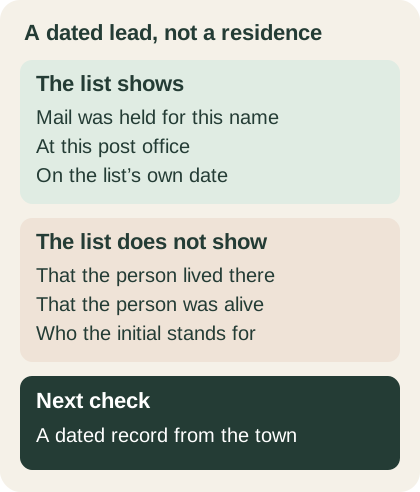
A listed name tells you that the post office held mail addressed to a person of that name at that office when the list was compiled. Keep the post office and list date with the printed name.
The Legal Genealogist post makes a useful point: someone sending a letter to that office had reason to think the addressee would be able to collect it there. It is not proof that the person lived in the town, was alive on the list date, or ever arrived. The letter may have been sent to someone who had already moved on, died, been delayed, or never planned to come. The list records what the post office was holding, not where your ancestor actually was.
It also helps to think about who did not appear. A person who collected mail promptly would never be listed. A household whose mail came through a business address might be listed under the business. People in towns without a newspaper might appear in a list printed in a neighbouring town's paper, or not at all.
Use the list to choose a town or date to investigate, then compare it with other records. If the gap falls between 1880 and 1900, our guide to newspapers and 1890 census substitutes puts this kind of clue alongside other records.
Read the columns, markings and instructions
Lists varied, so read the heading and any notes at the foot before reading names. Look for the post office name, the date the list was compiled, and the postmaster's name or initials. The compilation date and the newspaper's issue date are different dates, and your notes should keep both.
Volunteer transcriptions show how varied the format could be. A page of transcribed Clinton, Iowa, letter lists on the IAGenWeb site includes an 1857 list arranged in a single alphabetical table, and lists from 1892 and 1893 split into separate gentlemen's and ladies' lists. The later lists ask people collecting their mail to say "advertised" and give the date of the list. The 1857 list also has a separate group headed "Held for Postage". The transcriber does not say whether every name was checked against the page image, so treat it as an illustration of format rather than a source to copy names from.
Common features you may meet include:
- Separate lists for women and men, or a single list with "Mrs." and "Miss" before women's names.
- A number after a name, which may indicate more than one letter. If the paper does not explain it, record the number as printed rather than interpreting it.
- Entries for firms, churches or societies alongside individuals.
- Notes about letters held for postage, misdirected mail, or mail for people at a hotel or a camp.
- An instruction to ask for "advertised" letters, sometimes with a charge.
The instruction to ask for an "advertised" letter is visible in the Clinton transcriptions. If a family collection also contains an envelope marked "Advertised" or "ADV", compare its name, post office and dates with the newspaper lists before assuming they belong together. If a notice states a charge, record it as specific to that notice and date rather than assuming a standard fee.
Read initials and married names without guessing
Letter lists often reverse names, abbreviate given names and use titles. A woman may be listed as "Smith, Mrs. J. W." under her husband's initials, as "Smith, Mrs. Mary", or as "Smith, Miss Mary" before marriage. The first form tells you a title and a household name. It does not identify the woman herself, and it does not prove which J. W. Smith was her husband. The second form gives her own given name, which is more useful, but it still needs a separate record to connect her to a particular household.
Initials raise the same issue for men. "Brown, J." could be any J. Brown in the district, or someone passing through. When a list gives a fuller name or an occupation, record it exactly. When it gives only an initial, keep the entry under that initial in your notes and resist expanding it to the name you hope it represents.
If your ancestor had a common surname, a letter list will rarely settle identity on its own. Our guide to finding an ancestor with a common name shows how to keep separate working records for namesakes, which is exactly what a run of letter lists needs.
Follow one name across a run of lists
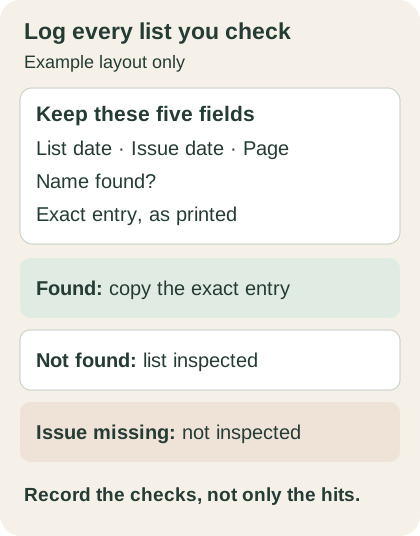
One listing gives you a single dated clue. Several consecutive lists let you see whether the name recurs, which is easier to reason about. Make a small table with one row per list you inspected: list date, issue date, page, whether the name appeared, the exact form printed, and any number or note.
The rows where the name does not appear matter as much as the rows where it does. If you inspected every list between two dates and the name appeared only once, that is a different picture from a name that appeared in four consecutive lists. Repeated appearances might suggest that letters kept arriving and kept going uncollected. One appearance might mean a single letter that the person later collected. Neither pattern proves residence or departure.
Watch for a name moving between towns. If you find "Quell, T." in one town's list and later in a list from a town further along a road or railway, that can point to a route worth testing. Our guide to military, legal and migration news explains how to follow movement through farewell items, arrivals and destination reporting. A letter list in the new town is a lead to that kind of local report, not a substitute for it.
Keep in mind that the same list may have been printed for several weeks in a row. The 1792 law quoted above asked for three successive weeks, and your own paper may have repeated lists on its own schedule. Three printings of one list are one list, not three pieces of evidence. Record the compilation date so you can see when you are looking at a repeat.
When the name or the list is missing
There are several reasons you may find nothing, and they lead to different next actions.
The paper may not have printed lists in the years you searched, or may have printed them only occasionally. Browse several issues to establish whether lists appear at all before concluding anything about your ancestor.
The issues may be missing from the digitised run. A title or date filter narrows the search to what has been digitised for that title; it cannot show issues that were never scanned. Check the title's list of available issues for gaps.
The list may be present but unreadable to the search engine. This is common. Open the page image and read the list directly.
The person may have been listed in a different town's paper. The 1792 provision asked for publication in a newspaper at or nearest the postmaster's place of residence, so a small office without its own paper could appear in a neighbouring town's paper. Search the nearest county seat's paper for the small office's name.
Or your ancestor may simply never have had uncollected mail. A blank result in a well-documented run of lists is a fair negative result for those dates. It is not evidence that the person was absent.
Write down which of these you have ruled out. A note such as "lists browsed for every issue from January 1862 to December 1866 except the missing March to May 1864 issues; no Quell entries" is far more useful later than "not found".
Save the list so the clue stays usable
For each list you use, record the newspaper title, place of publication, issue date, page and column, the list heading as printed, the list's own date, and the post office name. Add the collection name, the page URL and the date you viewed it. If you download the page image, keep the full page rather than a crop, because the heading and list date are often far from the name. Our guide to verifying and preserving newspaper evidence gives a fuller citation checklist.
Transcribe the entry exactly, including titles, initials, numbers and odd spellings. Put your interpretation in a separate note, for example: "May be Tobias Quell of the 1860 census household. Initial only; no occupation given. Needs a dated record from Brannock Falls to confirm." That separation lets you, or anyone else, revisit the identification without losing what the paper actually printed.
If a later record supports the identification, say what it adds. If a later record contradicts it, keep the list entry and change only your interpretation. Our guide to finding an ancestor's address in old newspapers shows a similar approach for keeping dated place clues in order without assuming continuous residence.
Copy these labels into your notebook or spreadsheet, with one record for each list you inspect:
- Newspaper title and publication town:
- Post office:
- List date:
- Issue date, page and column:
- Entry found, not found or issue missing:
- Exact entry and printed markings:
- Collection, page URL and access date:
- Interpretation:
- Next record to check:
Try a letter-list search this week
Choose one ancestor with a gap of at least a few years between two records, and one town where you have a documented reason to look during that gap.
Check whether Chronicling America or another free collection has that town's paper for your window. In Pages (Full Text), limit to that title and your dates, and search list of letters as an exact phrase, then letters remaining as an exact phrase, then advertised letters within 5 words. Note which search found a list and which page it was on.
Open three issues spread across your window and confirm whether the paper printed lists regularly. Then read every list in the window, page image by page image, looking for your surname and any initial that could fit.
Use the log above to record every list you inspect, including missing issues and lists with no matching name.
If you find a possible entry, choose one dated record from the same town and period, such as a tax list, church register or directory, and check whether it names the same person. If you find nothing, record the run you inspected, then try the nearest county seat's paper for the same window, in case the town's lists were printed there.
By the end of the session you should be able to say either "a person with this name had mail waiting here on these dates, and here is the record I will check next", or "the lists I inspected for these dates do not include this name, and these issues remain unchecked".
Sources
- The Legal Genealogist: Dead-letter clues (quotes section 18 of the 1792 Post Office Act)
- Smithsonian Magazine: A brief history of American dead letter offices, as archived on 25 August 2026
- Genealogical Publishing Company: Buried Genealogical Data, publisher's description (archived 13 February 2026)
- Library of Congress: Tips for searching in Chronicling America
- IAGenWeb Clinton County: transcribed lists of letters at the post office