
Newspaper people
How to research an ancestor who was a newspaper printer, editor or publisher
Trace an ancestor who printed, edited or published newspapers. Use mastheads, trade directories and archival records to distinguish people from firm names.

On this page
- Search a paper for its own staff
- Worked example: date a change in a newspaper partnership
- Where a newspaper names the people who made it
- Directories and reference works that list newspaper people
- Use newspaper histories to identify editors and owners
- Read roles and firm names carefully
- Check authorship and bias before using an editor's words
- Look for printers and staff outside the masthead
- Trace a career across several papers
- When the paper itself does not survive
- Record each source and what it claims
- Try a newspaper-career search this week
- Sources
If a census lists your ancestor as a printer, editor or publisher, or a family story says they "ran the paper", the newspaper itself becomes a family record. Its masthead, the heading or statement naming the paper and its makers, may name them, its columns may announce when they took over or left, and directories and library catalogues may record their name beside the title. Rival papers may have written about them too.
Your first action depends on whether you already know the newspaper:
- You know the newspaper: Open a run of issues, starting with a year supported by a census or directory. The Library of Congress guide to Chronicling America points to its free digitised collection. Read the masthead and editorial page for names and roles.
- You know only the town and occupation: Start with the newspaper directory guide and look for a directory volume close to the year in your record. Look up the town, note its newspaper titles and any names matching your ancestor, then look for surviving issues of those papers. A directory entry is a lead to check, not proof that a namesake is your ancestor.
Search a paper for its own staff
On Chronicling America, open Collection Items, expand Advanced Search and choose Pages (Full Text), as the Library of Congress explains in its tips for searching Chronicling America. Select the newspaper's title and a date range covering your ancestor's likely years, then try:
- Your surname with
editor,publisherorproprietor(owner), using These words within 5 words of each other. - Your surname with
retiresorsold, using These words within 10 words of each other, for announcements of a change. - Your surname with
printerorcompositor(a worker who arranged type for printing), using within 10 words, if your ancestor worked in the composing room rather than editing. - The paper's own title with
new management, using within 10 words.
For the fictional surname in the example below, a copy-ready query is Thorne editor with These words within 5 words of each other selected.
Then search rival papers in the same town or county for your surname with the same words. A rival may have reported a change that the paper itself passed over quickly.
Do not rely only on search. Mastheads may be set in large or decorative type that optical character recognition (OCR), the software that turns page images into searchable text, reads poorly. Begin with one year supported by a census or directory and sample the front or editorial page of one issue a month, noting names and gaps. Widen to other years as the evidence requires. If the wording changes, inspect the available issues between the last old wording and the first new wording. Record the interval you checked; an altered masthead does not by itself establish the exact date of a sale or appointment. Our guide to searching when OCR gets names wrong explains how to work from page images.
Worked example: date a change in a newspaper partnership
Everything in this example is invented: the people, the town of Brookfield Falls, both newspapers, the directory entry and all dates and wording. No real town, newspaper or person is described, and none of these items exists in any archive.
Suppose a census entry lists your ancestor Silas Thorne as "editor" in Brookfield Falls in 1880, and in 1900 as a "farmer" in another county. You want to know which paper he edited and when he left it.
A newspaper directory for 1881 lists, under Brookfield Falls, the Brookfield Falls Courier, weekly, "Republican; Thorne & Pike, editors and publishers". You open the Courier in a free digitised collection and find the masthead naming "Thorne & Pike, Proprietors" from 1878 to the issue of 6 October 1887. From 13 October 1887 it names "J. H. Pike, Editor and Proprietor."
Searching the issues around the change for Thorne, you find on 13 October 1887 a short editorial: "With this issue Mr. S. Thorne retires from the Courier, having disposed of his interest to his partner. We wish him every success in his new home in the West." The rival, the invented Brookfield Falls Herald, notes on 15 October: "Silas Thorne has sold out of the Courier and goes to farming."
Here is what you can record. The Courier's masthead named Thorne & Pike as proprietors from 1878 to 6 October 1887, and J. H. Pike alone from 13 October. The Courier of 13 October announced that S. Thorne had retired and sold his interest to his partner, and wished him well in a new home in the West. The Herald of 15 October said he had sold out and was going to farming.
Here is what you cannot record. The directory and the masthead show a firm name and a partnership, not who did which job. Neither paper states the sale price or the reason. "His new home in the West" is the paper's phrase, not a place. The Herald's comment comes from a rival with its own view. The 1900 census shows a farmer named Silas Thorne in another county, but you still need to show that he is the same man.
Where a newspaper names the people who made it
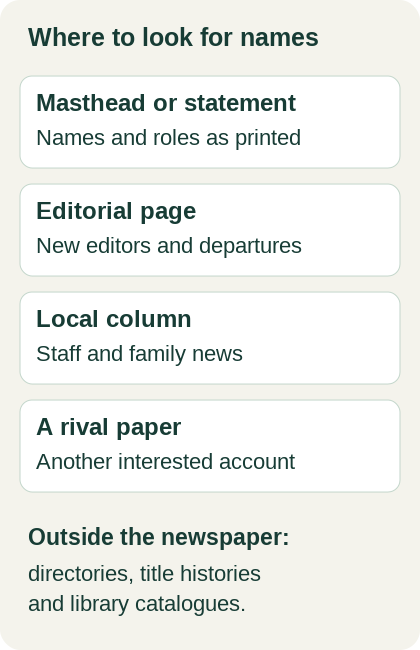
Many papers printed some statement of who published them. It might be in the masthead at the top of the front page, in a box on the editorial page, or in a line at the foot of the last page. It might name the proprietor, the editor, the publisher or the printer, or a firm that combined several of these roles.
Our guide to finding the right newspaper explains how to read a masthead like a catalogue record, for the exact title, place, frequency and edition. Read it again for names. A change of name in the masthead helps narrow the period in which a change was reported. Check announcements and other records before assigning an ownership or editorship date.
Names also appear elsewhere. A paper may announce a new editor, report the sale of the office, or print a farewell from a departing owner. It may list its own staff at an anniversary, or report a printer's wedding, accident or death in its local column. A rival paper in the same town may comment on any of these.
Directories and reference works that list newspaper people
Commercial newspaper directories, published for advertisers, list papers town by town with details about each. The University of Arkansas Libraries' guide to newspaper directories describes Rowell's American Newspaper Directory, published from 1869 to 1908, and the Ayer directories from 1880 onward, and says most Ayer entries include editors, circulation, advertising rates and frequency. It notes that some Ayer volumes are on HathiTrust. The University of North Texas Digital Library offers free scans of several Ayer volumes, such as the 1912 American Newspaper Annual and Directory, whose title page says it gives circulation, frequency, founding date, politics, and the names of editors and publishers.
For the earliest American printers, the American Antiquarian Society's Printers' File is an exceptional source. The Society's page on the Printers' File online describes a card file covering 6,145 printers, publishers, editors, binders, papermakers and others in the trade through 1820, compiled from newspapers, local histories, biographies and reference books, with mini-biographies that can include marriages, military service and misfortunes. The data is online as downloadable files, which the Society says are not indexed and are hard to search. For newspaper people specifically, it points to the index in Clarence Brigham's History and Bibliography of American Newspapers, 1690-1820.
A 2009 post on the Society's blog, introducing the Printers' File, describes Avis Clarke's work combining the skills of a historian, genealogist and bibliographer, including untangling family printing businesses that passed between relatives.
Use newspaper histories to identify editors and owners
For newspapers digitised in Chronicling America, a short history of the title may already exist. Molly Hardy of the National Endowment for the Humanities, in a 2022 post on newspaper title essays, describes these essays as roughly 500 words each, written by the state partners in the National Digital Newspaper Program and edited by NEH. She says they cover publication and circulation history, editors, publishers or reporters of note, events the paper covered and relationships with other papers, and that more than 2,000 had been written. She suggests searching the US Newspaper Directory by keyword, which searches these essays among other records.
A title essay can save you hours. It may name your ancestor, give years of ownership and mention a merger or rival. Treat it as a starting point. It is a short secondary summary written from available sources, and it may simplify a complicated succession of owners.
Read roles and firm names carefully
Titles in a masthead do not always tell you who did what. "Editor and proprietor" might describe one person who did everything, or a person who owned the paper and wrote little. A firm such as "Thorne & Pike" tells you about a business partnership, not who set type, who wrote editorials or who kept the accounts. A printer named in a masthead might be a separate firm that printed the paper under contract.
Shared surnames in a firm name are a lead, not proof of kinship. "Thorne & Son" suggests a father and son, but you need another record to confirm it. The American Antiquarian Society blog post shows how complicated family printing businesses could be. Our guide to tracing a family business through newspaper advertisements explains how to read partnership and succession wording such as "successor to" and "in partnership with".
Check authorship and bias before using an editor's words
An editor's words fill the paper, but most of them are not about the editor. An editorial expresses the paper's position, which may or may not reflect the editor's private views, and an unsigned piece may have been written by someone else. Be cautious about attributing particular opinions to your ancestor unless the piece is signed or the paper says who wrote it.
The paper is also likely to report its own staff favourably. A notice of an editor's retirement may be warm whatever the circumstances. A rival paper may be hostile for political or business reasons. Treat both as accounts by interested parties.
Family events are a different matter. A paper's report of its editor's marriage, a child's birth or a death in the family is a local news item like any other, and can be tested against civil and church records in the usual way.
Look for printers and staff outside the masthead
Not everyone who worked on a newspaper was named in it. A compositor setting type, a pressman, an apprentice or a carrier might work for years without a single mention. If your ancestor's occupation was "printer" rather than "editor", the masthead may only tell you who employed them.
Start with what places your ancestor in the trade: a census occupation, a city directory entry giving the newspaper office as a workplace, or a family document. Then look in the paper's local column for small items about its own office, such as a staff outing, an injury in the pressroom, a printer leaving for another town or a wedding of someone "employed in this office". These items are short and easily missed by search, so browse the local column for the years your ancestor worked there.
Occupational and trade publications may also mention printers. Our guide to finding ancestors in historical labor newspapers explains how to move from a documented workplace to a possible trade or union paper, and why a name in such a paper does not by itself prove membership of a union. The same caution applies here. An item saying that a man was employed at the Courier office places him there on that date. It does not tell you how long he stayed or what job he did.
A directory that lists a person as a printer at a particular newspaper is a useful bridge between the census and the paper. Note whether the directory gives the newspaper office as a workplace or as a home, because the two are easy to confuse.
Trace a career across several papers
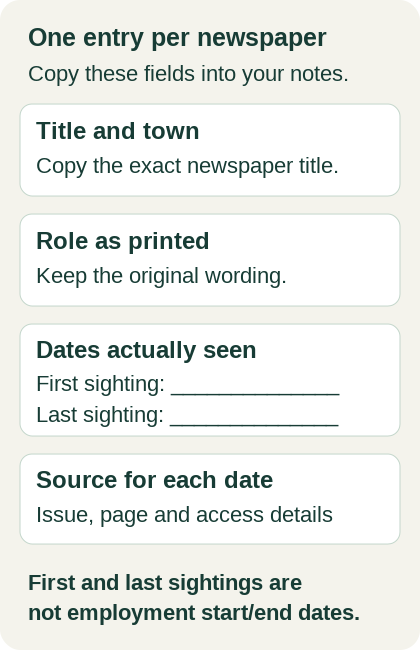
Some printers and editors moved between papers and towns. A directory entry in one year, a masthead in another and an announcement of a sale can each mark a stage. Build a career timeline with one entry per paper. Copy these fields into your notes:
- Newspaper title
- Town
- Role exactly as printed
- First date you saw the name
- Last date you saw the name
- Source for each date
Search the directories for your ancestor's name across states as well as by town, if the scanned volumes allow full-text search. A short entry in a different state may be the next stage of the career.
If your ancestor appears with a common name, check that the place and dates fit before adding a paper to the timeline. Our guide to finding an ancestor with a common name explains how to keep namesakes separate.
When the paper itself does not survive
Many papers survive only in scattered issues, or not at all. Even then, your ancestor's work may be recorded elsewhere: in directories, in title histories, in rival papers and in library catalogues that note publishers in their records.
Record which issues of the title survive before you conclude anything, and use our guide to free and library newspaper access to find microfilm. For papers before 1821, Brigham's bibliography and the Printers' File may record a paper's printers even where few issues survive.
Record each source and what it claims
For each item, record the source type (masthead, editorial, directory entry, title essay, rival paper), the title, date, page, and the exact wording naming your ancestor and their role. For mastheads, record the first and last issues you saw with each wording, and note any issues you did not check.
Keep interpretation apart: "Masthead names Thorne & Pike, proprietors, 1878 to 6 Oct 1887. Division of roles unknown. Courier 13 Oct 1887 says S. Thorne retired and sold his interest to his partner. Next: 1890s directories for S. Thorne; land records in the 1900 county." Our guide to verifying and preserving a newspaper discovery gives a full citation checklist.
Try a newspaper-career search this week
Choose one ancestor described as a printer, editor, publisher or newspaper proprietor in any record, and write down the town and years given there.
If you do not yet know the paper, look up the town in a scanned Ayer directory for a year inside that span, such as one of the volumes on the UNT Digital Library or HathiTrust, and note every paper listed with its editors and publishers. If the paper is in Chronicling America, check whether it has a title essay.
Once you have a title, begin with one year supported by a census or directory and sample the masthead or editorial-page statement once a month. Record the wording and any missing issues. If the names change, inspect the available issues between the last old wording and the first new wording before widening the search. Then search the paper and any rival for your surname with editor, retires and sold.
If you find nothing, check whether the paper's issues survive for your years, search the directories for the surname across other towns, and, if your ancestor worked before 1821, look for them in the Printers' File data or Brigham's bibliography.
Sources
- University of Arkansas Libraries: Newspaper directories research guide
- UNT Digital Library: N. W. Ayer & Son's American Newspaper Annual and Directory, 1912, volume 3
- American Antiquarian Society: Printers' File online
- American Antiquarian Society, Past is Present blog (Ashley Cataldo): Introducing the AAS Printers' File (2009)
- National Endowment for the Humanities (Molly Hardy): Newspaper biographies in digital environments (2022)
- Library of Congress: Tips for searching in Chronicling America