
Canadian newspapers
How to find a relative in historical Canadian newspapers
Find relatives in historical Canadian newspapers. Choose provincial and bilingual search routes, check title coverage and follow library or archive options.

On this page
- Online coverage leaves gaps
- Identify the right title first
- A fictional search and the next records to check
- Digitised Canadian newspaper collections to try
- Search in both official languages
- Provincial archives and libraries
- Getting microfilm when you cannot travel
- Use directories to narrow the newspaper search
- Reading what you find
- Separating relatives with common names
- When you find nothing
- Record each item and its source
- Try a Canadian newspaper search this week
- Sources
Start with the Canadian place and years. Use Library and Archives Canada's newspaper guide to identify titles, then check which collections cover those dates and whether the issues are available online, through a library, or onsite.
Families crossed the border between the United States and Canada in both directions, and some emigrants from Britain and Ireland spent years in Canada before moving south, or went north after time in the United States. If a relative disappears from American records, a Canadian newspaper may record their marriage, business, move or death. The difficulty is that newspaper holdings are spread across national, provincial, university and local collections. Some issues are digitised and searchable online; others may be available only on microfilm or in print.
This guide explains where Canadian newspapers are held, which digitised collections to try, how to search them, and how to reach the many papers that exist only on microfilm. It assumes you already have some reason to look in Canada, such as a census entry, a letter or a family story.
Online coverage leaves gaps
Library and Archives Canada's guide to finding newspapers, updated in March 2026, explains that most of its own newspaper collection is held on microform. The guide describes in-person access, interlibrary loan through a local library, and hiring a researcher as possible routes when an issue is not available online.
Use digitised collections for the titles and dates they cover, but check for gaps and expect that some local papers or years may require microfilm or print. A failed online search can mean that the title or issue is not in that collection, not that your relative was never mentioned.
Identify the right title first
The Library and Archives Canada guide recommends starting with three details: the newspaper's title, its place of publication and the dates you need. It explains that its Aurora catalogue creates a new record whenever a newspaper's title or publisher changes, and a separate record for each format, such as print, microfilm or digital. Records link earlier and later titles with "Follows" and "Followed by" fields, which help you trace a paper through name changes.
The guide also describes a microform tool listing newspapers held by Library and Archives Canada, their places of publication and available dates. Use it to identify LAC holdings for your place and years, then check provincial archives and local libraries too. The tool is not a complete list of every newspaper published in or near a town.
Our guide to finding the right newspaper explains how to think about which paper served a community, and our guide to building a newspaper coverage map shows how to record titles, formats and gaps. Both were written for US research, but the method transfers directly.
A fictional search and the next records to check
Everything in this example is invented: the people, the town of Ashgrove, the county, the newspaper, the notices and all dates. Ashgrove is not a real place, no real province or jurisdiction is implied, and none of these items exists in any archive or collection.
Suppose you descend from Thomas Kerr, born about 1820, who appears in an American census in 1860 with a wife, Mary, and children whose recorded birthplaces include "Canada" for the years 1846 to 1854. A family letter mentions "Ashgrove". You want to know when the family lived there and whether Mary's family stayed behind.
You check the national catalogue and find an invented weekly, the Ashgrove Observer, published from 1842 to 1898, held on microfilm, and not digitised. A neighbouring town's paper, the Lorne Valley Reporter, is digitised for some years in a free collection.
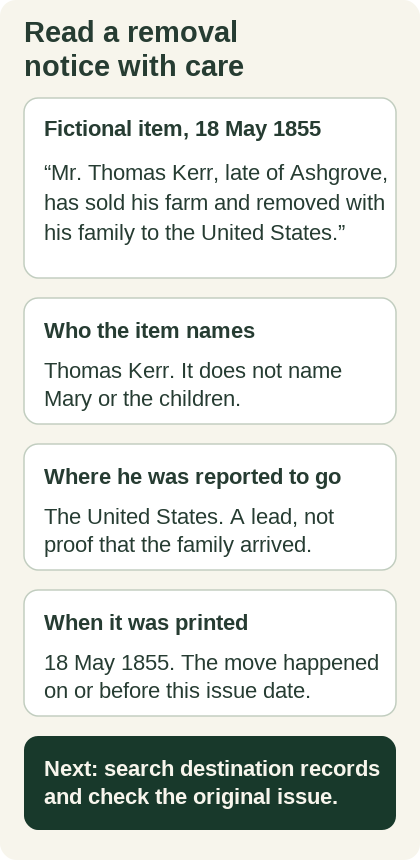
Searching the Reporter for Kerr with the town name, you find an item from 18 May 1855: "Mr. Thomas Kerr, late of Ashgrove, has sold his farm and removed with his family to the United States." A second search finds a death notice from 1871: "At Ashgrove, on the 2nd inst., Mrs. Ann Bell, relict of the late John Bell, aged 77 years. Her daughter, Mrs. T. Kerr, resides in Ohio."
Here is what you can record. A neighbouring paper reported in May 1855 that a Thomas Kerr, late of Ashgrove, had sold a farm and moved with his family to the United States. In 1871 it printed a death notice for Ann Bell of Ashgrove, widow of John Bell, aged 77, saying a daughter, "Mrs. T. Kerr", lived in Ohio.
Here is what you cannot record. The 1855 item does not name Mary or the children, so it may concern another Thomas Kerr. The 1871 notice identifies the daughter only as "Mrs. T. Kerr", so it does not show that she was your Mary, or that Mary's maiden name was Bell. It also gives no state of residence beyond Ohio, which may or may not match your census.
These items give you a hypothesis to test: that Mary Kerr was born Mary Bell, daughter of John and Ann Bell of Ashgrove. The next step is a marriage or church record in Ashgrove naming Thomas Kerr and Mary Bell, and the Observer on microfilm for the weeks around the 1855 move and the 1871 death.
Digitised Canadian newspaper collections to try
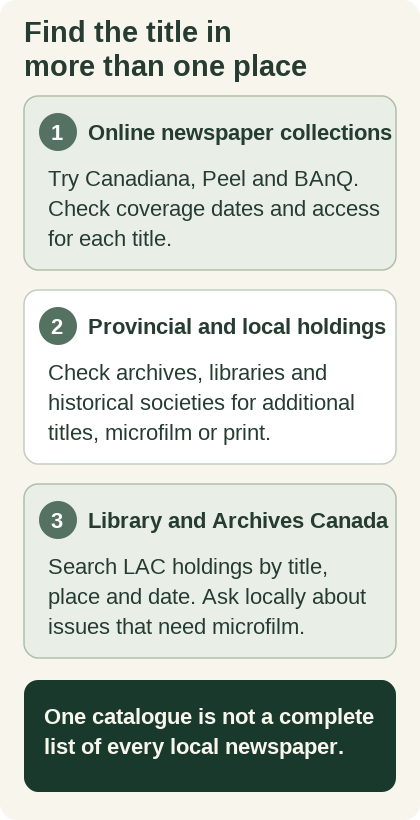
Start with these online collections, but check access as well as coverage. Some digitised issues are openly available; others may require an onsite visit or a library subscription.
Canadiana's Serials collection includes newspaper titles. The Canadian Research Knowledge Network's 2026 annual report describes its Canadiana and Héritage digital collections as open access. Check the title and coverage dates before searching, because an online collection may cover only part of a paper's run.
For the Prairie provinces, University of Alberta Libraries' Peel's Prairie Provinces newspaper collection lists more than 175 titles. You can filter title records by language, province and city. Digitised issues have full-text search and year filters, so check the available dates for the title you need.
For Quebec, Bibliothèque et Archives nationales du Québec (BAnQ) has digitised newspapers in BAnQ numérique. Its 2022 guide to BAnQ numérique describes keyword searching and filters that include newspaper title and date, and explains the lock marker for material available onsite only. The guide is dated, so check BAnQ's current access information before relying on a particular interface or item.
Library and Archives Canada also links to digitised newspaper collections, including French-language and Indigenous newspapers. Read each collection description for its title and date coverage; digitised does not necessarily mean that a complete run is online.
Search in both official languages
Quebec and parts of other provinces had French-language papers, and families moved between language communities. A relative might appear in an English paper under one spelling and in a French paper under another.
Search the surname in forms you can document, and search the place name in English and French where both forms were used. Search tools differ, so follow the collection's own help rather than assuming that quotation marks, capitalisation or filters work the same way everywhere.
If you cannot read French, look for structural clues first: a heading, a date, a place you recognise, a list of names. Our guide to immigrant-language newspapers explains how to work with a paper in a language you do not read well, including how to get help with a short passage.
Provincial archives and libraries
Each province has its own archives and major libraries, which often hold the most complete local newspaper runs. The Archives of Ontario's research guide to newspapers, last updated in March 2023, is an example. It describes Ontario newspapers from 1793 to the 1950s in original and microfilm formats, a self-service microfilm collection in its reading room, and a finding aid listing titles by place name. It points researchers to Library and Archives Canada, local libraries and two published inventories for finding other collections.
The same guide mentions that Toronto Public Library cardholders can use online archives of two Toronto dailies, and the Library and Archives Canada guide lists several subscription databases available in Ottawa, noting that local libraries may offer them too. Check whether your own library provides any of these.
Search for the archives and the provincial library of the province where your relative lived, and look for a newspaper guide or a list of microfilm holdings by place.
Getting microfilm when you cannot travel
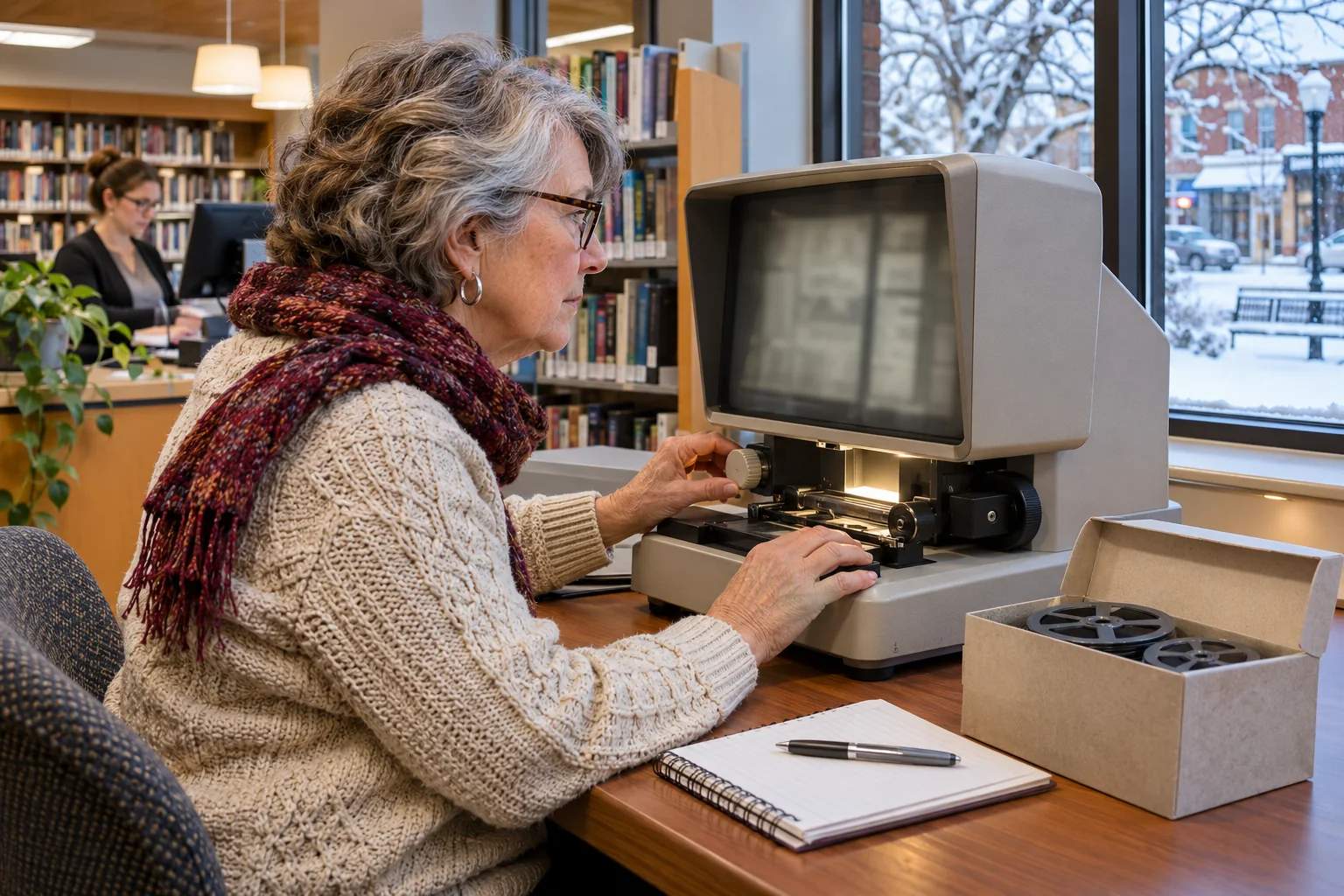
The Library and Archives Canada guide suggests interlibrary loan of microfilm through your local library, or hiring a researcher. The Archives of Ontario guide notes that its multicultural newspaper microfilm can be borrowed through an interloan service. Rules differ by institution and collection, so ask your library what it can request and from where.
A precise request works best. Give the newspaper title as listed in the catalogue, the place, the exact dates or a narrow range, and the reel number if the catalogue shows it. Our guide to free and library newspaper access explains how to frame a request so staff can answer it quickly. When the reel arrives, check the dates printed on its box or first frames against your target issues before you start reading, because one reel may cover only part of a year, and an issue you need may simply be missing from the film.
Use directories to narrow the newspaper search
A newspaper search is much easier when you know which town and which years to search. City and provincial directories can supply both. The University of Alberta article describes Henderson's directories for Prairie cities from the early 1900s on Peel's Prairie Provinces as keyword-searchable and listing names, addresses and sometimes occupations, and quotes a librarian calling them "the crown jewel for genealogists".
Search a directory for your relative's surname across several years. The first and last years in which a household appears give you a window for the newspaper search, and an address or occupation gives you extra words to pair with the surname. A carpenter on a named street is much easier to recognise in a local news item than a name alone.
Treat directory entries the way you would treat a newspaper address. A directory year was compiled at some point before publication, so an entry shows where a person was listed at that time, not that they lived there every day of the year. Our guide to finding an ancestor's address in old newspapers explains how to put dated place clues in order without assuming continuous residence.
The Library and Archives Canada newspaper guide also points family historians to its page on vital statistics, meaning births, marriages and deaths. A civil registration or church record of a marriage or death gives you an exact date, which lets you browse the local paper for the following weeks instead of searching blindly.
Reading what you find
Expect many of the same kinds of items you would look for in an American local paper, such as family notices, local news, removals and visits, legal notices and advertisements, but learn each paper's layout from a few issues before you rely on it. The same cautions apply.
A removal item records what the editor heard about someone leaving. A family notice records what the person who placed it chose to say. A woman named as "Mrs. T. Kerr" is identified only through her husband. Reports reprinted from other papers are one report, not several.
Pay attention to cross-border wording. "Removed to the States", "gone to Michigan" or "late of Canada West" can each help you date a move and narrow a destination. They are not proof that the family arrived where the item said, or stayed there. Our guide to military, legal and migration news explains how to follow a move from a departure report to the destination's papers.
Separating relatives with common names
Scottish, Irish and English surnames were common in Canada, and the same given names recur in families. A notice naming "Thomas Kerr" in a county with several Kerr households needs more than a name to be your relative.
Use the details that distinguish people: a township or concession, an occupation, a spouse's name, children's names and ages, and church affiliation. Keep separate working records for candidates until a record ties one of them to your family. Our guide to finding an ancestor with a common name explains this method.
When you find nothing
Assume first that the right paper is not yet in front of you. Check whether the title and years are digitised, whether a neighbouring town's paper covered the area, whether a French-language paper served part of the community, and whether the relative's name was spelled another way.
Then check whether the issues survive on microfilm, using the national catalogue's microform tool and the provincial archives' lists. Record what you searched and what you could not reach.
Record each item and its source
For each item, record the collection or repository, the newspaper title as printed, place of publication, issue date, page and column, the item's wording exactly, and the language of the original. For microfilm, add the reel number. Note your access date and any link.
Keep interpretation separate: "Death notice, Ann Bell, Ashgrove, 1871, mentions daughter Mrs. T. Kerr in Ohio. Possible link to Mary Kerr; maiden name not confirmed. Next: Ashgrove marriage and church records; Observer on microfilm, May 1855 and 1871." Our guide to verifying and preserving a newspaper discovery has a full checklist.
Try a Canadian newspaper search this week
Choose one relative with a documented link to a place in Canada, and write down the place, the years and the source of each.
Search Library and Archives Canada's catalogue for newspapers published in that place, and note each title, its dates and its formats. Then search Canadiana for the place name and the surname. If the place is in Quebec, try BAnQ's newspaper collection; if it is on the Prairies, try Peel's Prairie Provinces.
For each result, record what it says and whether it names a spouse, parent, township or occupation that matches your records.
If you find nothing online, choose the most likely title held on microfilm, identify the reel for your target dates, and ask your local library whether it can borrow it, or contact the holding archive about access.
Sources
- Library and Archives Canada: Finding newspapers
- Canadian Research Knowledge Network: 2026 year in review
- Canadiana: Serials collection
- University of Alberta Libraries: Peel's Prairie Provinces newspapers
- BAnQ: BAnQ numérique guide (PDF, 2022)
- Archives of Ontario: Research guide 212, Newspapers (PDF)
- University of Alberta, New Trail (Karen Sherlock): How to feed your inner genealogist (2018)